
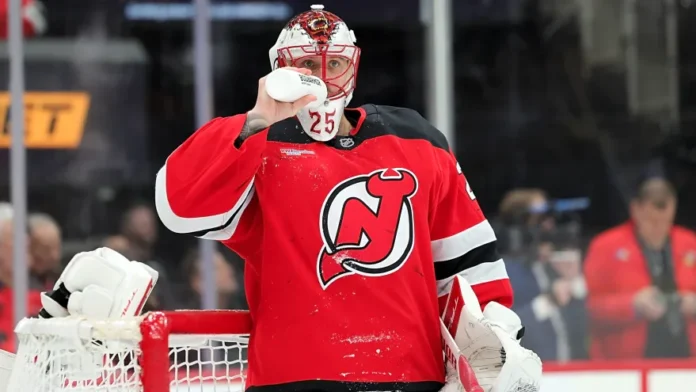

For much of the past decade, the New Jersey Devils have been viewed as one of the National Hockey League’s most intriguing young franchises. Armed with elite talent down the middle, a growing collection of high-end prospects, and a fan base eager to see sustained success return to Newark, the organization appeared poised to establish itself as a perennial contender in the Eastern Conference.
Instead, the 2025-26 season delivered a harsh reminder that potential alone does not guarantee results.
What began as a campaign filled with expectations ultimately evolved into one of frustration, inconsistency, and unanswered questions. Injuries played a role. Underperforming veterans contributed to the disappointment. Offensive struggles emerged at critical moments. Defensive breakdowns became recurring themes. Most concerning, the stability that championship-caliber teams require in goal never fully materialized.
Now, as the organization enters one of its most important offseasons in recent memory, the focus has shifted from what the Devils might become to what steps must be taken to ensure they return to serious playoff contention.
The arrival of new General Manager Sunny Mehta signals the beginning of a new chapter. A New Jersey native with a reputation for embracing analytical decision-making and modern roster construction principles, Mehta inherits a team rich in talent but burdened by several glaring structural weaknesses.
The encouraging news for Devils fans is that the franchise still possesses one of hockey’s strongest foundations down the middle.
Captain Nico Hischier remains one of the league’s premier two-way centers. Jack Hughes continues to be among the NHL’s most dynamic offensive players when healthy. Together, they provide the type of center depth that organizations spend years attempting to build. Elite centers remain one of the hardest assets to acquire in professional hockey, and the Devils already possess two cornerstone players capable of driving success for years to come.
The challenge lies in building the right roster around them.
Perhaps no issue was more evident during the 2025-26 season than New Jersey’s inability to consistently generate offense at five-on-five. Despite possessing skilled playmakers and offensive creativity, the Devils struggled to finish scoring opportunities. Far too often, dangerous offensive sequences resulted in missed chances, lost momentum, and games slipping away.
The statistics reflected that reality. New Jersey finished near the bottom of the league in five-on-five goal production, an alarming result for a team built around speed and offensive talent.
Addressing that weakness begins with the search for a legitimate top-six scoring winger.
Modern NHL contenders feature finishing talent throughout their lineup. While Hughes and Hischier can create opportunities, they need consistent finishers capable of converting those chances into goals. The Devils have received flashes of production from several forwards, but the consistency required to compete with the league’s elite teams has been absent.
Veteran winger Ondřej Palát has struggled to maintain the offensive impact that once made him such a valuable contributor. Timo Meier remains a physically gifted power forward, yet consistency has remained elusive. As a result, New Jersey enters the offseason searching for additional offensive punch capable of transforming the top six.
Whether that solution emerges through free agency, trade discussions, or internal development remains to be seen, but few would dispute that adding scoring support for Hughes and Hischier sits atop the organization’s priority list.
Equally important is the situation between the pipes.
For championship contenders, stability in goal often serves as the foundation upon which everything else is built. During the Devils’ most successful eras, dependable goaltending provided confidence throughout the lineup. Players knew mistakes could be overcome. Coaches could trust their systems. Momentum could be preserved even when games became chaotic.
That stability proved difficult to find during the 2025-26 season.
Veteran goaltender Jacob Markstrom entered the year expected to provide leadership and consistency, but the results failed to meet expectations. While flashes of strong play remained visible, the overall performance left management facing difficult questions regarding the future direction of the position.
With a significant cap hit and an increasingly competitive goaltending market, speculation has intensified regarding whether the Devils could explore alternative options. Any move involving the position would represent one of the most significant decisions of Mehta’s early tenure, given the importance of reliable goaltending to the organization’s long-term goals.
The search for improvement extends beyond the top of the lineup and the crease.
Depth has become increasingly critical throughout the NHL, particularly during long regular seasons and playoff runs. The Devils continue to seek a reliable third-line center capable of handling difficult defensive assignments while also providing offensive support when injuries occur.
Successful teams rarely rely solely on star players. Instead, they receive contributions throughout the lineup. A dependable third-line center would help stabilize matchups, improve roster flexibility, and reduce the burden placed on the club’s top offensive players.
On the blue line, the conversation centers around both present performance and future potential.
Defenseman Dougie Hamilton remains one of the most recognizable names on the roster, but questions surrounding consistency and long-term fit continue to surface. At the same time, the organization is preparing for the arrival of one of its most exciting young talents.
Anton Silayev represents a significant piece of the Devils’ future.
The towering defenseman, selected with the tenth overall pick in the 2024 NHL Draft, officially signed his entry-level contract and is expected to become an important part of New Jersey’s defensive plans moving forward. His combination of size, mobility, reach, and defensive instincts has generated considerable excitement among scouts and fans alike.
Integrating Silayev into the lineup while continuing to strengthen overall defensive depth will be another important objective as management evaluates potential roster moves.
Beyond immediate roster concerns, the Devils also face several significant contract and personnel decisions.
One of the most important involves captain Nico Hischier. As one of the franchise’s foundational players, Hischier has established himself as a leader both on and off the ice. His ability to contribute offensively while maintaining elite defensive standards has made him one of the NHL’s most respected centers.
As league revenues continue to rise and salary cap projections increase, speculation regarding future contract discussions has intensified. While no official agreement has been announced, Hischier remains central to the organization’s long-term plans, and securing his future will undoubtedly remain a priority.
Meanwhile, management continues monitoring the progress of promising forward prospect Arseny Gritsyuk. Discussions regarding his health, recovery, and future role within the organization remain ongoing as the Devils assess how he fits into their evolving roster structure.
These decisions arrive at a critical moment for the franchise.
The NHL Draft and free agency period are rapidly approaching, providing Mehta and his staff with their first major opportunities to reshape the roster. Armed with a valuable first-round selection and a prospect pool that still ranks among the better systems in hockey, the Devils possess assets capable of facilitating meaningful change.
What makes this offseason particularly fascinating is that New Jersey is not beginning from scratch.
This is not a rebuilding team searching for foundational pieces. The core already exists. Hughes, Hischier, Luke Hughes, Jesper Bratt, Silayev, and several other young contributors provide the framework of a competitive roster.
The challenge is transforming a talented team into a complete one.
For Devils fans, patience has been tested before. Yet there remains legitimate reason for optimism. Organizations rarely enter an offseason with elite centers, a respected prospect pipeline, financial flexibility, and new leadership all aligned simultaneously.
The coming months will reveal how aggressively the front office chooses to act. Trades, free-agent signings, prospect promotions, and contract negotiations will all shape the trajectory of the franchise.
One thing is clear: the 2026 offseason represents more than routine roster maintenance. It is a pivotal opportunity to address weaknesses, maximize the prime years of cornerstone players, and restore the Devils to the level of competition their talent suggests they can achieve.
The foundation remains strong. The questions are identifiable. The resources exist.
Now the task becomes turning potential into results and ensuring that when the puck drops on the 2026-27 season, the New Jersey Devils look far more like a contender than a team searching for answers.
















