
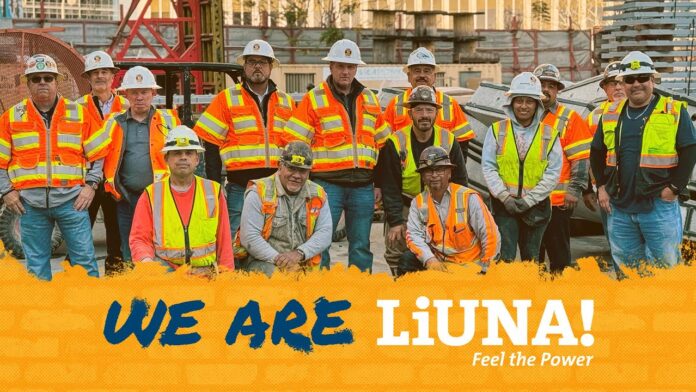

LIUNA has filed the first known lawsuit by a labor union under New Jersey’s up the chain liability statute, seeking more than $2 million on behalf of over 240 construction workers who say they were never paid for work on Kushner Companies’ and Namdar Group’s Jersey City developments.
A Union Just Tested New Jersey’s Newest Wage Theft Law, and Two Jersey City Towers Are the Test Case
The Laborers’ International Union of North America filed what organizers are calling a landmark lawsuit this week, the first known legal action brought by a labor union under New Jersey’s up the chain liability statute, a law designed to let workers recover unpaid wages from higher tier contractors and developers when their direct employer cannot or will not pay. LIUNA Local 3 and the Laborers Eastern Region Organizing Fund filed the suit in Hudson County Superior Court, seeking more than 2 million dollars in unpaid wages and liquidated damages on behalf of construction workers who say they were never paid for weeks of work on two major Jersey City developments.
Two Towers, One Alleged Pattern
The lawsuit names general contractor AJD Construction and subcontractor Concrete Rising as defendants, alleging both share liability for unpaid wages tied to work performed on Kushner Companies’ One Journal Square project and Namdar Group’s development at 35 Cottage Street. According to findings from the New Jersey Department of Labor and Workforce Development, more than 240 workers are owed over 716,000 dollars in unpaid wages alone, a figure that does not include the statutory liquidated damages, penalties, and other remedies the lawsuit is separately pursuing. The workers’ direct employer later filed for bankruptcy, a common pattern in construction wage theft cases that leaves laborers with essentially no practical way to recover what they are owed unless a law like New Jersey’s up the chain statute allows them to pursue the companies further up the contracting hierarchy instead.
One worker, identified in the lawsuit materials only as Raul to protect his safety, described what happened after payments stopped arriving during the summer of 2024 while he worked for GP Concrete on the One Journal Square site. He said the crew was routinely pushed to work faster without breaks, and that when the checks stopped coming, one missed week turned into two, then into a genuine financial crisis at home, forcing him to worry about rent and whether his family would have enough food. Two years later, he said, the fight to recover that money is still ongoing.
A Law Built for Exactly This Situation, Now Facing Its First Real Test
New Jersey’s up the chain liability statute was amended in early 2024 specifically to allow unions to enforce its protections on behalf of construction workers, including workers who are not themselves union members, according to Hugh Baran, a partner at Katz Banks Kumin, the law firm representing LIUNA in the case. That amendment is central to why this lawsuit carries weight beyond the roughly 240 workers named in it directly. As the first case brought by a union under the statute, its outcome is likely to shape how effectively the law can actually be used going forward, both by LIUNA in future cases and by other unions considering similar action on behalf of workers left unpaid when a contractor further down the chain collapses or simply disappears.
LIUNA Vice President Mike Hellstrom framed the lawsuit as a direct test of whether responsibility can still be shifted downward while profits continue flowing upward, arguing that companies benefiting from a construction project should not be able to walk away once workers go unpaid. Julie Ulmet, general counsel for the Laborers Eastern Region Organizing Fund, said the Legislature had specifically recognized unions as capable enforcement partners for wage theft protections, and that the lawsuit was meant to send a direct message to Jersey City’s construction workforce that the union intends to pursue accountability all the way to the courthouse when necessary.
Not the First Warning Sign at These Job Sites
This week’s lawsuit is not an isolated flashpoint but the latest escalation in a dispute that has been building publicly since at least 2023. LIUNA has held multiple rallies outside both the One Journal Square site and other Namdar and AJD projects over the past several years, and New Jersey’s Department of Labor issued multiple stop work orders against subcontractors tied to these developments earlier this year, citing unpaid or late wages, nonpayment of overtime, worker misclassification, and, in at least one instance, hindering the department’s own investigation. Concrete Rising specifically drew a separate stop work order from the state back in 2023 after Department of Labor investigators interviewed workers on an unrelated project who said they had been paid in cash without standard deductions, had money arbitrarily withheld from their pay, and were not properly compensated for overtime. LIUNA officials have also noted that Concrete Rising is co-owned by a former permit expediter who pleaded guilty in 2022 to corrupt interference with federal tax laws, a detail the union has pointed to as evidence of a broader pattern rather than a single administrative oversight.
AJD Construction and Concrete Rising did not immediately respond to requests for comment following the lawsuit’s filing, and neither company has publicly disputed the specific allegations laid out in the complaint as of this writing. As with any civil lawsuit, the claims represent allegations that have not yet been tested or proven in court, and both named defendants retain the right to contest the case fully as it proceeds through Hudson County Superior Court.
City and County Officials Line Up Behind the Workers
The lawsuit’s announcement drew an unusually broad show of local political support. Jersey City Mayor James Solomon, who appeared alongside LIUNA leadership for the announcement, said the city’s growth cannot continue to be built on the backs of exploited workers, and pledged stricter enforcement of payroll tax compliance among developers seeking city approval going forward. Hudson County Executive Craig Guy echoed that message, framing the litigation as a clear warning to bad actors in the construction industry that worker exploitation would not be tolerated in the county. Jersey City Council members Denise Ridley, Eleana Little, Rolando Lavarro, and Jake Ephros each issued their own statements backing the workers, with Ridley specifically noting that future development approvals should carry real expectations around fair labor practices, and Lavarro pointing to the city’s recent budget difficulties as additional reason developers should not be allowed to shortchange the very workforce building the projects that generate the city’s tax base.
For LIUNA, the case represents both a specific fight over roughly 716,000 dollars in documented unpaid wages and a broader effort to establish that New Jersey’s newest wage theft protections carry real, enforceable teeth. As Hellstrom put it, the goal is an industry where responsible contractors can compete on a level playing field precisely because workers can trust they will actually be paid, a standard the lawsuit argues has been absent at both Jersey City job sites for going on two years now.
The claims described in this article are allegations contained in a civil lawsuit and have not been proven in court. AJD Construction and Concrete Rising had not issued a public response to the specific allegations as of publication.
















