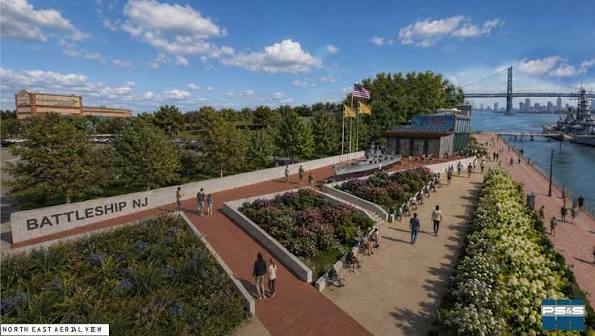

Battleship New Jersey will receive a $24.25 million redevelopment, including a new three story visitor center, double the parking, and a permanent event space on its fantail, the largest capital investment in the ship since it opened as a museum on the Camden waterfront a quarter century ago.
The Most Decorated Battleship in American History Is Finally Getting a Front Door
Battleship New Jersey, the most decorated battleship in United States history, is getting the kind of overhaul befitting a landmark that has spent 25 years welcoming visitors without ever really having a proper entrance. The New Jersey Economic Development Authority and museum leadership announced a $24.25 million redevelopment project on August 12th, funded largely through 19.9 million dollars in state tax credits, marking the single largest capital investment the ship has received since it opened as a floating museum and memorial on the Camden waterfront in 2001.
$9.5M — Visitor Center
New three-story, 8,760-square-foot building replacing the temporary structure used since 2001.
$6M — Onboard Upgrades
Permanent fantail event space, updated HVAC, security, internet, and restrooms.
$5.5M — Parking Garage
240-space structure at Wiggins Marina, roughly double current capacity.
A Museum Finally Gets a Building of Its Own
The centerpiece of the project is a brand new, three story, 8,760 square foot visitor center built on land beside the ship, replacing a temporary structure that has served as the museum’s entrance since it first opened. Battleship New Jersey CEO Marshall Spevak did not mince words about how overdue that upgrade is, saying visitors to one of the nation’s most historic landmarks should not have to search for the front door, and that school groups deserve a proper place to gather while families get better food and visitor amenities than the current setup allows. The new building will include a lobby, ticketing area, artifact display space, a small café, a gift shop, and administrative offices, giving the museum a genuine architectural identity to match the significance of the ship it introduces visitors to.
Onboard the ship itself, roughly 6 million dollars will fund a permanent, year round 8,140 square foot event space on the vessel’s fantail, eliminating the need for the seasonal tents the museum has relied on for weddings, corporate events, and other rentals in the past. That same funding will also cover considerably less glamorous but genuinely necessary infrastructure work, modern surveillance systems, upgraded internet connectivity, improved HVAC, and new restrooms, the kind of behind the scenes maintenance that rarely makes headlines but keeps a 46,000 ton, 82 year old vessel functional as both a tourist attraction and an active event venue.
Solving the Parking Problem
A third piece of the project addresses a complaint longtime visitors know well. A new 240 space parking garage will be built at the adjacent Wiggins Marina, roughly doubling the museum’s current parking capacity and replacing a disorganized surface lot that has long forced visitors into an unlandscaped walk down Clinton Street just to reach the ship. Camden County is playing a direct role in making that structure financially viable, agreeing to provide the nonprofit museum with a long term lease for the garage, contribute cash equity, and guarantee the bond required for construction, an arrangement that lets the museum borrow against the county’s own bond rating and secure considerably better financing terms than it could access on its own.
NJEDA Chief Executive Evan Weiss framed the investment as part of a broader pattern the agency’s Cultural Arts Facilities Expansion program has pursued across the state, describing the program’s goal as spurring economic activity, driving foot traffic into key corridors, and revitalizing communities. Camden Mayor Victor Carstarphen was more direct about what the project means locally, calling the battleship an unmistakable part of Camden’s identity and describing the redevelopment as new investment, new activity, and new opportunity along the city’s waterfront.
A Ship With a Story Worth the Investment
The timing of the announcement carries its own symmetry. Battleship New Jersey returned to Camden this past June after spending two years dry docked in Philadelphia and at the Paulsboro Marine Terminal, undergoing multimillion dollar routine maintenance and repairs, including its first full repaint in three decades. Commissioned for 50 years of active service spanning World War II, the Korean War, the Vietnam War, the Cold War, and conflicts in the Middle East, the ship has earned more battle stars than any other battleship in American history, a distinction that runs through nearly every official statement tied to this redevelopment. Vincent Solomeno, commissioner of the New Jersey Department of Veterans Affairs, described the ship as a living memorial to the sailors, Marines, and veterans of every era who served aboard it, and said the investment ensures that history remains preserved and properly interpreted for visitors rather than simply maintained as a static relic.
Groundbreaking on the redevelopment is expected in mid-2027, with construction running roughly two years toward a targeted completion in 2029. Museum officials have been clear that the ship will remain open to visitors throughout construction, with only brief, targeted closures of specific areas as work progresses, meaning the museum’s regular calendar, including its upcoming WWII Victory Day event on August 15th featuring detailed scale military models, will continue largely uninterrupted. Assemblyman Louis Greenwald called the funding the single largest state investment in the ship’s history under New Jersey’s stewardship, a distinction that, once construction wraps in 2029, should finally give one of the state’s most visited historic landmarks the arrival experience its history has always deserved.