
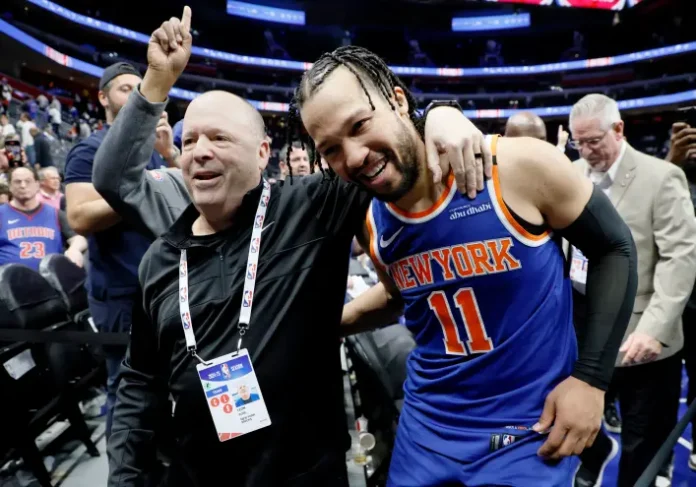

With complete honesty, I have never considered myself a hardcore NBA person in the way some fans consume basketball year-round. I follow the league, I pay attention to the major players and storylines, and once the playoffs arrive, my interest level rises significantly because the games begin to matter on a different level. Growing up in South Jersey, I was always more connected to the Philadelphia 76ers than the New York Knicks, and like a lot of people from this region, my sports identity was spread across multiple leagues and Basketball in the NCAA rather than centered exclusively on NBA basketball. Still, every once in a while, a story develops that becomes impossible not to admire, even from a distance. What Leon Rose has accomplished with the New York Knicks has become one of those stories.
There is also a personal layer to this for me because Leon Rose is not simply some anonymous executive sitting in a luxury suite at Madison Square Garden. He is from Cherry Hill, New Jersey. He grew up in the same town where I grew up. We attended the same overnight camp for years, even though he is older than I am, and I knew his brother back in college. We went to rival high schools, he attended Cherry Hill East while I stayed at Cherry Hill West largely because of baseball and the fact I drove at that time, but despite the school rivalry, there was always an awareness that Leon Rose was an exceptional basketball player long before he became one of the most powerful figures in the NBA.
And to be clear, that reputation was earned.
At Pine Forest Overnight Camp, where summer basketball games were taken surprisingly seriously, Leon and his brother were known for having outstanding left-handed jump shots from virtually anywhere on the court. They were legitimate players. I was never on that level in basketball terms, so there was no confusion about the difference. Even then, you could tell that certain people simply understood the sport differently. Looking back now, it feels obvious that the same basketball intelligence that made him stand out as a player eventually became the foundation for his success as an executive. I am not at all suprised about what Leon could have done and has done for the world. He also was great with people and had a J.D. Degree to back it all.
What makes Rose’s rise particularly fascinating is how unlikely his path into modern NBA power actually was. Before becoming President of Basketball Operations for the New York Knicks in March of 2020, Rose had already built one of the most influential careers in professional sports as an attorney and agent. Born in Cherry Hill in 1961, he played varsity basketball at Cherry Hill East and was later inducted into the school’s Basketball Hall of Fame. He attended Dickinson College, where he earned a political science degree while continuing to play basketball, before eventually graduating from Temple University’s Beasley School of Law.
Long before Madison Square Garden entered the picture, Rose’s roots remained firmly tied to New Jersey basketball. He coached at Cherry Hill East from 1983 through 1986 and later coached at Rutgers-Camden before transitioning fully into law. He began his legal career at the Camden County Prosecutor’s Office and eventually became a longtime partner at the South Jersey law firm Sherman, Silverstein, Kohl, Rose & Podolsky. During that period, he slowly built a sports representation business that would eventually become one of the most powerful agencies in basketball.
Ironically, one of the earliest relationships of Rose’s career would later become central to the Knicks’ transformation. His very first major client was Rick Brunson, the former Temple guard who carved out a lengthy NBA career after entering the league undrafted. Today, of course, Rick Brunson is better known as the father of Knicks superstar Jalen Brunson, but the relationship between the Brunson family and Leon Rose stretches back decades.
By the mid-2000s, Rose had become one of the NBA’s most influential agents. His practice eventually merged into Creative Artists Agency, where he rose to become co-head of CAA’s basketball division. At the height of his representation career, Rose represented an extraordinary list of elite NBA talent including LeBron James, Allen Iverson, Chris Paul, Carmelo Anthony, Dwyane Wade, Joel Embiid, Karl-Anthony Towns, Devin Booker, and many others. For years, he quietly operated behind the scenes as one of the most connected and respected figures in basketball.
That was the version of Leon Rose most NBA fans knew before he took over the Knicks.
For me personally, some of those years also produced one of the funniest examples of how surreal Rose’s rise had become. I remember watching Entourage years ago during one of the LeBron James scenes where LeBron, playing himself, is walking toward a private jet surrounded by agents, lawyers, and executives. Even though none of those surrounding figures had actual speaking roles, I remember joking at the time that one of those guys was basically Leon Rose. Technically, it was not literally him, but it also kind of was. My rationale was simple, if LeBron’s agents and lawyers were traveling with him in Entourage, then in real life, that would have been Leon Rose somewhere in that circle. Rose had become one of those behind-the-scenes power figures operating at the absolute highest level of sports business, the kind of executive whose influence was enormous even if casual fans never recognized his face.
That is part of what makes his transition into front-office management so impressive.
Then the Knicks hired him.
At the time, the franchise was viewed as one of the league’s most dysfunctional organizations. Madison Square Garden remained iconic, but the basketball operation itself had become synonymous with instability, poor roster construction, failed coaching hires, impatient rebuilds, and endless disappointment. Free agents routinely avoided New York. National media treated the Knicks more like a punchline than a contender. The organization cycled through executives and philosophies without any real continuity or identity.
Leon Rose inherited all of that.
What makes his tenure impressive is not simply that the Knicks improved, but how methodically and intelligently they improved. They almost did it quietly, so to speak, because I myself had no clue about the magnitude of what Jalen Brunson would become and that, to me, speaks directly to Leon Rose’s vision. Rose did not immediately chase splashy headlines or attempt reckless superstar acquisitions simply to dominate sports talk shows. Instead, he focused on culture, structure, and basketball fit. His first foundational move was hiring Tom Thibodeau as head coach in 2020. While some criticized the hire as predictable, Thibodeau immediately established accountability, defensive discipline, and toughness. The Knicks stopped looking disorganized almost overnight.
Still, the move that truly altered the trajectory of the franchise was the signing of Jalen Brunson.
And honestly, this is where I will admit I underestimated both Brunson and Rose’s vision entirely.
Like many people, I remembered Brunson primarily as a terrific Villanova college player who lacked elite NBA athleticism. Yes, he was a national champion. Yes, he won major college basketball awards. But plenty of outstanding college guards never become dominant NBA stars. In Dallas, Brunson often looked like a very good secondary piece next to Luka Dončić rather than a future franchise centerpiece.
Then he arrived in New York and became one of the best players in basketball.
I now understand that transformation did not happen by accident. Leon Rose clearly saw something deeper in Brunson’s game that many others either overlooked or undervalued. He understood Brunson’s pace, decision-making, toughness, leadership, footwork, and efficiency could scale upward dramatically if placed in the right system and surrounded by the right infrastructure. When the Knicks signed Brunson to a four-year, $104 million contract in 2022, many analysts criticized the deal as excessive. In hindsight, it now looks like one of the smartest free-agent signings of the modern NBA era.
The Brunson relationship also demonstrated something important about Rose’s overall philosophy. Basketball is not simply about talent accumulation. Trust matters. Familiarity matters. Stability matters. Rose hired Rick Brunson as an assistant coach shortly before free agency opened, creating an environment where Jalen Brunson felt comfortable both personally and professionally. The NBA eventually penalized the Knicks for tampering because the connections between Rose, the Brunson family, and the organization were so obvious, but the larger point remained clear, Rose understood exactly how to build an ecosystem where players could succeed.
Since then, he has continued constructing the roster with remarkable consistency. The acquisitions of Josh Hart, OG Anunoby, Mikal Bridges, and Karl-Anthony Towns were not random moves designed merely to create headlines. Each addition strengthened the identity Rose and Thibodeau wanted the Knicks to embody which is toughness, versatility, defensive intensity, professionalism, and playoff resilience. The Knicks no longer resemble a desperate organization chasing relevance. They look like a serious basketball team built with long-term vision.
That transformation starts at the top.
What stands out most about Leon Rose’s success is that he rarely seeks attention for it. Unlike many modern executives, he does not dominate media cycles or constantly position himself as the public face of the franchise. He operates quietly, strategically, and patiently, which honestly feels very reflective of South Jersey itself. There is a certain mentality here that values substance over noise. Less talking. More building.
And whether people fully realized it or not, Rose has become one of the most important executives in professional basketball because of that approach.
As someone who grew up watching the NBA from the perspective of a Sixers fan, it still feels strange admitting how impressive the Knicks have become. But credit belongs where it is earned. Leon Rose inherited one of the league’s most unstable organizations and transformed it into a legitimate contender through intelligence, patience, relationships, and vision. They are now 4 wins away from an NBA Championship ring. More than anything, he recognized what Jalen Brunson could become before the rest of basketball fully understood it, and that decision fundamentally changed the trajectory of the franchise.
For somebody who started out playing basketball in Cherry Hill gyms, the JCC while also spending summers at camp in Pennsylvania, and eventually navigating the sports agent world at the highest level imaginable, the story feels almost surreal. Yet at the center of it remains a very simple truth, the Knicks are winning again because Leon Rose built them to win.
And honestly, if the trajectory continues, perhaps one day the ultimate ending would involve Rose eventually bringing that same vision back home to Philadelphia and the 76ers organization itself. In modern professional sports, impossible ideas tend to become reality much faster than anyone expects.
The best thing about it all is that it helped me gain an interest in seeing the Knicks win and, moreover, they talk about the Knicks all the time on Morning Joe, so I get daily updates through them. At the same time, I honestly cannot remember ever hearing them mention the name Leon Rose. Maybe now they will have to.
















