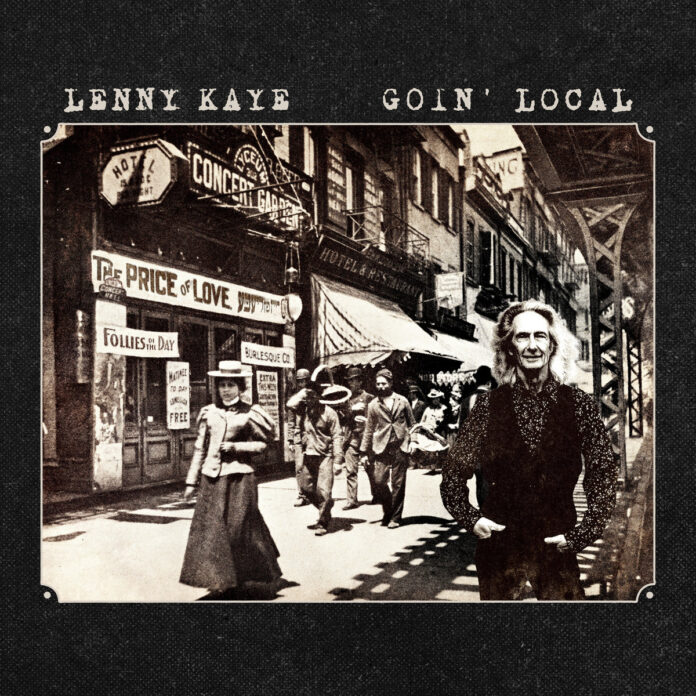

There are few figures in modern music whose influence runs as quietly deep—and as structurally important—as Lenny Kaye. For decades, his name has existed in the margins of major movements while simultaneously shaping them, whether through his role as a guitarist, producer, historian, or curator of the foundational Nuggets compilation that helped define the language of garage rock. Now, at 79, Kaye is stepping into a different kind of spotlight with the announcement of his first-ever solo album, Goin’ Local, set for release on July 17, 2026. For New Jersey, this is not just another album release. It is a full-circle moment tied directly to the state’s cultural identity and its expanding position within the national music conversation.
Kaye’s story, while often told through the lens of New York’s downtown scene, is fundamentally rooted in New Jersey. After being born in Manhattan, he relocated with his family to North Brunswick in 1960, a move that would quietly shape his creative foundation. It was there, in suburban New Jersey, that he began experimenting with storytelling and music, publishing a science fiction fanzine titled Obelisk as a teenager and immersing himself in the early rhythms of cultural expression. That early curiosity would evolve into something far more significant during his time at Rutgers University, where he graduated in 1967 with a degree in American History.
Rutgers was not simply an academic stop; it was an incubator. Kaye played in fraternity bands such as The Zoo and The Vandals, performing at campus events that blurred the line between casual entertainment and serious musical exploration. These were not headline-grabbing performances, but they were formative—spaces where instinct, collaboration, and audience connection began to take shape. Decades later, his return to Rutgers as an educator, teaching the course “Rock Music and American Culture,” reinforced his role not just as a participant in music history but as one of its most articulate interpreters.
That dual identity—practitioner and historian—has defined Kaye’s career. He is widely recognized for his long-standing collaboration with Patti Smith, a partnership that helped establish one of the most influential artistic voices of the punk era. But Kaye’s reach extends far beyond a single collaboration. His work as a producer, critic, and archivist has consistently connected past and present, shaping how audiences understand the lineage of American rock.
New Jersey formally recognized that impact when Kaye was inducted into the New Jersey Hall of Fame in 2021, a milestone that underscored his importance not only as a musician but as a cultural figure tied to the state’s identity. Yet even with that recognition, Kaye has remained actively engaged with the local arts community, including recent benefit performances that revisit his early years in New Brunswick and reaffirm his connection to the region.
That context is essential in understanding Goin’ Local. The album is not a late-career experiment or a nostalgic exercise. It is a deliberate statement—one that reflects a lifetime of experience while returning to the intimacy and immediacy that defined Kaye’s beginnings. The project, consisting of twelve tracks, has been described by Kaye as his most personal work to date, built over years of writing and reflection. The title itself is not metaphorical. It is literal in its intent: a focus on connection, community, and the kind of creative environment that shaped him in New Jersey.
The album’s lead single, also titled “Goin’ Local,” offers an early glimpse into that direction. Critics have noted a sharp, guitar-driven energy reminiscent of classic art-rock structures, paired with melodic sensibilities that draw from earlier eras of American songwriting. The result is a sound that feels both historically informed and emotionally immediate, aligning with Kaye’s long-standing ability to bridge eras without diluting either.
What elevates the project further is the caliber of its collaborators. Kaye reunites with Patti Smith on the track “Solstice,” reinforcing a creative partnership that has defined generations. The album also features contributions from a diverse group of musicians, including jazz pianist Matthew Shipp, John Jackson of The Jayhawks, Tim Carbone of Railroad Earth, and multi-instrumentalist David Mansfield. This is not a collection of guest appearances for the sake of visibility; it is a carefully assembled ensemble that reflects the breadth of Kaye’s musical relationships and influences.
Thematically, Goin’ Local operates as both a personal narrative and a broader commentary on the value of place in artistic development. Tracks such as “World Book Night” and “The Things You Leave Behind” suggest a reflective tone, while titles like “Let’s Make a Memory” and “A Friend Like You” point toward connection and shared experience. It is an album that resists the scale of modern production in favor of something more grounded—an approach that aligns with the ethos of local scenes that have historically driven innovation in American music.
That emphasis on locality resonates strongly within New Jersey’s current music landscape, which continues to expand in both visibility and infrastructure. Platforms such as Explore New Jersey Music document a growing ecosystem that spans live performance venues, emerging artists, and established acts returning to their roots. Kaye’s reemergence with Goin’ Local fits directly into that narrative, serving as both a reflection of the state’s past contributions and a signal of its ongoing relevance.
In many ways, the album arrives at a moment when the concept of “local” is being redefined. In an industry increasingly driven by global distribution and digital reach, Kaye’s focus on intimacy and community stands in contrast to scale for its own sake. It is a reminder that some of the most enduring musical ideas originate not from massive platforms, but from smaller, interconnected spaces where creativity is allowed to develop organically.
As anticipation builds toward the July release, Goin’ Local positions itself as more than a debut. It is a culmination of decades of work, a reintroduction of an essential figure in American music, and a reaffirmation of New Jersey’s role as a foundational contributor to the cultural landscape. For audiences within the state and beyond, it offers an opportunity to engage with an artist whose influence has long been felt—and who is now, finally, telling his story on his own terms.