
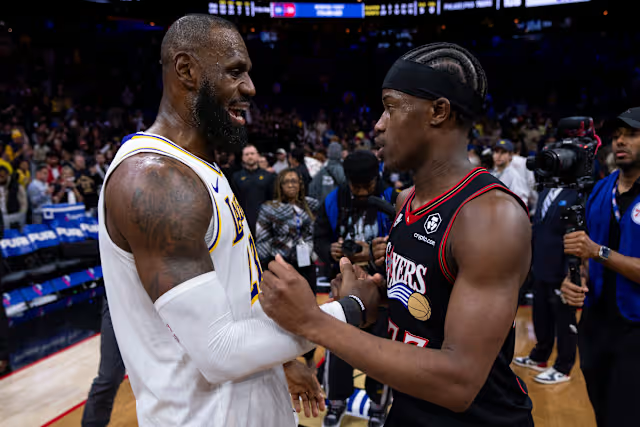

Philadelphia has seen plenty of jaw dropping free agency news over the years, but few moments have carried the sheer disbelief of watching LeBron James, at 41 years old and entering his twenty fourth NBA season, choose the 76ers as what he has called his final decision in the league. James agreed to a two year, eight million dollar veteran’s minimum contract with a player option, walking away from a Los Angeles Lakers payout worth roughly 53 million dollars to chase one more championship in a city that has waited a long time for this kind of superstar arrival. It is, by any reasonable measure, one of the most calculated and audacious roster gambles the league has witnessed in a generation, and the ripple effects are still being felt across both the basketball world and the city itself.
Following LeBron James’ decision to sign a two-year deal with Philadelphia, the Philadelphia 76ers depth chart features one of the most star-studded starting lineups in modern NBA history.
The roster overhaul orchestrated by the front office has established a clear, defined rotation across all five positions:
| Position | Starter | Second Unit | Deep Bench / Two-Way |
|---|---|---|---|
| PG | Tyrese Maxey | Labaron Philon Jr. | Caleb Love (Two-Way) |
| SG | VJ Edgecombe | Anfernee Simons | Dalen Terry |
| SF | Jaylen Brown | Justin Edwards | Jabari Walker |
| PF | LeBron James | Dean Wade | Dominick Barlow |
| C | Joel Embiid | Adem Bona | Ariel Hukporti / Johni Broome |
Depth Chart Breakdown
- The Starting Five: Nick Nurse’s opening lineup boasts five total MVP and Finals MVP awards. Maxey handles the primary scoring engine, Edgecombe steps into a high-athleticism defensive guard role, and Jaylen Brown anchors the two-way wing brigade alongside LeBron James.
- The Backcourt Relief: Rookie draft pick Labaron Philon Jr. and veteran shotmaker Anfernee Simons serve as the primary ball-handlers off the bench to ease the structural burden on Maxey.
- Frontcourt Size: Dean Wade, Dominick Barlow, and Adem Bona offer valuable interior insurance and physical rim-protection to preserve Joel Embiid’s health over the course of the long 82-game regular season.
None of this happened in a vacuum. Mike Gansey, the Sixers’ new President of Basketball Operations, engineered an offseason overhaul that reshaped the franchise’s ceiling before James ever entered the picture. Philadelphia stunned the league by sending Paul George and additional assets to the Boston Celtics in exchange for Jaylen Brown, instantly pairing a proven, two way wing scorer with the core Gansey had already built around All NBA guard Tyrese Maxey, former MVP Joel Embiid, and rookie riser VJ Edgecombe. That combination of talent, timing, and cap flexibility created exactly the kind of low risk, high reward opportunity that could convince a player of James’s stature to walk away from significantly more guaranteed money elsewhere. For a 41 year old chasing a championship rather than a paycheck, joining a roster this deep for practically nothing represented a genuinely rational bet, one that speaks to how thoroughly Gansey reshaped the organization’s outlook in a single summer.
On paper, the fit looks close to ideal, and much of the optimism traces back to a blueprint James already proved out on the international stage. Head coach Nick Nurse is expected to deploy James not as a primary scoring option but as a pass first, cerebral point forward, essentially recreating the facilitator role he played for Team USA during the Paris Olympics. That framing matters enormously for a player his age, because it shifts the physical burden away from him and onto younger legs. With Embiid anchoring the interior and drawing defensive attention in the paint, Maxey and Brown are freed up to attack downhill aggressively, while James can conserve his energy, pick his moments, and orchestrate an offense stacked with players fully capable of creating and finishing on their own. It is a role tailor made for a player entering the twilight of his career while still surrounded by enough talent to make every possession count.
Governor Josh Shapiro captured the statewide reaction about as clearly as anyone could, going so far as to declare an official LeBron James Day in Pennsylvania in the hours after the signing became official, a symbolic gesture that underscored just how significant the moment felt beyond the confines of the arena. That kind of civic enthusiasm reflects a fan base that has spent years craving exactly this sort of transformative addition, and for a few days at least, Philadelphia’s basketball conversation has been almost entirely about possibility rather than the usual tempered skepticism that follows the city’s teams.
Still, no roster gamble of this magnitude comes without serious risk, and two factors in particular will determine whether this experiment produces a championship or an expensive, star studded disappointment. The first is health, and it is not a small concern. Relying on a 41 year old James across an 82 game season, let alone a deep playoff run, is already a considerable bet on its own, and pairing that bet with Embiid’s long documented history of injury issues means the Sixers’ entire championship ceiling is effectively dictated by the training room rather than the box score. If either superstar breaks down by the time May rolls around, the whole structure the front office built this summer collapses regardless of how well everything else fits together.
The second concern is structural rather than medical. Because the Sixers are operating under a hard cap tied to the mid level exception rules they used this offseason, fitting James’s 3.9 million dollar cap hit under the first tax apron required real maneuvering, and the roster building has not stopped there. Philadelphia has had to waive guaranteed contracts and work out smaller trades simply to make the math work, leaving a depth chart that, outside of role players like Dean Wade and Anfernee Simons, is unusually thin for a team with championship aspirations. That thinness means the star core, James included, will almost certainly be asked to play heavier minutes than a typical contender would prefer, compounding the very health risk that already looms over the entire arrangement.
Reaction across the league and among Philadelphia’s notoriously passionate fan base has been swift and largely centered on one question, which is how James and Brown will actually share the floor together on a nightly basis. Analysts broadly agree that the sheer accumulation of star power alone has already reshaped the Eastern Conference’s power balance before a single regular season game has been played, even as they debate exactly how the offensive touches and defensive matchups will sort themselves out over an 82 game grind.
Perhaps no one in Philadelphia understands the emotional whiplash of this moment quite like Bryce Harper. Long before James agreed to join the Sixers, Harper lived through a strikingly similar experience when he signed a thirteen year, 330 million dollar contract with the Phillies back in February 2019, a deal that sent the city into an immediate frenzy. The Phillies sold one hundred thousand tickets within hours of that announcement, followed by another eighty thousand the very next day, numbers the organization has described as the fastest ticket sales it had ever recorded. Speaking before a series opener against the Yankees, Harper reflected on watching Philadelphia embrace another transformative star arrival, noting simply that the city is on fire about it, and acknowledging that four members of that Sixers starting lineup are likely feeling something close to what he felt six years earlier. Harper admitted that in the actual chaos of his own free agency, he had not fully processed the magnitude of what his signing would mean for the franchise, but looking back, he credits that decision with reshaping the Phillies’ entire trajectory over the years that followed, opening the door for other stars like Kyle Schwarber, Trea Turner, and J.T. Realmuto to eventually follow him to Philadelphia. For a city that has now watched two generational free agents choose it over more lucrative or more conventional destinations, Harper’s perspective offers a useful reminder that the full impact of a signing like James’s rarely reveals itself in the moment. It tends to show up years later, in the shape of everything that decision makes possible afterward.
















