
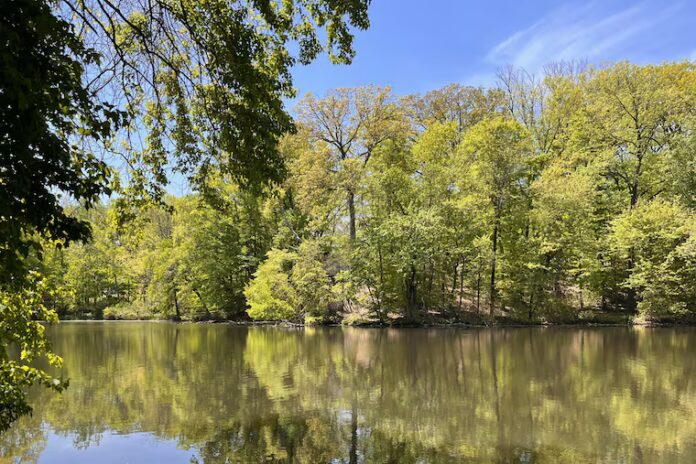

In a state where development pressures often compete with preservation priorities, a rare and meaningful victory has taken shape in Laurel Springs. After more than five decades of quiet, determined stewardship, a 3.5-acre tract of woodland along Laurel Lake—once revered by Walt Whitman—has been permanently protected as public open space, now formally recognized as the Laurel Lake Preserve. The milestone marks not only the safeguarding of a natural environment, but the preservation of a deeply rooted cultural and literary connection that ties New Jersey directly to one of the most influential figures in American history.
For the Kuehner family, the preservation represents the culmination of a decades-long commitment to protecting land that holds both ecological and historical significance. As the final undeveloped parcel along Laurel Lake, the property stood as one of the last remaining opportunities to maintain the integrity of a landscape that has largely resisted modern encroachment. Their efforts ensured that this stretch of woodland would not be absorbed into private development, but instead remain accessible to the public as a living extension of the region’s natural heritage.
The significance of this preservation effort is amplified by its direct connection to Walt Whitman, whose presence in South Jersey during the late 19th century shaped both his personal life and his literary work. Whitman spent extended periods in the area between 1876 and 1884, residing at nearby Stafford Farm while recovering from the effects of a stroke. During that time, Laurel Lake became more than a scenic backdrop—it served as a restorative environment that Whitman credited with aiding his physical and emotional recovery. His admiration for the setting was unequivocal, describing it as “the prettiest lake in either America or Europe,” a statement that underscores the profound impression the landscape left on him.
Whitman’s legacy extends far beyond his connection to Laurel Springs. Widely regarded as the father of free verse, his work redefined the possibilities of American poetry. Through his lifelong project, Leaves of Grass, Whitman introduced a style that broke from traditional European forms, embracing a more expansive, democratic voice that celebrated individuality, diversity, and the shared experience of humanity. His writings, including “Song of Myself” and his elegies for Abraham Lincoln such as “O Captain! My Captain!” and “When Lilacs Last in the Dooryard Bloom’d,” remain central to the American literary canon.
Equally important was Whitman’s role during the American Civil War, where he served as a volunteer nurse in Washington, D.C., tending to wounded soldiers and offering comfort during one of the nation’s most turbulent periods. That experience deepened the humanistic themes present in his work, reinforcing his reputation as a poet of empathy and connection.
The preservation of Laurel Lake’s woodland ensures that this layered history remains accessible and tangible. Beyond its literary associations, the site represents an increasingly rare example of Inner Coastal Plain forest, an ecological environment that supports a range of native species. The protected land now serves as a refuge for wildlife, including sightings of Bald Eagle populations that have returned to the region in recent years. This ecological dimension adds another layer of importance to the preserve, positioning it as both a cultural landmark and a vital natural habitat.
Public access to the Laurel Lake Preserve transforms the site into an experiential destination, allowing visitors to engage directly with a landscape that once inspired one of America’s most important voices. Walking along the lake’s edge or through the wooded areas offers more than a recreational outing—it provides a connection to history that is both immediate and immersive. In an era where many historic sites are mediated through museums and interpretive centers, the preservation of this land allows for a more organic interaction with the past.
Within the broader context of New Jersey’s parks and open space initiatives, the Laurel Lake Preserve stands as a model of what long-term community commitment can achieve. Coverage across Explore New Jersey’s parks section continues to highlight the importance of protecting spaces that contribute to both environmental sustainability and cultural identity. This project exemplifies that dual mission, demonstrating how individual stewardship can intersect with public policy to produce outcomes that benefit future generations.
The timing of this preservation also reflects a growing awareness of the value of open space within densely populated regions. As communities across the state continue to expand, the availability of accessible natural environments becomes increasingly critical—not only for recreation, but for mental health, environmental resilience, and historical continuity. The Laurel Lake Preserve addresses each of these considerations, offering a space that is at once restorative, educational, and enduring.
For Laurel Springs, the designation of the preserve represents a defining moment, reinforcing the borough’s connection to both its natural surroundings and its historical narrative. For the Kuehner family, it is the realization of a vision sustained over half a century—a commitment to ensuring that this land would remain intact, accessible, and protected.
For New Jersey as a whole, it is a reminder that preservation is not simply about maintaining land, but about safeguarding the stories, experiences, and environments that shape a place’s identity. Along the shores of Laurel Lake, where Whitman once found solace and inspiration, that identity now has a permanent home—one that will continue to resonate with visitors, readers, and nature enthusiasts for generations to come.
















