
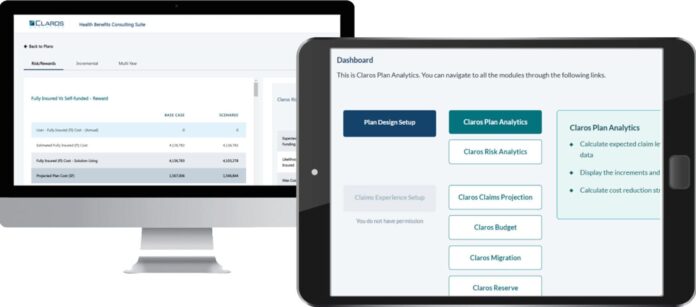

New Jersey’s reputation as a national hub for healthcare innovation continues to grow, and one of the latest examples is unfolding in Princeton, where Claros Analytics has announced a significant expansion of its platform through new integration capabilities and product enhancements designed to help employers, insurance professionals, and healthcare advisors navigate an increasingly complex benefits landscape.
As healthcare costs continue to rise and employers search for more sophisticated ways to manage risk, forecast expenses, and improve outcomes, technology companies capable of transforming raw data into actionable intelligence have become indispensable. Claros Analytics has spent the last decade building a reputation as one of the nation’s leading healthcare actuarial technology firms, and its latest platform advancements underscore a broader shift taking place across the healthcare and insurance sectors.
The announcement arrives at a pivotal moment for the healthcare industry. Organizations are no longer simply looking for historical reporting or retrospective claims analysis. They are demanding predictive insights, real-time data connectivity, and advanced modeling tools capable of helping decision-makers anticipate challenges before they emerge. The ability to accurately project healthcare spending, evaluate plan design options, and understand financial exposure has evolved from a competitive advantage into a business necessity.
From its headquarters in Princeton, Claros Analytics has positioned itself at the center of that transformation.
The company specializes in healthcare actuarial technology, developing software solutions that help employers, insurance brokers, consultants, underwriters, and healthcare organizations better understand the financial realities of health benefits programs. By combining actuarial science, predictive analytics, healthcare economics, and advanced software engineering, the firm has created tools designed to bring greater transparency and precision to one of the most challenging areas of corporate financial planning.
Healthcare benefits remain one of the largest operating expenses for employers across the country. Yet despite the size of these investments, many organizations continue to struggle with uncertainty surrounding future healthcare costs. Claims fluctuations, changing utilization patterns, demographic shifts, prescription drug spending, and evolving regulatory requirements create layers of complexity that can be difficult to forecast using traditional methods.
This is where predictive modeling has become increasingly valuable.
Rather than relying solely on historical claims information, advanced actuarial platforms can evaluate multiple variables simultaneously, generating projections that help organizations prepare for a range of possible outcomes. These models allow benefits professionals to test scenarios, evaluate potential plan changes, and assess risk with greater confidence before making strategic decisions.
The newest enhancements introduced by Claros Analytics reflect the growing demand for interconnected systems capable of delivering these insights faster and more efficiently than ever before.
Modern organizations operate within increasingly complex data environments. Information exists across multiple platforms, carriers, third-party administrators, payroll systems, benefits administrators, wellness vendors, and healthcare providers. Bringing those datasets together into a unified framework has historically required significant manual effort, creating inefficiencies and increasing the risk of errors.
Enhanced integration capabilities address this challenge by allowing data to move more seamlessly between systems. The result is a more comprehensive view of healthcare utilization, financial performance, and emerging trends.
For employers, this means access to clearer information when evaluating benefits strategies.
For brokers and consultants, it provides deeper analytical capabilities that support more informed recommendations.
For underwriters and carriers, it creates opportunities to improve risk assessment and pricing accuracy.
For employees and plan participants, it can ultimately contribute to benefits programs that are more sustainable, efficient, and responsive to evolving healthcare needs.
The implications extend beyond technology alone.
Healthcare costs have become one of the defining financial challenges facing organizations of all sizes. Whether a company employs fifty people or fifty thousand, managing benefits expenses remains a critical component of long-term financial planning. The ability to forecast costs accurately and evaluate alternative strategies can influence everything from hiring decisions and compensation planning to investment priorities and organizational growth.
One area where Claros Analytics has gained significant attention is self-funded healthcare analysis.
An increasing number of employers are exploring self-insurance models as an alternative to traditional fully insured plans. While self-funding offers potential financial advantages, it also introduces additional risk. Employers must understand not only expected claims costs but also the likelihood of catastrophic events, utilization spikes, and other variables that can dramatically impact financial outcomes.
Sophisticated modeling tools help organizations navigate these decisions with greater clarity.
Rather than relying on assumptions or incomplete information, employers can evaluate multiple scenarios and understand the financial implications of different plan designs. This data-driven approach allows leadership teams to make more informed choices regarding healthcare investments while minimizing unexpected surprises.
The growing importance of analytics within healthcare mirrors broader trends occurring across nearly every industry.
Artificial intelligence, machine learning, predictive modeling, and advanced data science are transforming how organizations operate. Businesses increasingly recognize that data is one of their most valuable strategic assets, but only if it can be converted into meaningful insights.
In healthcare, that challenge is particularly significant because of the volume and complexity of available information.
Claims records, prescription utilization, demographic trends, provider networks, treatment patterns, and regulatory requirements generate enormous amounts of data. Without sophisticated analytical tools, extracting value from that information becomes nearly impossible.
Companies like Claros Analytics are helping bridge that gap by turning complexity into clarity.
Their continued growth also highlights New Jersey’s increasingly important role within the healthcare technology ecosystem.
For decades, the state has served as a center for pharmaceutical innovation, biotechnology research, insurance operations, and healthcare administration. Today, that foundation is expanding into new areas that combine healthcare expertise with advanced technology development.
Princeton remains one of the state’s most important innovation corridors, bringing together entrepreneurs, software developers, healthcare specialists, researchers, and business leaders. Organizations operating within this environment benefit from access to world-class talent, major healthcare institutions, academic resources, and a sophisticated professional services infrastructure.
The result is a business ecosystem uniquely positioned to support healthcare technology innovation.
As healthcare organizations continue embracing digital transformation, demand for predictive analytics platforms is expected to accelerate. Employers face mounting pressure to control costs while maintaining competitive benefits packages. Insurers must navigate increasingly dynamic risk environments. Brokers and consultants require more advanced tools to support clients effectively.
Each of these challenges points toward the same conclusion: better decisions depend on better data and more powerful analytical capabilities.
The enhancements announced by Claros Analytics reflect this reality. They represent more than a product update; they illustrate how healthcare technology is evolving to meet the demands of a rapidly changing marketplace.
For New Jersey, the announcement serves as another example of the state’s growing influence in sectors where technology and healthcare intersect. Companies headquartered here are not simply participating in national conversations about healthcare innovation—they are helping shape them.
As organizations across the country confront rising healthcare costs, increasingly complex regulatory environments, and growing demands for transparency, the need for predictive intelligence will only continue to expand. The future of healthcare management is becoming increasingly data-driven, and firms capable of translating information into actionable strategy are poised to play a central role in that transformation.
From Princeton to employers nationwide, the message is becoming clear. Healthcare planning is no longer about reacting to costs after they occur. It is about anticipating challenges, evaluating opportunities, and building smarter strategies before decisions are made. With its latest integration capabilities and platform enhancements, Claros Analytics is positioning itself at the forefront of that movement, helping organizations navigate the future of healthcare with greater confidence, precision, and insight.
















