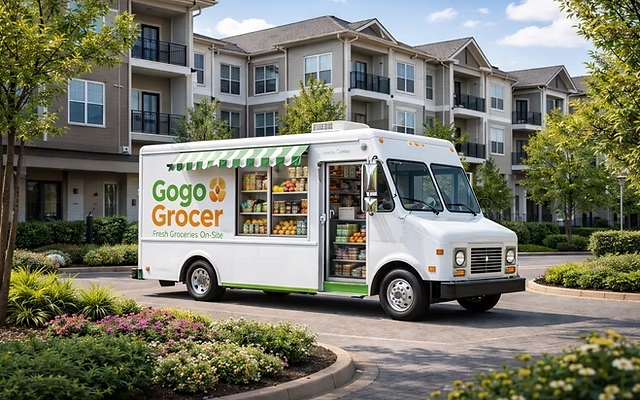

A quiet but transformative shift is taking place in how New Jersey residents access everyday essentials, and it is unfolding not inside traditional supermarkets, but directly outside their front doors. With the launch of Gogo Grocer’s mobile grocery service at an AvalonBay Communities residential property in Maplewood, the concept of grocery shopping is being reimagined through a model that blends technology, convenience, and community-based sourcing into a single, highly efficient experience. This is not simply a delivery service or a pop-up market—it is a fully operational supermarket on wheels, designed to meet residents where they live and redefine the expectations of modern retail access.
Officially debuting its first deployment in Maplewood earlier this month, Gogo Grocer introduces a turnkey amenity that integrates seamlessly into residential life. Every Tuesday evening, a fully stocked grocery truck arrives on-site, offering a curated selection of fresh produce, pantry staples, meats, grains, and specialty items. Residents can step outside and shop directly from the mobile storefront or place orders in advance through a dedicated app, eliminating both the need for travel and the unpredictability of traditional delivery windows. The absence of delivery fees further enhances the appeal, positioning the service as both convenient and cost-effective.
What distinguishes Gogo Grocer from conventional grocery models is its hybrid approach to retail and logistics. Rather than operating as a standalone supermarket chain, the company functions as a bridge between local vendors and consumers, partnering with established community-based businesses to source its inventory. In Maplewood, this includes collaborations with Mini Market Zoyatla, Lakay Deli and Grocery, and the Ahkils Autism Foundation, ensuring that the products available on the truck reflect both quality and local identity. This structure allows Gogo Grocer to support small businesses while delivering a level of convenience typically associated with larger-scale operations.
The underlying technology driving this model is equally significant. By leveraging data-driven inventory management and last-mile logistics systems, Gogo Grocer is able to tailor its offerings to the preferences of specific communities. The truck is not simply stocked with generic products; it is curated based on demand, creating a more efficient and responsive retail experience. This approach transforms the mobile unit into a dynamic, adaptive marketplace—one that evolves alongside the needs of its customers.
For AvalonBay Communities, the introduction of Gogo Grocer represents a broader trend in property development, where amenities are increasingly defined by their ability to enhance daily life. The service is offered at no cost to property owners or management, functioning as a value-added feature that improves resident satisfaction without adding operational complexity. This aligns with a growing emphasis on lifestyle-driven design within multifamily housing, where convenience, accessibility, and experience are central to attracting and retaining residents.
Beyond its immediate impact in Maplewood, Gogo Grocer’s model carries broader implications for New Jersey’s supermarket landscape. As highlighted across Explore New Jersey’s supermarkets coverage, the industry is undergoing a period of rapid transformation, driven by changing consumer expectations and advancements in technology. Traditional brick-and-mortar stores are no longer the sole point of access; instead, a range of hybrid models is emerging, each designed to reduce friction and increase flexibility. Gogo Grocer sits at the forefront of this evolution, offering a solution that combines the tactile experience of in-person shopping with the efficiency of digital ordering.
Importantly, the company’s vision extends beyond high-end residential developments. While the Maplewood launch serves as a proof of concept within a controlled environment, Gogo Grocer is actively exploring expansion into senior living communities and underserved areas across the state. This broader mission introduces a social dimension to the model, addressing issues of food access and mobility that affect a significant portion of the population. By bringing groceries directly to communities that may lack convenient access to traditional supermarkets, the service has the potential to play a meaningful role in reducing food insecurity while maintaining its core focus on quality and convenience.
The early response to the Maplewood deployment has already indicated strong demand, with residents embracing the ability to shop on their own schedule without leaving their neighborhood. This momentum is fueling plans for additional rollouts across New Jersey, where similar residential partnerships are expected to follow. Each new location will further refine the model, incorporating feedback and data to enhance both product selection and operational efficiency.
What makes Gogo Grocer particularly compelling is its ability to align multiple trends into a single, cohesive concept. It reflects the rise of localized commerce, where supporting nearby businesses becomes part of the purchasing decision. It embodies the integration of technology into everyday life, where data and logistics work behind the scenes to deliver a seamless experience. And it responds directly to the demand for convenience, offering a solution that fits naturally into the routines of modern consumers.
In a state as densely populated and diverse as New Jersey, where time and accessibility are often defining factors in daily life, the introduction of a mobile grocery platform represents more than innovation—it represents adaptation. It acknowledges that the way people shop is changing and that the infrastructure supporting those habits must evolve accordingly.
As Gogo Grocer continues to expand its footprint, it is not just introducing a new service; it is contributing to a redefinition of what a supermarket can be. No longer confined to a fixed location, the grocery store is becoming mobile, responsive, and deeply integrated into the communities it serves. In Maplewood, that future is already parked curbside, stocked, and ready.