
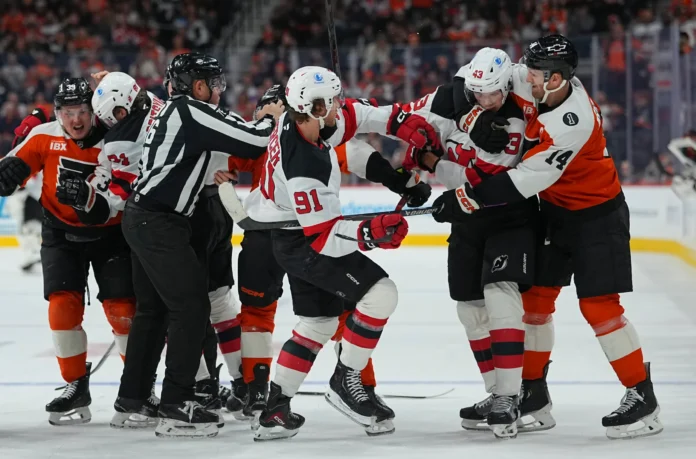

The 2025–26 NHL regular season closed on April 16 with a familiar truth and a newly sharpened contrast in the Metropolitan Division: one team found its identity at exactly the right time, while another spent the spring confronting the cost of a season that never fully stabilized. Across the league, the playoff field is now locked, the Colorado Avalanche have secured the Presidents’ Trophy, and the Eastern Conference has taken on the look of a pressure chamber heading into the Stanley Cup Playoffs. In that environment, the Philadelphia Flyers have emerged as one of the East’s defining late-season stories, while the New Jersey Devils move into an offseason that now feels far more consequential than anyone in North Jersey envisioned when this campaign began.
For New Jersey, this ending lands with particular force because the season did not begin with the profile of a non-playoff team. The roster had enough recognizable top-end talent to justify expectation, enough offensive skill to threaten games in bursts, and enough urgency around the organization to create the belief that the Devils were moving toward something more stable and more dangerous. Instead, the year unraveled in fits and starts. Injuries disrupted rhythm, consistency never arrived for long, and the team’s overall body of work failed to match the standard attached to its core. By the time the final days of the season arrived, the conversation had already shifted away from standings mathematics and toward accountability, leadership, and the shape of the franchise’s next phase. Explore New Jersey’s recent Devils coverage has reflected exactly that shift, framing this moment not as a simple disappointment, but as a turning point that will define what comes next for the organization.
That is what makes the Flyers’ finish feel even more dramatic from a regional perspective. Philadelphia did not merely slip into the postseason. The Flyers forced their way back into relevance with the kind of late push that changes how an entire season is remembered. Their shootout victory over the Carolina Hurricanes on April 13 locked in a playoff berth and clinched third place in the Metropolitan Division, sending the franchise back to the postseason for the first time since 2020. That result did more than secure a spot. It confirmed that Philadelphia had found enough discipline, enough composure, and enough timely production to survive a race that stayed crowded deep into the final stretch. The reward is immediate and combustible: a first-round showdown with the Pittsburgh Penguins, a rivalry series that instantly gives the Eastern Conference bracket added edge.
The Flyers’ resurgence matters because it cuts against the assumptions that followed them through much of the season. They were not universally treated as a lock, nor were they consistently viewed as one of the East’s cleanest or deepest rosters. What they became instead was resilient. They won the games they had to win late, absorbed pressure, and leaned into the kind of narrow-margin hockey that often decides spring races. Tyson Foerster delivered the clinching shootout goal against Carolina, Dan Vladar shut the door in the tiebreaker, and Philadelphia’s attack found just enough finish in the decisive moments to convert urgency into result. By the time the regular season ended, the Flyers were no longer just hanging around the race. They had completed one of the conference’s most important closing surges and re-entered the postseason conversation as a team nobody will dismiss lightly.
What has made Philadelphia’s finish especially compelling is that it has not been built solely on star power or one explosive run of scoring. It has come from a broader collective hardening. Travis Konecny and Sean Couturier remain central figures in the team’s identity, while younger contributors helped inject life into the final stretch. Porter Martone’s late-season production gave the Flyers an additional push at the right time, and the team’s structure held together long enough for that offense to matter. This was not the story of a club that coasted on reputation. It was the story of a team that kept surviving its pressure points until survival became belief and belief became position. The result is a Battle of Pennsylvania playoff series that gives the Flyers a national spotlight and gives the Metropolitan Division a fittingly volatile first-round theater.
For the Devils, the emotional weight of this week is of a very different kind. Their elimination was not theoretical, nor was it softened by a gentle landing. The loss to Philadelphia in early April was part of the final blow to their postseason hopes, and the aftermath moved quickly. The organization parted ways with General Manager Tom Fitzgerald as the season collapsed into evaluation mode, and the closing days became less about chasing improbable math and more about confronting what the year had exposed. Explore New Jersey’s coverage has already positioned this stretch as a defining offseason, and that framing feels accurate. The Devils are not entering the summer with minor housekeeping in front of them. They are entering it with structural questions.
That is the heart of the Devils story right now: not simply that they missed the playoffs, but that the miss has forced the franchise into a broader examination of its operating model. The team’s core talent remains real. Jesper Bratt continued to produce. Jack Hughes, even amid frustration and interruption, remained a player capable of changing the pace and profile of a game. Nico Hischier still anchors the room and the identity of the club. Luke Hughes remains a major part of the long-view picture. Yet none of that prevented the season from becoming disjointed. A talented nucleus is not the same as a finished team, and this year pushed that distinction into the open. In a division where Carolina stayed elite and Philadelphia found late conviction, New Jersey spent too much of the season trying to recover from its own instability.
Injuries were undeniably part of that story. They affected continuity, strained depth, and repeatedly altered the rhythm of the lineup. Luke Hughes was shut down for the remainder of the season to address a lingering shoulder issue, and the broader campaign had already been shaped by interruptions affecting key personnel. But injuries alone do not explain the full gap between expectation and outcome. Teams survive adversity when their structure is strong enough to absorb it. The Devils too often looked like a club trying to rediscover itself from week to week, and that kind of uncertainty becomes fatal in the modern Metropolitan Division, where postseason margins disappear quickly and confidence evaporates even faster when a team cannot defend or finish consistently enough over time. (Reuters)
The final image of the Devils’ season did not suggest a team one tweak away. It suggested a team in need of recalibration. Their season-ending loss in Boston underscored the flatness that had settled over the group after elimination, and the larger numbers tell the same story: New Jersey finished 42-37-3 and outside the playoff field, a record that reads as middling on paper but feels heavier in context because of what the roster was expected to challenge for. This is why the offseason conversation has already accelerated beyond surface-level fixes. The question in New Jersey is no longer whether changes are coming. It is how broad those changes will be, how decisively leadership will act, and whether the organization can translate a talented foundation into a clearer identity.
That leadership conversation is unavoidable now, and it is already one of the most closely watched storylines in the state’s hockey landscape. Reports and analysis around the vacancy have linked the Devils to a range of established and emerging executive names, including experienced former team and league figures as well as analytics-driven candidates with direct or indirect ties to New Jersey. The precise structure remains unsettled, with discussion centered on whether the franchise will install one voice atop hockey operations or divide responsibilities across multiple roles. What matters most is not the noise of a candidate list by itself, but the philosophical decision beneath it. The Devils need more than a replacement. They need alignment. They need a front office structure capable of integrating roster construction, player development, cap strategy, and organizational identity into something coherent and durable. (All About The Jersey)
This is where the regional contrast becomes especially sharp. The Flyers are stepping into the playoffs with momentum, clarity, and an emotional payoff for a season that tightened in the right places late. The Devils are stepping into the offseason with unresolved questions that can no longer be deferred. One team gets to discover how far its surge can carry it. The other has to confront why a roster with this much name recognition and internal investment did not produce a better table position than seventh in the division. That divergence is not just a snapshot of April. It is a measure of organizational direction.
League-wide, this season will also be remembered for the larger context surrounding it. Colorado’s Presidents’ Trophy run established the Avalanche as the NHL’s top regular-season club, while Carolina closed atop the Eastern Conference and reinforced its place among the league’s most reliable contenders. The season also carried the distinctive interruption of the Milano Cortina Olympics, which brought NHL players back to the Winter Games for the first time since 2014. That international pause altered rhythms across the league and added a layer of physical and mental complexity to the second half. Some teams used the transition well. Others never fully found their footing again. In a season shaped by both elite top-end contenders and compressed middle-tier races, the ability to regain form after February became one of the defining separators.
For Explore New Jersey readers, the deeper significance lies in what this moment says about hockey in the region right now. The Devils remain one of the state’s most important franchises, one still capable of commanding attention, drawing expectation, and carrying emotional weight well beyond the standings. That is exactly why this offseason feels so important. It is not just about patching a disappointing season. It is about determining whether the franchise can turn talent into traction and whether the next decisions made in the front office can finally stabilize a club that has flashed promise without sustaining it often enough. The Flyers, meanwhile, have reminded the division that trajectory can change quickly when a team hardens under pressure and gets enough from the right players at the right time.
So as the Stanley Cup Playoffs begin on April 18, the map is clear even if the future is not. Philadelphia is back in the fight, carrying the urgency and reward of a late-season breakthrough into a rivalry series that should command the full attention of the hockey world. New Jersey is out, but not irrelevant; if anything, the opposite is true. The Devils now enter one of the most revealing offseasons the franchise has faced in years, and what happens next may determine whether this season is remembered as a temporary derailment or the point at which the organization finally accepted that talent alone was never going to be enough. For one Metropolitan team, the story has turned toward opportunity. For the other, it has turned toward consequence. In this part of the hockey calendar, both are powerful, and both will shape what New Jersey hockey looks like when the next chapter begins.
If you want, I can also turn this into a second version tailored specifically as a homepage lead story with a stronger SEO headline and meta description.
















