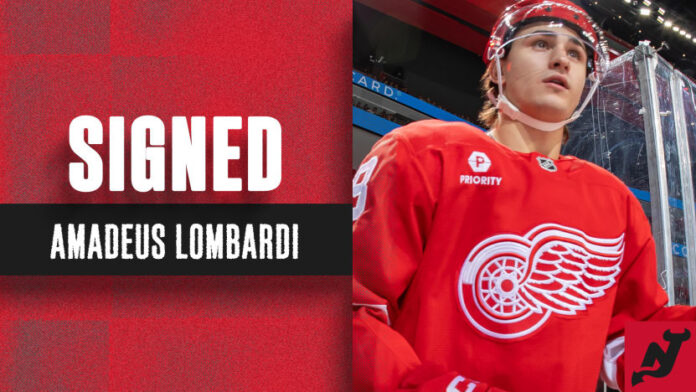

Two days after a July 1 that reshaped the New Jersey Devils’ organizational outlook in ways that will be discussed through the summer — Nico Hischier’s five-year extension, the Barrett Hayton offer sheet, Nico Daws’s re-signing — General Manager Sunny Mehta continued building depth at the roster’s margins over the following 48 hours with a pair of signings that complete the organization’s short-term goaltending infrastructure and add an analytically intriguing young center to the organizational inventory. The signings of David Rittich to a one-year contract and Amadeus Lombardi to a two-year deal announced on July 3 each address specific organizational needs in characteristically efficient fashion: one contract resolves an immediate question about what the goaltending depth chart looks like between Jake Allen and Jakub Malek’s development timeline, and the other adds a forward who has produced at a rate that significantly outperforms his acquisition cost.
Free Agency & Roster Signings (July 1–3)
| Player | Position | Contract Details | Context / Role |
|---|---|---|---|
| Arseny Gritsyuk | LW | 3 years, $9.75M | Signed out of the KHL; expected to push for a top-6 role immediately. |
| Amadeus Lombardi | C | 2 years, two-way/one-way | Acquired from Detroit for a 4th-round pick, then signed to an extension. |
| David Rittich | G | 1 year, $1M | Brought in as “Big Save Dave” to provide critical veteran netminding depth. |
| Nico Daws | G | 2 years, extension | Re-signed to secure the team’s internal young goaltending picture. |
| Riley Tufte | LW | 1 year, $850K | Depth winger signed on Day 1 of free agency for size and muscle. |
David Rittich brings to the Devils’ crease a professional biography that spans 260 career NHL regular-season appearances across ten seasons and six organizations — Calgary, Toronto, Nashville, Winnipeg, Los Angeles, and most recently the New York Islanders — along with the specific statistical profile of a goaltender who, in his best seasons, has been genuinely good and who, in his worst, has been the kind of volatile backup that teams at the league’s margins roster to manage uncertainty. The one-year, one-way contract at $1 million does not carry trade protection, which means the Devils retain full flexibility over where Rittich fits into the goaltending rotation as the season develops. His 2025-26 season with the Islanders — 14-10-3 in 30 games, a 2.76 goals-against average, a .894 save percentage, two shutouts, and a positive 4.2 goals saved above expected figure that placed him among the better-performing backup goaltenders in the league — represents the kind of recent performance that makes a $1 million commitment entirely defensible as a third netminder depth signing.
Rittich’s career trajectory follows the pattern typical of the European undrafted goaltender who finds his way to the NHL through perseverance and a specific skill set rather than through early organizational investment. A native of Jihlava in the Czech Republic, he signed as an undrafted free agent with the Calgary Flames in June 2016, spent most of his first professional season with the AHL’s Stockton Heat, and made his NHL debut on April 8, 2017, against San Jose. His best NHL season came in 2018-19 with Calgary, where he posted a 27-9-5 record with a 2.61 goals-against average and a .911 save percentage in 45 games — performance that earned him a selection to the 2020 NHL All-Star Game and established him as a legitimate backup capable of carrying a starter’s workload in specific circumstances. He represented Czechia at the 2018 IIHF Men’s World Championship, going 2-1-0 with a 1.98 goals-against average, a performance that demonstrated his competency in high-pressure environments independent of his NHL club.
The analytical case for the Rittich signing is well-grounded in the specific strategic question it answers for the organization. When Mehta addressed the media on July 3, he acknowledged that the current goaltending configuration — Jake Allen projected as the primary starter, Nico Daws as a candidate for genuine NHL minutes following his two-year re-signing — was a situation he was comfortable with but one he did not necessarily expect to remain unchanged. Adding Rittich creates a three-goaltender competition for effectively two jobs, with the third netminder expected to clear waivers at the conclusion of training camp and report to the Utica Comets unless injury circumstances create a different roster dynamic. The structure of the situation is specifically designed to give Daws a legitimate opportunity to beat out Rittich for the backup role behind Allen — creating competitive pressure for the development-track prospect rather than simply handing him a spot based on organizational loyalty while simultaneously protecting against the scenario where Allen and Daws’s combined experience is insufficient to stabilize the crease through a full season.
The analytical context around the Rittich-versus-Markstrom comparison is worth noting explicitly. Markstrom, who departed in the Florida trade, had a save percentage on high-danger shots of .734 last season — a figure that analysts consistently cited as evidence that he was not making difficult saves when they mattered most. Rittich’s high-danger save percentage over the same period was .818, sixth in the league among qualifiers. His save percentage on low-danger shots was .968, significantly above Markstrom’s .949. For a goaltender the Devils are carrying at $1 million against the cap versus Markstrom’s $6 million, those comparative numbers are striking — though the caveat that Rittich’s performance has fluctuated meaningfully from year to year, posting .886 and -11.4 goals saved above expected in 2024-25 before his 2025-26 rebound, means the sample represents opportunity rather than certainty. The three-goaltender depth structure the Devils are building gives them optionality without committing to any single answer before training camp competition actually takes place.
The Amadeus Lombardi signing occupies a different position in the offseason narrative — the story of how a fourth-round draft pick acquired mid-draft from Detroit becomes a two-year organizational commitment within ten days of the transaction. Lombardi, 23, was selected by New Jersey in the June 25 trade with Detroit, a deal in which the Devils sent the 108th overall pick to the Red Wings in exchange for the rights to a center who had spent three seasons demonstrating in the AHL that the player Detroit had drafted 113th overall in 2022 was considerably better than that position suggests. The production is unambiguous: 40 points in 44 AHL games in 2024-25, then 42 points in 47 games in 2025-26 — a rate that reflects genuine offensive capability at the AHL level, particularly for a player who has done it across two consecutive seasons rather than in a single breakout year that might be explained by circumstances.
Lombardi’s OHL background provides additional context for the production rate he has sustained professionally. In 2022-23 with the Flint Firebirds, his final junior season, he produced 102 points in 67 games — goal and point totals that led Flint, placed him third in the OHL in total points, and sixth in goals across the entire league. The conversion from OHL offensive production to professional relevance is imperfect and varies substantially by player, but Lombardi’s AHL numbers suggest he has retained enough of his offensive capability to project as a contributor at the pro level. The two-year contract structure — $850,000 at the NHL level or $175,000 at the AHL level in year one, transitioning to a one-way deal at $900,000 in year two — is constructed specifically to preserve the competition dynamic that will determine whether Lombardi pushes for NHL minutes or becomes an organizational AHL asset. The year-two one-way term is significant: it signals the Devils believe Lombardi’s NHL case is legitimate rather than speculative, committing to pay him an NHL wage in his second contract year regardless of which level he is playing at.
The Mehta-era offseason has now assembled a picture for 2026-27 that reflects a deliberate front office philosophy: secure the organizational pillars at the top through Hischier’s extension, use unconventional mechanisms where necessary to address roster needs — the Hayton offer sheet, the fourth-round-for-rights Lombardi trade — and fill depth slots with low-risk, analytically defensible contracts at the margin. The three-netminder situation, the Hayton offer sheet awaiting Utah’s response, the Lombardi competition for AHL or NHL ice time, the Florida-acquired forwards (Rodrigues, Boqvist, Steeves) working their way into the system — these are the questions that training camp in September will begin resolving. What Mehta’s first full offseason has established, across eleven days of transactions beginning with the Gritsyuk extension on June 30 and continuing through the Rittich and Lombardi signings on July 3, is that the organization is not simply managing its way toward a neutral baseline following the Markstrom transition. It is actively building a more interesting roster than the one it started the offseason with, and doing so without creating the kind of cap-space problems that constrain future options.
The Devils’ current cap situation, with approximately $7.6 million in remaining space before any potential cap implications from the Hayton offer sheet, gives Mehta continued room to respond to the Barrett Hayton situation — if Utah matches the offer sheet and keeps Hayton, the Devils receive a 2027 second-round pick as compensation, maintaining draft capital and cap flexibility; if Utah declines to match and Hayton reports to Newark, he joins a center depth chart that includes Hischier, the recently acquired forwards, and Lombardi at various levels of the organizational hierarchy. Either outcome leaves the Devils with options rather than commitments, which is precisely the kind of roster construction flexibility that distinguishes a thoughtfully assembled offseason from an impulsive one.