
New Jersey’s role in the FIFA World Cup 2026 is no longer confined to stadium headlines or international tourism projections. What is now taking shape across the state is something much broader, more strategic, and potentially more transformative for local communities than many initially anticipated. As global attention begins turning toward the United States ahead of the largest FIFA World Cup ever staged, New Jersey is making a deliberate push to ensure the economic, cultural, and community impact of the tournament reaches far beyond the walls of the region’s marquee venues.
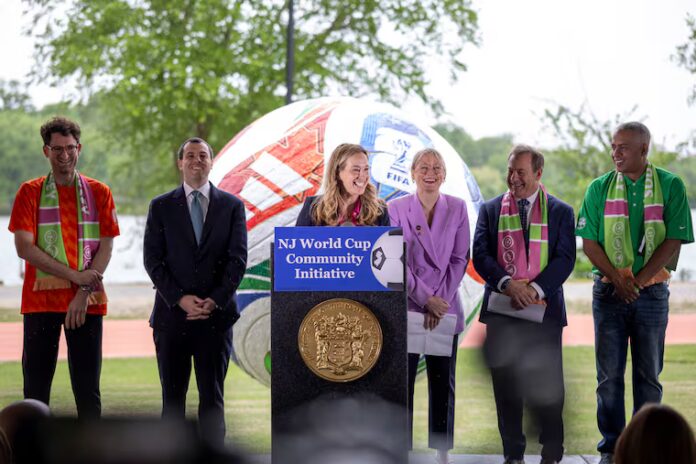
That vision moved into sharper focus on May 6, 2026, when Governor Mikie Sherrill traveled to Camden County to formally announce the NJ World Cup Community Initiative, a statewide grant program designed to spread World Cup-related economic activity into neighborhoods, municipalities, small business districts, and local cultural organizations throughout New Jersey.
The initiative, backed by $5 million in funding, will support 34 organizations across the state as they develop fan zones, public watch parties, soccer festivals, cultural activations, youth programming, waterfront gatherings, and community-driven events tied directly to the FIFA World Cup 2026 experience.
The strategy reflects an increasingly sophisticated understanding of what global sporting events can mean economically and culturally when states move beyond a stadium-centered model.
Rather than concentrating activity solely around host venues, New Jersey’s leadership is positioning the World Cup as a statewide tourism, hospitality, entertainment, and economic development opportunity. Officials estimate that approximately 1.5 million visitors could move through the broader region during the tournament period, creating enormous opportunities not only for transportation hubs and major venues, but for restaurants, hotels, retailers, entertainment districts, cultural institutions, and small businesses throughout New Jersey.
For Camden County specifically, the announcement further solidified the region’s growing role as one of the central public gathering points connected to the tournament.
That positioning is both geographic and symbolic.
With Philadelphia’s Lincoln Financial Field hosting multiple FIFA World Cup 2026 matches directly across the river, Camden finds itself uniquely positioned to absorb major fan activity while simultaneously showcasing its evolving waterfront, entertainment infrastructure, parks system, and cultural identity to an international audience.
The planned Camden County events reveal just how expansive the local vision has become.
World Cup Events in Camden County
Camden will be a major hub for festivities, especially given its proximity to the matches being held across the river at Lincoln Financial Field. Planned events include:
- SoccerFest26 (June 25–27): A three-day “hub” for fans on the Camden Waterfront, featuring match viewings and interactive activities.
- World Cup Final Watch Party (July 19): A massive public viewing of the final match at Cooper River Park in Pennsauken.
- Pop-up Fan Activations: Community-driven events, including soccer festivals for kids and appearances at local festivals like the Down & Derby Wine Festival.
- Regional Watch Parties: Local celebrations are also slated for nearby Haddon Heights and Mount Holly.
Upcoming Group Stage Matches Near Camden
While the finals will be at MetLife Stadium, several key group stage matches will take place at Lincoln Financial Field in Philadelphia (just across the bridge from Camden):
| Date | Time (EDT) | Matchup | Local Broadcast |
|---|---|---|---|
| June 14, 2026 | 7:00 PM | Ivory Coast vs. Ecuador | Fox Sports |
| June 19, 2026 | 8:30 PM | Haiti vs. Brazil | Fox Sports |
| June 22, 2026 | 3:00 PM | To Be Determined | Fox Sports |
Among the centerpiece activations will be SoccerFest26, a three-day fan hub scheduled for June 25 through June 27 along the Camden Waterfront. Organizers envision the event as a large-scale gathering space blending live match screenings, interactive soccer activities, youth engagement, entertainment programming, community vendors, food experiences, and public celebrations tied directly to the global tournament atmosphere unfolding across the region.
The Camden Waterfront has spent years evolving into one of South Jersey’s most active entertainment and event corridors, and the World Cup presents an opportunity to elevate that visibility on an entirely new level. With skyline views, transit access, public spaces, and direct proximity to Philadelphia’s match venues, Camden becomes more than an adjacent city during the tournament. It becomes part of the World Cup experience itself.
Additional major events are already planned throughout the county and surrounding region.
A large-scale World Cup Final Watch Party is scheduled for July 19 at Cooper River Park in Pennsauken, transforming one of South Jersey’s signature public spaces into a communal international viewing environment expected to draw substantial crowds. Community-focused pop-up activations, youth soccer festivals, cultural programming, and tournament-themed appearances at established regional events such as the Down & Derby Wine Festival are also expected to become part of the broader celebration strategy.
Regional watch parties are additionally planned for municipalities including Haddon Heights and Mount Holly, reflecting the initiative’s emphasis on distributing activity into multiple communities rather than centralizing everything into a single destination.
That decentralized model may ultimately become one of New Jersey’s biggest advantages during the tournament.
Unlike many World Cup host regions that rely heavily on one dominant urban core, New Jersey’s geography allows visitors to move fluidly between cities, shore communities, entertainment districts, suburban downtowns, parks systems, cultural attractions, and hospitality hubs within relatively short travel distances. The result is a far broader economic footprint than what traditional stadium economics alone would normally generate.
For Explore New Jersey readers and businesses throughout the state, that reality could create opportunities extending well beyond sports itself.
Hospitality industries are expected to see enormous increases in demand. Restaurants, bars, breweries, waterfront venues, transportation services, hotels, retail corridors, entertainment spaces, and tourism operators throughout New Jersey are already preparing for the influx of domestic and international visitors expected next summer.
At the same time, the World Cup is creating new momentum for public investment, infrastructure coordination, cultural programming, and regional branding efforts.
The tournament also arrives during a particularly important period for New Jersey’s broader economic and cultural identity.
Over the last several years, the state has aggressively positioned itself as a destination for large-scale events, entertainment tourism, sports infrastructure, film production, waterfront redevelopment, and experiential travel. The FIFA World Cup 2026 now becomes perhaps the largest international showcase New Jersey has ever participated in at this scale.
The state’s proximity to New York City and Philadelphia has historically created both opportunities and challenges for New Jersey branding efforts. Large events often unfolded around the state without fully centering New Jersey itself within the narrative. The NJ World Cup Community Initiative appears designed specifically to avoid that dynamic.
Instead of functioning merely as overflow territory for neighboring host cities, New Jersey is asserting itself as a primary participant in the cultural and economic experience surrounding the tournament.
That matters for long-term tourism positioning as much as short-term economic impact.
The World Cup is expected to generate massive global media exposure, international social media engagement, tourism content creation, and long-lasting destination branding opportunities. Communities that successfully activate around the tournament stand to benefit not only during the event itself, but potentially for years afterward through increased tourism recognition and investment visibility.
Camden County’s role may prove especially significant because of how dramatically the area has evolved over the last decade.
Once discussed primarily through the lens of industrial decline and economic hardship, Camden has increasingly repositioned itself through waterfront development, educational investment, healthcare expansion, arts programming, entertainment initiatives, and regional tourism efforts. The World Cup provides another opportunity to reshape external perceptions while strengthening local economic ecosystems.
The tournament atmosphere itself will likely transform the entire South Jersey and Philadelphia region.
Lincoln Financial Field’s group stage schedule already includes several highly anticipated matches that are expected to draw massive international audiences and traveling fan bases. Among the announced fixtures are Ivory Coast versus Ecuador on June 14 and Haiti versus Brazil on June 19, both expected to generate substantial regional tourism activity and international media attention.
The Brazil match in particular could become one of the largest sporting events the Philadelphia-South Jersey region has hosted in years, given Brazil’s global fan base and the historic passion surrounding the national team.
The proximity of those matches to Camden positions the county as a natural gathering point before and after games, especially for visitors seeking waterfront experiences, public celebrations, dining, entertainment, and alternative viewing environments outside the stadium itself.
That larger regional ecosystem is exactly what the NJ World Cup Community Initiative is attempting to cultivate.
Major Fan Fests in NJ (June 2026)
| Date | Event Type | Location | Featured Highlight |
|---|---|---|---|
| June 11–July 19 | FIFA Experience | LEGOLAND NY | Soccer-themed LEGO builds & games |
| June 11–July 15 | FIFA Fan Festival | Liberty State Park | Central hub for match viewings and food |
| June 13 | World Cup Concert | American Dream | Performance by rapper French Montana |
| June 21 | Fan Festival | Laurel Hill Park | Pre-game festivities for Norway vs. Senegal |
Governor Sherrill’s appearance in Camden underscored the state’s belief that the economic upside of the tournament should not remain concentrated solely among large venues or corporate stakeholders. Instead, the initiative emphasizes the importance of local participation, community engagement, and small business inclusion within the broader World Cup economy.
That philosophy reflects changing approaches to major-event planning nationally.
Increasingly, states and municipalities are recognizing that the true long-term success of global events depends on whether local communities feel included in both the experience and the economic benefits attached to it. Public viewing spaces, cultural festivals, youth programming, and local business partnerships help transform an event from a televised spectacle into a regional civic experience.
For New Jersey, the FIFA World Cup 2026 represents something even larger than sports.
It is a test of how effectively the state can coordinate tourism, transportation, entertainment, hospitality, culture, and economic development around a globally significant moment. It is an opportunity to introduce international visitors to communities they might otherwise never experience. It is a chance for local businesses to access unprecedented consumer traffic. And it is a platform for New Jersey to define its own identity within one of the largest sporting events on earth.
As preparations continue accelerating across the state, one thing is already becoming clear: New Jersey does not intend to stand quietly on the sidelines of the FIFA World Cup 2026.
From the Camden Waterfront to Cooper River Park, from neighborhood watch parties to international fan festivals, the Garden State is positioning itself not simply as a host-adjacent location, but as an active and essential part of the World Cup experience itself.