

- This event has passed.
The 39 Steps
Four Actors, 150 Characters, and a Plane Crash on a Black-Box Stage: Princeton Summer Theater Stages “The 39 Steps”
July 2 @ 7:30 PM – July 18 @ 11:30 PM
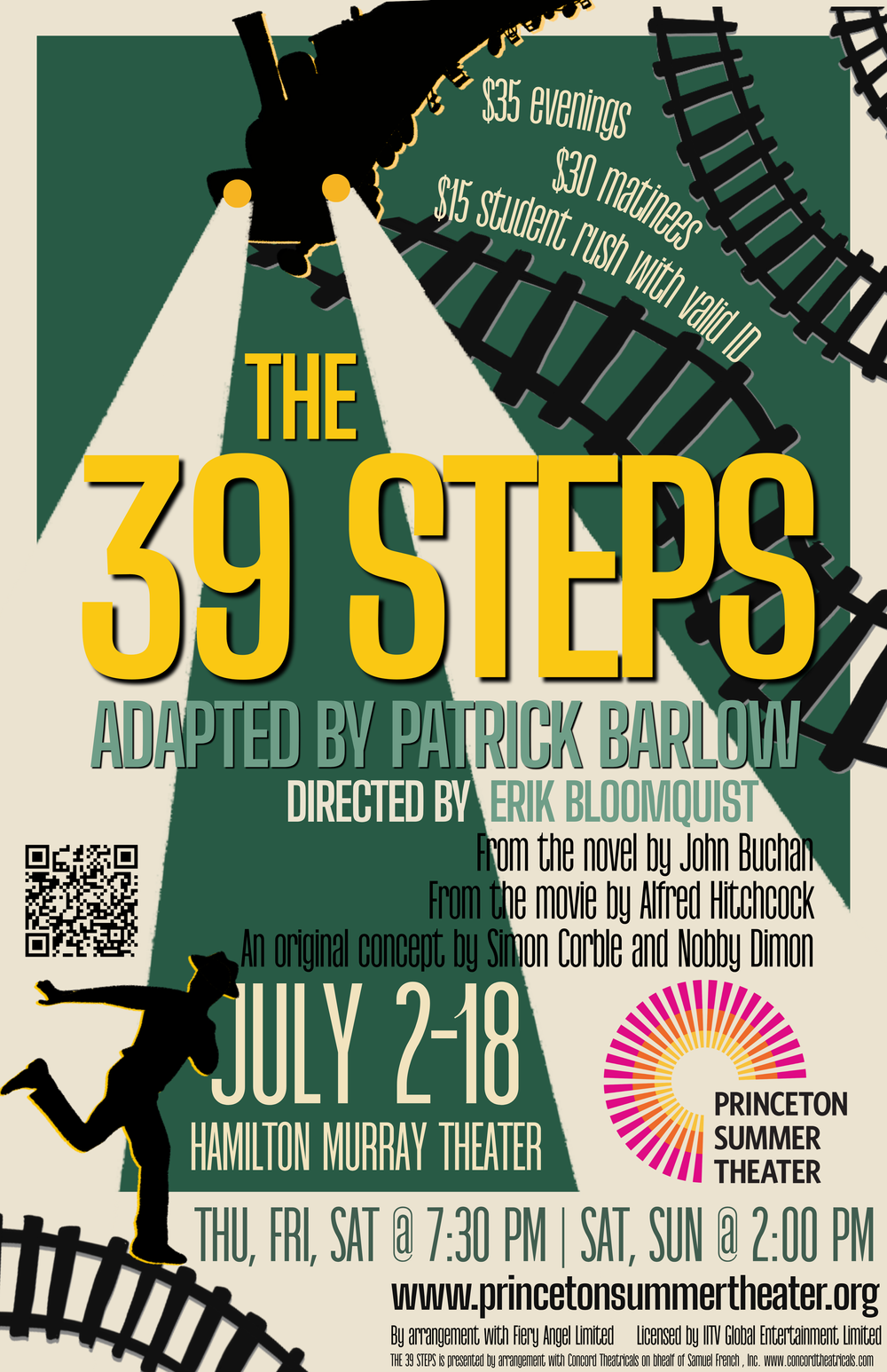
The technical challenge embedded in Patrick Barlow’s stage adaptation of The 39 Steps is, on paper, close to absurd: take Alfred Hitchcock’s sprawling 1935 spy thriller — a film built around train chases across the Scottish Highlands, a manhunt spanning multiple cities, and a cast of dozens of characters — and stage it with exactly four actors, none of whom leave the stage for long enough to suggest the production has any budget for understudies or scene changes in the conventional sense. Princeton Summer Theater opens that production on July 2, running Thursdays through Sundays through July 18 at the Hamilton Murray Theater on the Princeton University campus, and the company’s track record over more than five decades of summer programming suggests they understand exactly what makes this particular theatrical magic trick work.
The production is the second mainstage offering in Princeton Summer Theater’s 56th season, following the company’s June run of Neil Simon’s Barefoot in the Park and preceding a July 23 production of Sam Shepard’s True West that closes the company’s main stage programming for the summer. Evening performances run Thursday through Saturday at 7:30 p.m., with Saturday and Sunday matinees at 2:00 p.m. — a four-show-per-week rotation across the production’s three-week run, July 2 through July 18, with specific performance dates of July 2-5, July 9-12, and July 16-18.
What The 39 Steps Actually Is
Patrick Barlow’s adaptation, which won two Tony Awards and two Drama Desk Awards during its Broadway run, takes John Buchan’s 1915 spy novel and Alfred Hitchcock’s celebrated 1935 film adaptation and compresses them into a two-hour stage farce that functions simultaneously as a loving homage to classic Hitchcock suspense and as a deliberate parody of the theatrical conventions that period mystery thrillers depend on. The plot follows Richard Hannay, an ordinary man whose unremarkable life is upended when a mysterious woman is murdered in his London flat, leaving him the prime suspect in her death and the unwitting custodian of a dangerous secret involving an international spy ring. Hannay flees north toward Scotland, encountering an escalating series of dangers, disguises, and unlikely allies and adversaries as he attempts to clear his name and unravel the conspiracy at the center of the plot.
The genius of Barlow’s theatrical adaptation lies not in faithfully recreating the cinematic scope of Hitchcock’s film but in openly acknowledging the impossibility of doing so and turning that impossibility into the production’s central comedic engine. Where the film uses the full resources of 1930s British cinema to depict train chases across the Highlands, biplane pursuits over open countryside, and crowd scenes in London theaters, the stage production accomplishes the same narrative beats using minimal set pieces, deliberately visible theatrical artifice, and a small ensemble of performers who must physically transform between characters in full view of the audience. A description that mixes “a Hitchcock masterpiece with a juicy spy novel, add a dash of Monty Python” captures the production’s tonal blend accurately: this is suspense theater that is fully aware of its own absurdity and that invites the audience to delight in watching the mechanics of theatrical illusion rather than concealing them.
The Four-Actor Structure That Makes It Work
Princeton Summer Theater’s production features Jacob Schorsch as Richard Hannay — the production’s sole actor playing a single character throughout, anchoring the frantic transformations happening around him — alongside Shaelin McKenna, who takes on the principal female roles of Annabella, Margaret, and Pamela, and Joseph McLean and Jordan Rashdan, credited as Clown 1 and Clown 2, who between them portray the remaining roster of more than 150 characters that populate Buchan’s and Hitchcock’s narrative.
The character count is not exaggeration for marketing purposes. The structural demand of Barlow’s script requires McLean and Rashdan to embody an enormous range of supporting roles — policemen, conspirators, hotel proprietors, train passengers, Scottish farmers, London theatrical performers, and dozens of others — through the kind of instantaneous costume and characterization shifts that depend entirely on quick-change choreography, vocal and physical versatility, and split-second timing between the performers and the production’s backstage crew. This structural constraint is what gives the production its distinctive energy: rather than concealing the labor of theatrical transformation behind the curtain, The 39 Steps puts that labor on display as the central spectacle of the evening. Audiences are not simply watching a story unfold — they are watching two performers execute an extraordinary feat of theatrical athleticism in real time, swapping hats, coats, and accents with a speed that becomes, in itself, one of the production’s primary comedic and technical achievements.
This kind of multi-role demand is genuinely difficult to execute well, and it places significant pressure on the production’s pacing and stage management. A transition that takes a beat too long breaks the comedic momentum the entire show depends on; a transition executed with precision becomes one of the most purely enjoyable elements of live theatrical craft an audience can witness. Princeton Summer Theater’s track record of training young theater professionals across every discipline of production — performance, direction, stage management, design — gives the company’s productions a level of technical rigor that this particular script rewards heavily.
A Director With a Specific Pedigree for This Material
The production is directed by Erik Bloomquist, an award-winning New England stage and film director whose background gives him a particular and well-matched set of credentials for material built around tight comedic timing and suspense pacing. Bloomquist is a two-time Emmy Award winner, having won for Outstanding Director and Outstanding Writer for his nationally syndicated PBS mystery-comedy television series The Cobblestone Corridor — credentials that place him squarely within the genre territory The 39 Steps occupies, blending mystery plotting with comedic execution in a format that depends on disciplined pacing rather than indulgent scene work.
Bloomquist’s stage credits include productions at Ivoryton Playhouse, Ozark Actors Theatre, Priscilla Beach Theatre, and Trinity College, while his film credits include Founders Day, She Came from the Woods, and Long Lost — a filmography weighted toward suspense and genre filmmaking that gives him direct professional experience with exactly the kind of tonal balance The 39 Steps requires: genuine tension and stakes delivered with a wink, never losing narrative momentum even as the production acknowledges its own theatrical artifice. A director whose professional television work specifically rewards tight cues and cinematic pacing over long, drawn-out theatrical pauses is, for a script built around relentless forward motion and rapid-fire character transformation, close to an ideal match.
The Venue: An Intimate Black-Box Alternative to the Outdoor Festival Circuit
Princeton Summer Theater stages all of its productions at the Hamilton Murray Theater, also known as Theatre Intime, located inside Murray-Dodge Hall on the Princeton University campus. The venue’s character is central to understanding what this production will actually feel like to attend. Unlike the large-scale outdoor festival tent productions that define much of central New Jersey’s summer performing arts calendar, Hamilton Murray Theater is a small, indoor, air-conditioned space — the kind of intimate black-box-adjacent environment where audiences sit close enough to performers that vocal nuance, physical comedy, and the small technical details of quick-change craft register clearly without amplification or the acoustic compromises that outdoor tent venues introduce.
For a production built specifically around the visible mechanics of theatrical transformation — the audience needs to actually see McLean and Rashdan swap a hat and a coat in three seconds to register the joke — the intimacy of the venue is not incidental. It is structurally necessary to the production’s comedic and technical effect in a way that a large outdoor amphitheater or festival tent could not replicate. The historic character of Hamilton Murray Theater, a building with its own substantial history within Princeton’s campus theatrical tradition, adds a further dimension of atmosphere appropriate to material steeped in the visual and tonal conventions of 1930s British mystery theater.
Princeton Summer Theater’s Place in the American Theatrical Pipeline
Founded by a group of Princeton University students in 1968, Princeton Summer Theater has operated continuously for more than five decades as an institution explicitly dedicated to training the next generation of theatrical professionals — offering young artists, including current Princeton students and recent graduates from Princeton and other institutions, the opportunity to develop expertise across every dimension of theatrical production, from performance and direction to stage management, design, and company administration. The organization’s alumni roster includes Tony Award-winning actress Bebe Neuwirth, Broadway and television writer Winnie Holzman, and the late actor William Hootkins, whose film career included roles in the original Star Wars trilogy and Batman — a roster that reflects the organization’s genuine track record of launching durable professional careers across multiple branches of the entertainment industry.
The 2026 season’s leadership reflects that ongoing mission directly. Executive Director Orion Lopez-Ramirez, returning for his second year in the role, graduated this spring from Princeton University with a degree in Public and International Affairs and minors in Urban Studies and Theatre, bringing both administrative and performance experience to the organization’s operational leadership. Artistic Director Lucy Shea, an English major from the Class of 2027 pursuing minors in theater and teacher preparation, has described the 2026 season’s programming as deliberately structured to move audiences between registers — from the romantic comedy of Barefoot in the Park through the mystery and wit of The 39 Steps to the family reckoning at the center of True West — a season Shea has characterized as bringing together a youthful spark and a mature sensibility across its four productions.
What to Expect and How to Attend
The production carries a recommended age guidance of 11 and older, with the company noting that the show includes stage haze, gunshot sound effects, and content of a suggestive nature consistent with its noir source material. The fast-paced, multi-role theatrical format is, by design, constructed to prevent the kind of slow, static pacing that can sometimes characterize traditional regional theater drama — the production’s entire structural premise depends on relentless forward momentum, and audiences attending should expect a brisk, high-energy two hours rather than a contemplative evening.
Evening tickets for performances at 7:30 p.m. and matinee tickets for the 2:00 p.m. performances are available for purchase online through Princeton Summer Theater’s ticketing partner. Opening night, July 2nd, includes an additional program at the Princeton Public Library — Princeton Summer Theater: Live at the Library — a moderated conversation with the production’s actors and director discussing the behind-the-scenes process of mounting the show, scheduled for 5:30 p.m. ahead of that evening’s performance.
For audiences in central New Jersey looking for a summer theatrical experience distinct from the large-scale outdoor festival programming that defines much of the region’s warm-weather arts calendar, Princeton Summer Theater’s production of The 39 Steps offers something genuinely different: an intimate, air-conditioned, tightly paced evening of theatrical craft, built around a script whose entire reason for existing is to demonstrate what four skilled performers and a disciplined director can accomplish with almost nothing but timing, talent, and a closet full of hats.











