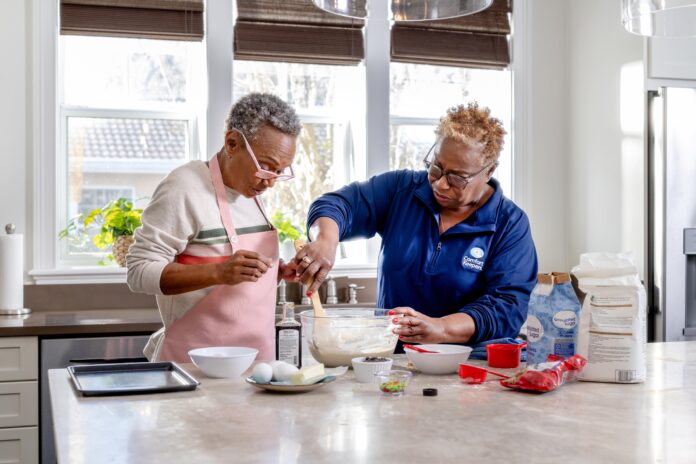

On a busy weekday, a daughter like Sarah may leave work thinking about dinner, her children’s schedules, and the mother she checks on every evening. What she may not realize is that her mother’s cabinets are thinner than they used to be, not because her mother forgot to shop, but because the choice between filling a prescription and filling a grocery cart has quietly become a monthly reality. That tension, playing out in kitchens across Bergen and Hudson counties, is the exact problem the Comfort Keepers Food Drive for Seniors was built to address. Officially launched on July 24, 2026, by the Secaucus and Rochelle Park regional offices of Comfort Keepers, the initiative is a community donation effort aimed squarely at elder malnutrition, hunger, and the isolation that so often travels alongside them.
The timing is not incidental. New Jersey’s senior population is aging faster than its infrastructure for feeding it. State health data show that in 2023 alone, roughly 203,000 New Jersey residents aged 60 and older were living in food insecure households, a figure equal to 8.8 percent of the state’s senior population. That single statistic ranked New Jersey nineteenth among all states for senior food insecurity, a surprising and uncomfortable distinction for a state that otherwise posts some of the lowest overall hunger rates in the country. Advocacy groups tracking the issue put the number even higher when older adults aged 50 and above are included, estimating that close to 340,000 residents in that broader age bracket struggle with consistent access to food, a share expected to grow substantially as New Jersey’s over-60 population climbs toward a quarter of the state by 2030. Local hunger relief organizations have also documented a troubling trend line, with the number of food insecure seniors in New Jersey rising by roughly 26 percent in a single recent year, nearly three times the growth rate seen among the general population. For a state accustomed to strong social safety nets, that kind of acceleration is a warning sign, and it is precisely the warning sign that prompted Comfort Keepers to act at the local level rather than wait on broader policy solutions.
The Secaucus and Rochelle Park offices designed the drive as a natural extension of Comfort Keepers’ core mission, which centers on non-medical in-home care for aging adults who want to remain independent and safe in their own homes. Rather than operate as a stand-alone charity event, the food drive functions as an embedded piece of the franchise’s ongoing outreach, one that treats nutrition as inseparable from the broader work of caregiving. The collection effort focuses specifically on non-perishable goods, chosen because they hold up well in home pantries and can be distributed efficiently to homebound seniors who may not have reliable transportation to a grocery store or a food pantry. The population the drive is built around is a familiar one to anyone who has worked in elder care: low-income seniors who, month after month, are forced to weigh nutritious groceries against essential prescriptions, utility bills, or rent, and who often quietly choose to go without food rather than fall behind on a medical need.
That trade-off carries consequences that extend well beyond an empty refrigerator. Clinical research on aging populations has repeatedly linked food insecurity to worse chronic disease outcomes, slower recovery from illness or surgery, higher rates of depression, and greater difficulty managing conditions like diabetes and hypertension that require stable, consistent nutrition. Malnutrition in older adults can also mimic or worsen cognitive symptoms, contributing to the kind of fatigue, confusion, and disorientation that families sometimes mistake for the early stages of dementia when the underlying cause is simply an empty stomach or chronic dehydration. Recognizing this overlap is central to how Comfort Keepers frames the drive. The organization has made a deliberate effort to educate adult children and family caregivers on the subtle, easily missed warning signs of senior hunger and dehydration, from unexplained weight loss and low energy to sudden shifts in mood or memory that families often attribute to age rather than nutrition. By naming these signs explicitly, the campaign gives families a practical tool for catching a problem early, before it escalates into a medical crisis or an emergency room visit.
There is also a quieter, less clinical goal running underneath the food collection itself, and that is connection. Many of the seniors this drive is designed to reach live alone, and isolation compounds every other risk factor tied to poor nutrition. A volunteer dropping off a bag of shelf-stable groceries is rarely just delivering food. More often, that visit becomes a check-in, a few minutes of conversation, and a small but meaningful signal to an isolated older adult that someone outside their immediate family is paying attention. For the adult children juggling careers, their own households, and the emotional weight of watching a parent age, the drive also offers something they rarely get enough of, which is a structured, low-effort way to plug into a support system that already exists rather than trying to solve their parent’s needs alone at eleven o’clock at night.
The launch also lands at a moment when Comfort Keepers has been drawing national recognition for the quality of its care. The organization was recently named to Newsweek’s America’s Best of the Best rankings in the home care category, an honor determined through an independent survey of more than 190,000 customer evaluations measuring trust, customer service, value, and overall experience. It marked the second consecutive year Comfort Keepers earned that distinction, a repeat recognition that speaks to consistency rather than a single strong year. That kind of validation matters in an industry where families are often choosing a caregiver during one of the most stressful and vulnerable periods of their lives, and it lends additional credibility to the Secaucus and Rochelle Park offices as they ask their communities to trust them with a mission as sensitive as feeding the elderly.
Geographically, the drive is structured around the two regional hubs that anchor it. The Secaucus and Rochelle Park offices are coordinating donation drop-off locations and awareness efforts across a footprint that includes Secaucus, Rochelle Park, Bayonne, Jersey City, and Hoboken, along with the surrounding towns that make up North Jersey’s densely populated Hudson and Bergen county corridor. That coverage area was chosen deliberately, reflecting both the concentration of aging residents in these communities and the logistical reality that urban and inner suburban seniors in this part of the state often face unique barriers to consistent nutrition, including limited access to full-service grocery stores, reliance on public transportation, and higher costs of living that eat into fixed incomes faster than in less densely populated parts of the state.
For families in these communities who want to get involved, the path is straightforward. Residents can locate a nearby donation barrel, request information on nutritional resources for an aging parent, or schedule a free in-home care consultation by reaching out directly to the Comfort Keepers Secaucus office or the Rochelle Park network. Those same contact points also serve as an entry point for anyone who suspects a loved one may already be experiencing the early, easy to miss signs of hunger or malnutrition and wants guidance on what to do next, whether that means connecting with SNAP benefits, congregate meal programs, or simply a caregiver trained to notice changes in appetite and energy during regular home visits.
What makes this drive worth watching is not just the pounds of canned goods it collects, though that matters, but the broader model it represents. It treats hunger among the elderly not as a separate social issue to be handled by food banks alone, but as a core part of what it means to care for an aging population, woven directly into the daily work of an in-home care provider that already sees these seniors face to face. In a state where nearly one in eleven seniors goes without consistent access to food, and where that number is climbing faster than almost anywhere else in the country, a hyperlocal effort rooted in two North Jersey offices may end up mattering far more than its size suggests. For a daughter like Sarah, checking in on her mother after a long day at work, that is precisely the kind of quiet, practical support that makes the difference between managing alone and having somewhere to turn.