
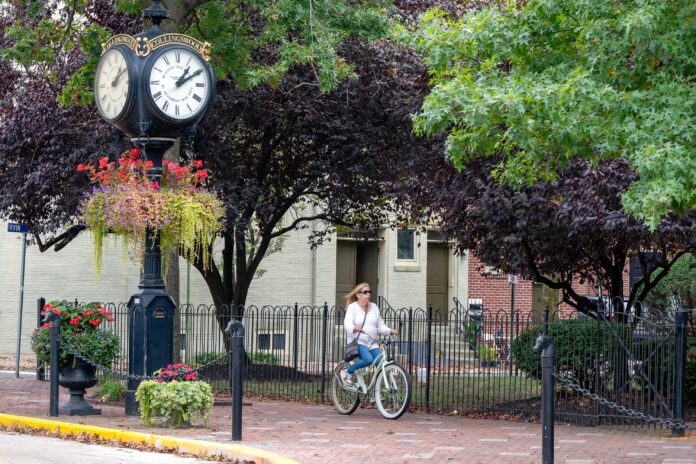

A grassroots petition drive has finished collecting signatures to put Collingswood’s dry town status before voters this November, leaving the borough with a hard, statutory deadline just days away to formally send the question to the county clerk.
Collingswood’s Century-Old Dry Town Status Just Cleared Its Biggest Hurdle Yet
The grassroots effort to finally bring alcohol sales to Collingswood has cleared its most important procedural hurdle. Organizers say they have collected enough signatures from registered borough voters to force a public referendum onto the November 2026 general election ballot, and municipal staff are now working through a clerical review of the submitted petition. That review sets up a genuinely tight final stretch, with the Board of Commissioners facing what borough solicitor Caitlin Harney Norcia has called a statutory drop dead date of August 21st to formally transmit the referendum language to the Camden County Clerk’s Office.
Two Separate Questions, Both Needed for a Full Bar
If commissioners meet the deadline and the county clerk certifies the question, Collingswood voters will actually be deciding two separate matters on their November ballot rather than one. The first question asks whether the borough should allow on premises sale and consumption of alcohol at bars and restaurants Monday through Saturday. The second, decided independently, asks specifically whether that same on premises sale and consumption should be permitted on Sundays. A restaurant hoping to offer full, standard bar service every day of the week needs both questions to pass, meaning a single “no” vote on either measure could leave Collingswood with only a partial rollback of its dry status rather than a complete one.
State law caps how many retail licenses a municipality can actually issue, tying the total directly to population at a rate of one license for every 3,000 residents. With Collingswood’s population sitting just under 14,000, that formula caps the borough at up to four total licenses, a mix of retail consumption licenses for restaurants and bars and a distribution license for a standalone liquor store, rather than an unlimited number of new bars opening across town. That scarcity is very much the point for local officials weighing the change, since a genuinely limited number of licenses means whichever businesses eventually secure one stand to gain a real competitive advantage in a downtown already known for its restaurant scene.
A Roadmap Already Written Next Door
Collingswood’s organizers have pointed directly to neighboring Haddon Heights as both inspiration and a practical preview of what comes next if the referendum succeeds. Haddon Heights voters approved a similar measure ending their own roughly 120 year old dry status, and the borough has since moved into the harder, more expensive part of the process, auctioning off its very first retail licenses. Early bidding minimums there ran between 200,000 and 400,000 dollars for a single license, a figure that underscores just how significant a financial hurdle these scarce, population capped licenses represent for smaller, independently owned restaurants rather than deep pocketed chains or investment groups.
Collingswood is not currently a fully dry town in the strictest sense. A 2012 state law aimed at supporting local business and agriculture already allows the borough’s restaurants to sell New Jersey produced wine, and a 2015 local ordinance opened the door specifically for microbreweries, a carve out currently used by exactly one business in town, the Raccoon Taproom, operated under a limited brewery license by Swedesboro Brewing Co. What Collingswood still lacks, and what this referendum is specifically designed to change, is the ability for a standard restaurant to pour a mixed drink or a bottle of hard liquor, or for any business in town to sell packaged liquor for off premises consumption.
Part of a Broader Shift Across South Jersey
Collingswood’s push fits within a genuinely notable statewide pattern. New Jersey still counts roughly 30 municipalities as dry towns, a number that has been steadily shrinking as more communities move to repeal decades or centuries old prohibition rules, often citing exactly the pressures Collingswood officials have raised, rising costs for local restaurants and a desire to capture new municipal revenue rather than watch it flow to neighboring towns that already permit alcohol sales. Should Collingswood’s commissioners meet the August 21st deadline and voters approve both ballot questions in November, the borough would move directly into drafting the local ordinances needed to regulate and eventually auction its own newly available licenses. Should voters reject the measure instead, state law imposes a genuinely steep consequence, barring Collingswood from holding another referendum on the same question for a full five years, a real deterrent that has likely shaped how carefully organizers built their signature drive in the first place.
















