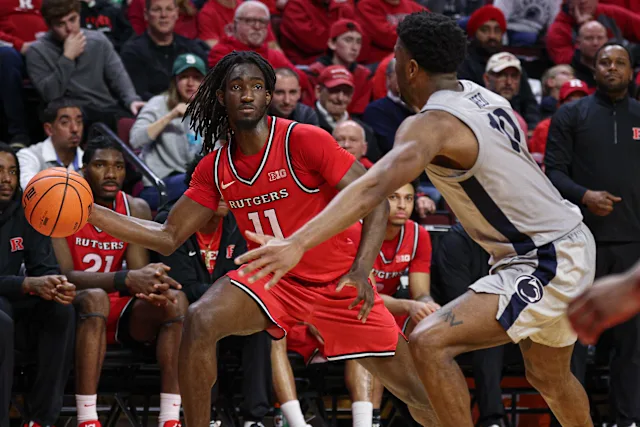

College basketball in New Jersey has entered a completely new era, and one transfer portal decision may end up becoming one of the defining moments in the modern history of the state’s in-state basketball rivalries. In a move that instantly sent shockwaves throughout the Garden State basketball community, former Rutgers freshman forward Chris Nwuli has officially committed to Seton Hall, becoming the first player ever to transfer directly between the two fierce in-state rivals during the modern transfer portal era.
For longtime followers of New Jersey college basketball, the significance of the move extends far beyond roster management or offseason player movement. This is not simply another transfer story in an era where player mobility has become increasingly common across NCAA athletics. Nwuli’s decision represents a symbolic crossing of one of the deepest competitive divides in the region’s sports culture — the emotionally charged rivalry between the Rutgers Scarlet Knights and the Seton Hall Pirates.
The Garden State Hardwood Classic has always carried a unique intensity because it reflects more than basketball alone. It is a rivalry rooted in geography, recruiting battles, alumni pride, conference identity, institutional culture, and the long-running competition for basketball relevance within one of America’s most talent-rich states. While national attention often focuses on major blue-blood programs elsewhere, New Jersey basketball insiders understand just how personal the Rutgers-Seton Hall rivalry truly is.
That is exactly why Chris Nwuli’s decision feels historic.
Until now, no player had directly crossed the divide between the two programs in the transfer portal era. Players transferring between rival programs has become increasingly normal across the national college basketball landscape, but certain rivalries still carry unwritten boundaries. Rutgers and Seton Hall represented one of those lines — until now.
The move becomes even more dramatic considering the broader context surrounding Rutgers’ offseason roster situation.
Of the seven Rutgers players eligible to transfer, Nwuli reportedly became the lone player actively targeted for retention by Scarlet Knights head coach Steve Pikiell who ultimately chose to leave the program. That detail changes the interpretation significantly. This was not simply a player buried deep on the bench seeking minutes elsewhere. Rutgers clearly viewed Nwuli as an important long-term developmental piece within the program’s future plans.
Instead, he will now continue his development directly under Seton Hall head coach Shaheen Holloway, immediately intensifying one of the most compelling storylines entering the next chapter of New Jersey college basketball.
Nwuli himself remains one of the more intriguing young prospects to emerge through the Garden State recruiting ecosystem in recent years despite originally hailing from North Las Vegas. Before arriving at Rutgers, he was widely regarded as one of the top prospects in the 2025 recruiting class, earning consensus four-star status and a national ranking inside ESPN’s Top 50 prospects nationally.
At 6-foot-8 with elite length, explosive vertical athleticism, defensive versatility, and rapidly developing offensive upside, Nwuli entered Rutgers as a long-term project possessing unusually high ceiling potential. Although his freshman statistics were modest — averaging 2.2 points and 1.5 rebounds across approximately 10 minutes per game in 29 appearances — the raw tools consistently stood out to evaluators and opposing coaches alike.
What made Nwuli especially intriguing was never statistical production alone. It was the energy profile he brought to the floor.
His game is built heavily around defensive intensity, physical disruption, transition athleticism, and multi-positional flexibility. Coaches and scouts have repeatedly praised his willingness to embrace physical defensive play, and Nwuli himself has openly discussed how much he values defensive aggression and tone-setting physicality. His comments about leaving practice with scratches and bloody arms because of his defensive commitment quickly became emblematic of the edge and mentality he brings to the court.
That identity fits almost perfectly into the system Shaheen Holloway continues constructing at Seton Hall.
Since arriving in South Orange, Holloway has aggressively shaped the Pirates around toughness, pressure defense, physicality, athletic versatility, and relentless competitive energy. His preferred style demands players capable of switching defensively, applying constant ball pressure, creating chaos in transition, and embracing highly physical full-court intensity.
Nwuli’s athletic profile aligns naturally with those demands.
In many ways, the transfer feels less like a random portal move and more like a stylistic recalibration where a young player may have identified a system potentially better suited to maximizing his specific strengths.
For Seton Hall, the addition could ultimately become enormously significant long term.
The Pirates are not simply acquiring another rotational forward. They are adding a highly regarded former Top 50 recruit with three years of remaining eligibility, major developmental upside, defensive versatility, and the type of athletic ceiling increasingly necessary to compete within the modern high-major college basketball landscape.
Players like Nwuli are exactly the type of developmental assets programs spend years attempting to secure through recruiting pipelines. Holloway now gets the opportunity to mold that talent directly while simultaneously delivering a symbolic recruiting and portal victory over Rutgers in the process.
The psychological component of the move matters just as much as the basketball itself.
Rivalries thrive on emotional storylines, and college sports have historically depended on those personal narratives to elevate games beyond simple standings implications. In an increasingly transient transfer portal era where roster continuity can feel temporary, rivalry intensity sometimes risks dilution. Moves like this restore some of that emotional volatility instantly.
The next Rutgers-Seton Hall matchup in Piscataway already carries a dramatically different atmosphere because of Nwuli’s presence alone.
Every defensive stop, dunk, transition block, rebound, and emotional interaction will now carry added weight because of the transfer storyline attached to him. Fans will circle his name immediately when schedules release. Social media conversations surrounding the rivalry have already intensified significantly because of the unprecedented nature of the move.
Complicating matters even further is Nwuli’s existing connection to Rutgers guard Lino Mark, his former AAU teammate who now remains on the opposite side of the rivalry divide. Those personal basketball relationships always add another layer of competitive intensity to college rivalries because players know each other’s tendencies, personalities, strengths, and histories long before the opening tip.
The broader implications for New Jersey basketball culture are equally fascinating.
The state continues producing high-level basketball talent at an extraordinary rate, and the competition between Rutgers and Seton Hall for regional recruiting relevance has intensified dramatically over the last decade. Rutgers’ rise under Steve Pikiell transformed the Scarlet Knights from a long-struggling Big Ten program into a nationally respected recruiting presence capable of landing elite prospects and competing for NCAA Tournament positioning.
Meanwhile, Seton Hall continues maintaining one of the deepest basketball traditions in the Northeast under a coaching lineage deeply connected to New Jersey’s basketball identity itself.
The rivalry between the programs increasingly reflects a larger battle for influence over the future of New Jersey basketball.
Who controls regional recruiting pipelines? Which program becomes the preferred destination for top in-state talent? Which coaching staff builds the stronger developmental culture? Which system better prepares players for professional opportunities? Those questions continue shaping every major recruiting cycle throughout the state.
Nwuli’s transfer now becomes part of that larger narrative.
It also reflects the dramatically evolving reality of modern college basketball itself.
The transfer portal has fundamentally altered roster construction nationwide. Player movement is no longer occasional. It is central to the sport’s operational structure. Coaches must now recruit their own rosters annually while simultaneously competing across the national portal marketplace. In that environment, emotional rivalries and historical boundaries increasingly collide with player empowerment, opportunity evaluation, and developmental fit considerations.
Yet even within that fluid environment, certain moves still feel shocking.
A direct Rutgers-to-Seton Hall transfer represents exactly that kind of moment because it touches something deeper within New Jersey sports identity. These programs do not merely coexist geographically. They compete culturally, emotionally, and symbolically for basketball relevance inside one of America’s most basketball-obsessed regions.
The move also reinforces how important defensive versatility and athletic length have become in modern roster-building strategies. Across college basketball, coaches increasingly prioritize players capable of guarding multiple positions, switching defensively, playing in transition, and contributing within aggressive pressure systems. Nwuli’s profile fits that trend perfectly, which helps explain why Seton Hall moved aggressively once he entered the portal.
For Rutgers, the departure creates additional pressure surrounding player development and retention narratives moving forward.
While roster turnover has become unavoidable nationally, losing a highly regarded freshman directly to a primary in-state rival inevitably creates scrutiny. Fans will immediately compare Nwuli’s developmental trajectory at Seton Hall against what might have occurred had he remained in Piscataway.
Every breakout performance he eventually delivers will now be viewed through that rivalry lens.
Still, this situation also highlights the extraordinary level of basketball talent and program quality currently operating within New Jersey itself.
Not long ago, direct movement between Rutgers and Seton Hall might not have carried this level of national intrigue because neither program consistently occupied major relevance simultaneously. Today, both schools command serious attention within the broader college basketball landscape, making portal decisions like this feel genuinely consequential.
That speaks volumes about the health of New Jersey college basketball overall.
For Explore New Jersey readers following the state’s rapidly evolving sports landscape, Chris Nwuli’s transfer represents far more than a single offseason roster transaction. It symbolizes the modern transformation of college athletics, the intensifying competition between New Jersey’s premier basketball programs, and the growing national significance of the Garden State’s college basketball culture.
It also guarantees one thing with absolute certainty: the next Rutgers-Seton Hall matchup just became one of the most anticipated games on New Jersey’s entire college basketball calendar.
Because now, for the first time in rivalry history, one player will step onto the floor carrying both sides of the rivalry inside his own basketball journey.