

New Jersey’s performing arts community has long stood at the forefront of socially conscious storytelling, emotionally charged movement, and boundary-pushing artistic expression, but few dance companies have consistently fused humanity, history, activism, and physical storytelling with the emotional precision of Carolyn Dorfman Dance. For decades, the celebrated New Jersey-based company has built a national reputation for creating dance works that move beyond abstraction and athleticism into something far more intimate and urgent: deeply human narratives centered on identity, resilience, memory, justice, and connection.
Now, that artistic mission has reached a new emotional peak with the world premiere of “The Power of One,” a sweeping and visually striking new production that officially debuted Thursday, May 14, 2026, at the Victoria Theater inside the New Jersey Performing Arts Center in Newark. Presented as a co-production with NJPAC, the ambitious evening-length program explored themes of courage, individual accountability, moral resistance, community tension, and collective action through a trio of emotionally layered contemporary dance works that critics and audiences alike are already describing as among the company’s most timely and resonant performances in recent memory.
At the center of the production was the highly anticipated premiere of “The Hero Within: The Story of Max Heller, Mary Mills and Miracles,” a narrative-driven dance work rooted in true historical events that connected deeply personal human experience to larger conversations surrounding displacement, immigration, compassion, survival, and moral courage during periods of political extremism.
The piece tells the story of Max Heller, a 19-year-old Jewish refugee who fled Nazi-occupied Vienna in 1938 and ultimately rebuilt his life in South Carolina after receiving life-changing support from Mary Mills, an American woman whose intervention helped alter the trajectory of his future forever. Heller would later rise to become both a successful businessman and eventually the mayor of Greenville, South Carolina, transforming a story of displacement and survival into one of reinvention, civic leadership, and enduring gratitude.
Yet what makes Carolyn Dorfman Dance’s interpretation so compelling is not simply the historical framework itself but the emotional clarity with which the story is translated through movement. Rather than relying heavily on theatrical exposition or literal reconstruction, the choreography channels emotional tension, fear, hope, displacement, rescue, and transformation directly into physical language. The result becomes less a historical reenactment and more an embodied emotional experience where movement itself carries the weight of memory and survival.
That approach has long defined Carolyn Dorfman’s artistic philosophy.
Unlike many contemporary dance productions that lean heavily toward conceptual ambiguity or abstract experimentation, Dorfman’s choreography prioritizes emotional accessibility, narrative clarity, and deeply recognizable human feeling. Her work consistently invites audiences into stories rather than distancing them through intellectual detachment. Every gesture, movement phrase, ensemble interaction, and physical relationship serves narrative and emotional purpose.
Critics attending the premiere repeatedly highlighted this commitment to clarity as one of the evening’s defining strengths. Reviewers noted that the choreography avoids unnecessary filler movement and instead maintains relentless focus on storytelling precision, emotional resonance, and thematic depth. In an era when many contemporary performance works intentionally obscure meaning, “The Power of One” instead embraces direct emotional communication without sacrificing artistic sophistication.
That accessibility is part of what continues making Carolyn Dorfman Dance one of New Jersey’s most respected and enduring cultural institutions.
The production’s title itself — “The Power of One” — establishes the evening’s central thematic tension between individual agency and larger collective structures. Throughout all three featured works, audiences are repeatedly confronted with questions surrounding moral courage, personal responsibility, conformity, resistance, and the impact one individual can have within broader systems of pressure, fear, or social expectation.
Nowhere is that tension more visually and physically powerful than in “Echad,” Dorfman’s internationally acclaimed signature masterpiece and one of the evening’s most talked-about works.
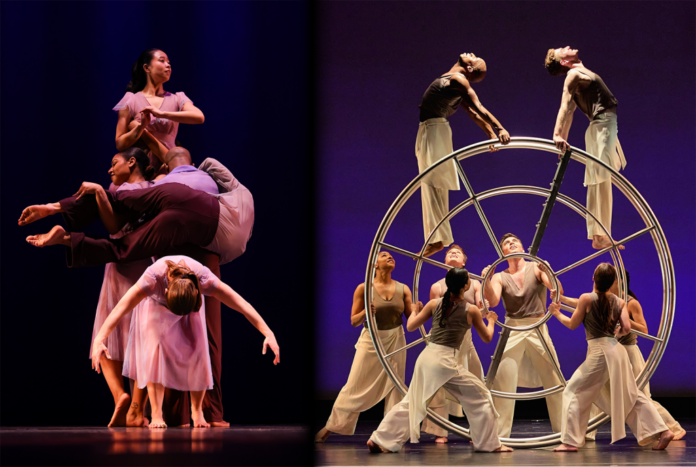
Originally created years earlier but described by many critics as uncannily timely in today’s social climate, “Echad” remains one of the most visually arresting pieces in modern American dance. The work explores the fragile balance between individuality and community through an intricate physical relationship involving eight dancers and an enormous 120-pound aluminum wheel that functions simultaneously as prop, structure, metaphor, obstacle, and symbolic force.
The wheel itself becomes almost another character within the performance.
Throughout the piece, dancers cling to it, move around it, resist it, support it, and struggle against it in ways that evoke everything from social systems and inherited traditions to institutional conformity and communal pressure. The choreography creates a constantly shifting dynamic where the group and the individual remain in tension with one another — dependent yet conflicted, connected yet restrictive.
Critics singled out dancer Charles Scheland in particular for a physically punishing and emotionally intense solo sequence involving the massive wheel. During the performance, Scheland wrestles with the structure in an effort to rescue a trapped dancer, transforming the act into a larger metaphor for individual defiance against overwhelming systems or inherited structures that communities sometimes cling to even when they become harmful or restrictive.
The visual impact of the piece reportedly stunned audiences throughout the premiere.
Reviewers described “Echad” as visually striking, emotionally gripping, and perhaps more socially relevant now than at any previous point in its performance history. The choreography’s exploration of conformity, resistance, identity, and collective behavior resonates especially strongly within a modern cultural environment increasingly shaped by political polarization, social anxiety, ideological conflict, and broader debates surrounding individual responsibility within larger systems.
The emotional and philosophical weight of “Echad” was then counterbalanced by the evening’s third featured work, “Now,” created by acclaimed guest choreographer Juel D. Lane.
Lane, recognized nationally as one of Dance Magazine’s celebrated “25 to Watch,” brought a dramatically different energy into the production through a fast-paced, highly physical, contemporary work that injected urgency, athleticism, and modern rhythmic intensity into the evening’s emotional arc. While Dorfman’s pieces often build through layered emotional storytelling and symbolic imagery, “Now” operates with explosive momentum and contemporary dynamism.
The work functions almost as a call to action.
Through rapid movement patterns, sharp physical phrasing, and emotionally charged ensemble interaction, “Now” challenges audiences to confront the immediacy of the present moment itself — to recognize how quickly life shifts, how fleeting defining moments can become, and how urgently individuals must respond to the realities unfolding around them.
That contrast between Dorfman’s narrative emotionality and Lane’s modern physical urgency created one of the evening’s most effective structural balances. Critics noted that “Now” brought a contemporary punch and kinetic intensity to the production while reinforcing the broader thematic exploration of action, accountability, and personal agency running throughout the entire program.
Together, the three works formed a remarkably cohesive artistic statement despite their stylistic differences.
The larger significance of “The Power of One” also extends beyond the stage itself because the production arrives during a period when performing arts organizations across New Jersey and nationally are increasingly embracing socially engaged programming tied directly to questions of identity, history, justice, migration, resilience, and civic responsibility.
Carolyn Dorfman Dance has occupied that intersection for years.
The company’s work consistently reflects a belief that dance is not merely aesthetic performance but a vehicle for empathy, dialogue, emotional understanding, and social reflection. Through movement, the company creates spaces where audiences confront difficult historical realities, emotional vulnerability, and collective human experience in ways that transcend language and political division.
That mission feels especially relevant inside Newark and NJPAC itself.
The New Jersey Performing Arts Center has steadily evolved into one of the state’s most important cultural anchors, not only presenting world-class performances but also fostering civic dialogue, educational engagement, and community-focused artistic programming. Hosting “The Power of One” inside the Victoria Theater reinforces NJPAC’s ongoing commitment to supporting works that connect art directly to contemporary social conversation.
The emotional impact of the premiere also appears likely to extend beyond Newark.
For audiences unable to attend the initial performances, portions of the production will continue later this season at the 2026 DUMBO Dance Festival in Brooklyn, where the prologue of “The Hero Within” is scheduled to appear from June 26 through June 28. That continuation ensures the production’s themes and artistic momentum will continue reaching broader regional audiences beyond New Jersey itself.
Yet despite future performances elsewhere, “The Power of One” remains profoundly connected to New Jersey’s cultural identity.
Carolyn Dorfman Dance represents one of the state’s most respected artistic institutions, and this latest production reinforces how deeply New Jersey’s arts community continues contributing to larger national conversations through performance, storytelling, and socially engaged creative work.
At a time when public discourse often feels fragmented, reactionary, and emotionally exhausted, productions like “The Power of One” remind audiences that art still possesses extraordinary power to humanize history, challenge complacency, illuminate moral complexity, and create emotional connection across deeply divided experiences.
Inside the Victoria Theater on opening night, movement became memory. Dance became testimony. Individual stories became collective reflection. And through choreography shaped by courage, vulnerability, resistance, and hope, Carolyn Dorfman Dance delivered one of the most emotionally resonant and artistically significant performances New Jersey’s performing arts scene has seen this year.
















