
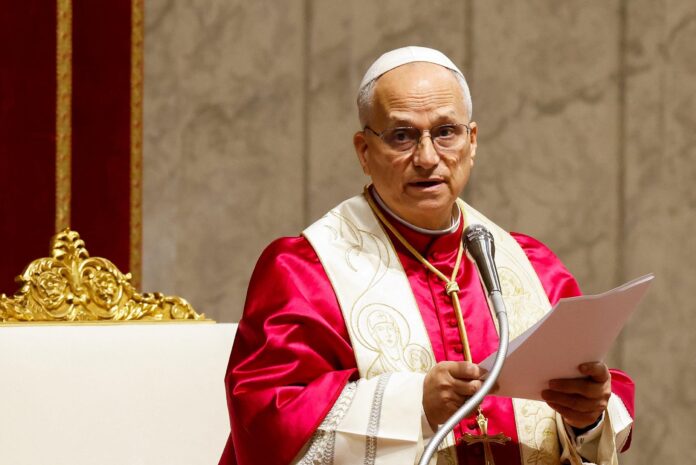

New Jersey has long operated as more than a geographic corridor between major media markets—it is a place where national narratives are often clarified, challenged, and reframed. On April 13, 2026, that dynamic was once again brought into sharp focus as Cardinal Joseph W. Tobin, Archbishop of Newark and the highest-ranking Catholic leader in the state, issued a direct and unambiguous condemnation of a viral AI-generated image shared by former President Donald Trump. The image, which depicted Trump in a Christ-like role performing what appeared to be a healing act, triggered immediate backlash across religious, political, and media communities, igniting a national conversation that sits squarely at the intersection of technology, faith, and representation.
Within the broader lens of Explore New Jersey’s coverage of cultural narratives and media influence across the film & tv landscape, this moment is not isolated. It reflects a rapidly evolving environment where digital imagery, synthetic media, and platform-driven amplification are reshaping how symbolic content is created, distributed, and interpreted. What distinguishes this particular incident is not simply its virality, but the institutional response it provoked—and the clarity with which that response was delivered from within New Jersey.
Cardinal Tobin’s statement characterized the image as a “graphic exploitation of sacred imagery,” emphasizing the degree to which it crossed established boundaries between political messaging and religious symbolism. His reaction was not framed as a partisan critique, but as a defense of theological integrity and the sanctity of imagery that holds profound meaning for millions of believers. The language was deliberate, measured, and precise, reflecting a broader concern about how emerging technologies are being deployed in ways that can distort or trivialize deeply held traditions.
The timing of the controversy amplified its impact. The image was shared during a period of heightened tension between Trump and Pope Leo XIV, the first American-born pontiff, whose leadership has already introduced a new dynamic into global religious discourse. Public criticism from Trump had targeted the Pope’s positions on international conflict and immigration, framing them as politically weak or strategically flawed. In response, members of the American Catholic hierarchy—including Cardinal Tobin—moved to clarify the distinction between spiritual leadership and political governance.
This distinction became a central theme during a nationally broadcast appearance on 60 Minutes just one day prior to the image controversy. Cardinal Tobin, alongside Cardinals Blase Cupich and Robert McElroy, articulated a consistent message: the role of the Pope is not to operate as a political strategist, but as a moral and pastoral voice addressing global human concerns. Tobin’s description of Pope Leo XIV as “the right man” for the current moment underscored a belief that leadership in this context must be evaluated through a different lens—one grounded in ethical guidance rather than policy execution.
The conversation extended beyond abstract principles into specific policy critiques, particularly around immigration enforcement practices and the broader implications of international conflict. These positions, while aligned with longstanding Vatican perspectives, have taken on renewed visibility given the Pope’s American origin and the current geopolitical climate. The result is a layered dialogue in which religious leadership, political authority, and public perception intersect in increasingly complex ways.
The AI-generated image introduced a new dimension to that dialogue. Unlike traditional political messaging, which relies on language and rhetoric, this form of content operates visually and symbolically, often bypassing analytical filters in favor of immediate emotional response. The depiction of a public figure in a Christ-like role carries inherent theological implications, regardless of the creator’s stated intent. This is precisely the space in which Cardinal Tobin’s critique is situated—not as a reaction to political positioning, but as a response to the misuse of imagery that holds sacred significance.
Trump’s subsequent explanation added another layer of complexity. In remarks delivered later that day, he suggested that he did not interpret the image as religious, instead framing it as a representation of healing or service, akin to that of a medical professional. He stated that he believed the image portrayed him “as a doctor” or in connection with humanitarian symbolism, and maintained that his actions were intended to reflect his broader narrative of improving conditions for others. The image was ultimately removed approximately 13 hours after it was posted, though no formal apology was issued.
The response from within political circles was notably varied. While some figures defended the President’s actions as misinterpreted or exaggerated, others—including voices typically aligned with his positions—expressed discomfort with the imagery, describing it in terms that echoed the concerns raised by religious leaders. This divergence highlights the broader challenge of navigating symbolic content in an era where boundaries between satire, messaging, and representation are increasingly fluid.
Pope Leo XIV’s own response, delivered during an international trip, reinforced the distinction between political discourse and spiritual mission. His remarks emphasized a lack of concern for political criticism, redirecting attention toward the core principles of his role. By framing his work as fundamentally rooted in the message of the Gospel rather than political alignment, he underscored the conceptual divide that has become central to this unfolding narrative.
Within New Jersey, Cardinal Tobin’s position carries particular weight. As Archbishop of Newark, his influence extends across one of the most diverse and densely populated Catholic communities in the country. His decision to address the issue directly reflects both the significance of the moment and the responsibility of leadership within that context. It also reinforces New Jersey’s role as a place where national conversations are not only observed, but actively shaped.
From a media perspective, this controversy illustrates the accelerating convergence of technology and storytelling. AI-generated imagery is no longer confined to experimental spaces—it is now embedded within mainstream communication channels, capable of reaching global audiences within minutes. The implications for film, television, and digital content creation are substantial, as the tools used to craft narratives become more sophisticated and more accessible.
At the same time, the incident raises fundamental questions about authorship, intent, and accountability. When an image is created through artificial intelligence, the lines between creator and distributor can become blurred. Yet the impact of that image—particularly when it engages with culturally or religiously sensitive material—remains very real. This tension is likely to define the next phase of media evolution, as institutions, creators, and audiences work to establish new frameworks for interpretation and responsibility.
For Explore New Jersey, this moment aligns with a broader commitment to examining how media and culture intersect across disciplines. Whether through film, television, or emerging digital platforms, the stories that shape public perception are increasingly complex, requiring analysis that goes beyond surface-level interpretation. The events of April 13 serve as a case study in how quickly those narratives can develop—and how essential it is to approach them with clarity, context, and precision.
As the conversation continues to unfold, one element remains constant: the role of New Jersey as a place where these issues are engaged with seriousness and depth. From the statements issued in Newark to the national platforms that amplify them, the state is not on the periphery of this dialogue. It is at its center, contributing perspective, leadership, and a clear articulation of the values at stake in an era defined by rapid technological and cultural change.
















