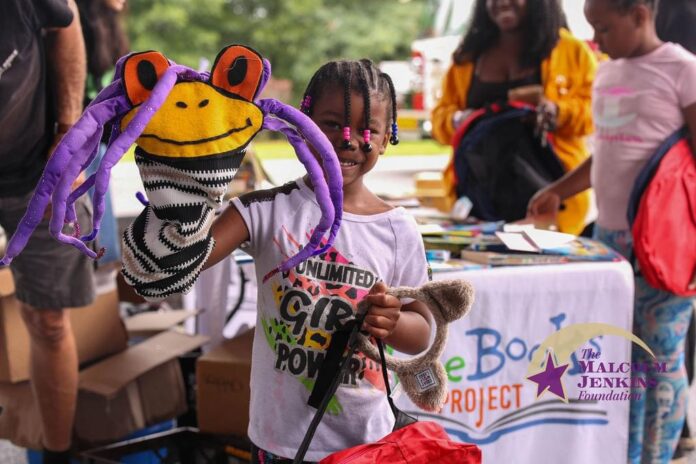

In a world increasingly dominated by algorithms, digital distraction, and social fragmentation, one South Jersey initiative continues proving that something as simple as handing someone a free book can still change lives, create human connection, and transform public space into a source of hope, dignity, and opportunity. This week in Camden, that mission reached a remarkable milestone as the Free Books Project officially celebrated its 1,500th pop-up event with a major community block party outside Camden City Hall — a moment that represented far more than a number.
For founder Tom Martin of Haddon Township, the achievement marked the continuation of a grassroots movement built not around corporate funding campaigns or massive institutional infrastructure, but around direct human interaction, public accessibility, literacy outreach, and a deeply held belief that books still matter in powerful ways within communities too often overlooked by traditional cultural investment.
What began as a simple effort to distribute free reading materials in high-foot-traffic, low-income neighborhoods has steadily evolved into one of South Jersey’s most visible and emotionally resonant community literacy initiatives. Through 1,500 separate public pop-up events, Martin and the Free Books Project have quietly created a mobile network of reading access points stretching across urban corridors, transit hubs, public gathering spaces, neighborhoods, and community centers where books are placed directly into the hands of residents without barriers, cost, or expectation.
That work was celebrated Tuesday afternoon in Camden as residents, community advocates, elected officials, and supporters gathered outside City Hall to recognize not only the organization’s milestone but also the larger social impact the project has had throughout the region.
The atmosphere surrounding the celebration reflected the exact spirit that has defined the Free Books Project from the beginning. The block party transformed civic space into a vibrant public gathering focused on literacy, accessibility, and community engagement rather than transactional programming or institutional formality. Books circulated freely among residents. Conversations unfolded between strangers. Families explored tables of reading materials. Community leaders recognized Martin’s efforts publicly. And throughout the event, the deeper message remained clear: literacy is not a luxury, and access to books should never depend on income level or zip code.
That principle sits at the center of the Free Books Project’s mission.
For years, Martin has intentionally targeted locations often overlooked by traditional literary outreach efforts — areas where bookstores may be limited, educational inequities remain visible, and residents frequently face economic barriers that make book ownership far less accessible than many people realize. Instead of waiting for communities to come to libraries or formal literacy institutions, the project brings books directly into public spaces where people already gather naturally.
Transit stops, parks, downtown corridors, sidewalks, shelters, neighborhoods, and busy community intersections become temporary literary spaces where books are distributed freely and casually without judgment or bureaucracy. The approach strips away many of the invisible barriers that often discourage engagement with traditional educational or literary systems.
That accessibility has become increasingly important throughout New Jersey as conversations surrounding literacy gaps, educational equity, childhood reading development, and community investment continue expanding statewide. While New Jersey remains home to some of the strongest educational institutions in the country, disparities in access to books and literacy resources still exist heavily across income lines and geographic regions.
The Free Books Project addresses those gaps not through abstract policy debate but through direct action.
At each pop-up, books are placed directly into the public sphere in a way that feels approachable, welcoming, and community-centered rather than institutional. Residents can browse casually, take what interests them, return later, or simply stop to talk. The interactions themselves often become as meaningful as the books being distributed.
That human connection has become one of the defining elements of the project’s long-term success.
In many ways, the initiative functions as both a literacy movement and a social engagement project simultaneously. Martin’s work is rooted not only in distributing reading materials but also in creating moments of visibility, dignity, conversation, and public interaction within spaces that often receive attention primarily through narratives centered around poverty, crime, disinvestment, or political conflict.
Instead, the Free Books Project reframes public space through literature, curiosity, and accessibility.
The choice to celebrate the 1,500th pop-up in Camden carried particularly strong symbolic significance. Camden has long stood at the center of broader conversations surrounding urban revitalization, educational opportunity, economic inequality, and community reinvestment throughout New Jersey. While the city has experienced substantial redevelopment and institutional growth in recent years, many residents continue confronting longstanding socioeconomic challenges tied to generational inequities and resource disparities.
Initiatives like the Free Books Project therefore carry importance far beyond the books themselves because they reinforce the idea that cultural investment, literacy access, and community engagement belong within every neighborhood regardless of economic status.
The public recognition Martin received from elected officials during the celebration also reflects growing acknowledgment that grassroots civic initiatives often accomplish forms of community-building traditional institutions struggle to replicate. Small-scale, consistent, hyperlocal outreach efforts frequently generate deeper trust and stronger interpersonal relationships precisely because they operate outside formal systems and engage people directly within their daily environments.
Over 1,500 events, Martin has created a visible and recognizable presence throughout South Jersey communities. Residents know the tables of books. Children recognize the project. Families return repeatedly. Conversations develop organically around reading, storytelling, education, and personal connection. In a time when many public interactions have become increasingly digitized and transactional, the simplicity of offering someone a free book face-to-face carries unusual emotional power.
The milestone also highlights the enduring importance of physical books themselves in modern community life. Despite the dominance of digital media and online content ecosystems, books continue serving as uniquely powerful tools for education, imagination, self-discovery, emotional reflection, and intellectual development. Physical books in particular remain deeply significant because they are durable, shareable, screen-free, and accessible without technology or subscription barriers.
For many children encountering the Free Books Project, the experience may represent one of their first opportunities to personally select and own books entirely on their own terms. That sense of ownership and autonomy can profoundly influence relationships with reading and learning long-term.
The project’s success also reflects broader cultural shifts occurring throughout New Jersey’s literary and community engagement landscape. Across the state, independent literacy programs, community book festivals, neighborhood reading initiatives, mobile libraries, and grassroots educational projects have experienced growing visibility as communities increasingly recognize literacy as a foundational component of long-term social and economic health.
Books function not merely as educational tools but also as instruments of empowerment, imagination, mobility, and civic participation. Communities with stronger literacy access generally experience stronger educational outcomes, broader civic engagement, and expanded long-term opportunity structures. Projects like Martin’s contribute directly to that ecosystem in ways that may not always be immediately measurable but remain deeply impactful over time.
The emotional resonance surrounding the Camden block party also came from the sheer persistence represented by 1,500 separate events. Grassroots community initiatives often struggle with sustainability because they rely heavily on consistency, volunteer energy, logistical coordination, donations, and personal dedication over long periods of time. Reaching 1,500 pop-ups reflects not only organizational commitment but also extraordinary personal endurance and belief in the mission itself.
That consistency matters because trust within communities is built over time through repeated presence rather than isolated moments of visibility. The Free Books Project has become woven into the fabric of many South Jersey neighborhoods precisely because residents have seen it return again and again over the years.
As the celebration unfolded outside Camden City Hall, the broader meaning of the milestone became increasingly clear. This was not simply a recognition ceremony for a nonprofit initiative. It was a public acknowledgment of literacy as community infrastructure, books as tools of dignity and empowerment, and public outreach as a form of civic care.
In an age increasingly defined by polarization, economic anxiety, technological overload, and social isolation, the image of neighbors gathering outdoors around tables of free books carried unusual symbolic weight. It represented optimism rooted not in grand political rhetoric but in small, repeated acts of accessibility and generosity capable of strengthening communities one interaction at a time.
The Free Books Project’s 1,500th pop-up ultimately stands as proof that grassroots efforts can still create meaningful cultural impact even without massive budgets or institutional power. Sometimes transforming a community begins not with billion-dollar development projects or sweeping policy shifts, but with something far simpler: showing up consistently, opening books across a folding table, and inviting people to take one home.