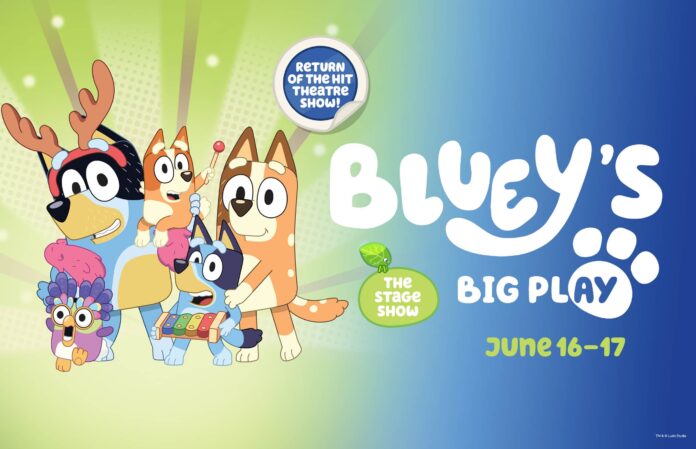

Children’s entertainment has undergone a profound transformation over the last decade as modern families increasingly search for experiences capable of bringing multiple generations together in ways that feel emotionally meaningful rather than simply distracting. In an era dominated by streaming platforms, tablets, short-form content, and fragmented digital viewing habits, only a small number of children’s properties have managed to transcend the screen itself and evolve into genuine cultural phenomena capable of resonating equally with kids, parents, educators, and even theater audiences.
Few modern franchises have achieved that balance as successfully as Bluey.
What began as an animated Australian children’s television series has rapidly evolved into one of the most beloved family entertainment brands in the world, celebrated not only for its humor and visual charm but for its emotional intelligence, warmth, creativity, and unusually sophisticated understanding of family dynamics, childhood imagination, and modern parenting. Now, that phenomenon continues expanding into the live performance world through Bluey’s Big Play, the theatrical adaptation bringing Bluey, Bingo, Bandit, and Chilli directly onto the stage in a fully immersive live production that is quickly becoming one of the most sought-after family theater experiences touring across the country.
For New Jersey audiences, the arrival of Bluey’s Big Play represents something much larger than a standard children’s stage production.
It reflects the continuing evolution of live family entertainment itself — a growing movement toward theatrical experiences that prioritize emotional storytelling, interactivity, music, imagination, and shared family connection over passive spectacle alone. Across the Garden State, theaters and performing arts venues are increasingly recognizing that modern audiences want productions capable of engaging children without alienating adults, creating experiences where entire families can participate together rather than simply accompanying younger viewers.
Bluey’s Big Play appears uniquely positioned to succeed within that environment.
At its core, the production adapts the emotional spirit and playful energy of the Emmy Award-winning television series into a live theatrical setting built around an original story created by Bluey mastermind Joe Brumm himself, alongside new music composed by series composer Joff Bush. That direct creative continuity matters enormously because one of the defining strengths of the Bluey franchise has always been its authenticity.
Unlike many children’s entertainment properties that rely heavily on overstimulation, frenetic pacing, or simplistic storytelling, Bluey has built its global reputation through emotional nuance, observational humor, imaginative play, and remarkably grounded portrayals of everyday family life. The series consistently treats childhood not as chaos to be controlled but as imagination to be celebrated.
That philosophy carries directly into the live production.
The premise of Bluey’s Big Play immediately captures the emotional simplicity and relatability that has made the franchise resonate so strongly worldwide. When Dad — Bandit — decides he needs a little time to relax on the bean bag, Bluey and Bingo have entirely different plans. What follows becomes an escalating sequence of games, imagination, humor, and playful chaos as the sisters deploy every ounce of creativity they possess to pull their father back into active playtime.
It is a deceptively simple narrative framework.
Yet that simplicity is precisely what allows Bluey to work so effectively both on television and on stage. The stories are never truly about grand adventures or complicated plot mechanics. They are about relationships, attention, emotional presence, family connection, and the tiny moments of imagination that shape childhood itself.
That emotional accessibility has become one of the franchise’s defining cultural strengths.
Parents watching Bluey often find themselves emotionally affected as deeply as their children because the show understands the realities of modern family life with unusual honesty. It recognizes parental exhaustion, emotional vulnerability, time pressures, and the complicated balance between adulthood responsibilities and the desire to remain fully present for children. Simultaneously, it celebrates childhood imagination without ever talking down to young audiences.
Translating that emotional tone into live theater creates enormous potential.
Theater, perhaps more than any other entertainment form, thrives on emotional immediacy and collective experience. Watching Bluey and Bingo leap from the screen into physical space allows children to experience beloved characters as tangible, living presences while allowing parents to share directly in that emotional excitement in real time.
That shared participation is becoming increasingly valuable in modern entertainment culture.
In many ways, productions like Bluey’s Big Play function as antidotes to isolated digital viewing habits. Rather than consuming content individually on personal devices, families gather together inside a shared physical environment where laughter, music, storytelling, and emotional reactions unfold collectively. The communal energy of live performance transforms familiar characters into something newly immersive and memorable.
The production’s emphasis on games and imaginative play further strengthens that effect.
One of Bluey’s greatest accomplishments has been reminding modern audiences how powerful imaginative play can be for both children and adults. The show consistently portrays ordinary household objects, routines, and spaces becoming gateways to creativity and adventure through sheer imagination. That sensibility naturally aligns with theater itself, an art form fundamentally built around transforming physical space through storytelling and audience belief.
Live theater therefore becomes an ideal medium for Bluey’s imaginative world.
The addition of original music by Joff Bush also significantly enhances the production’s emotional potential. Music has always been central to Bluey’s emotional identity, helping elevate scenes from simple comedy into moments of surprising tenderness, joy, nostalgia, or reflection. Bush’s compositions often operate almost cinematically within the series, giving emotional weight to everyday family interactions in ways that resonate deeply with audiences across generations.
On stage, that musical dimension becomes even more powerful.
Live music introduces emotional texture, pacing, and theatrical rhythm capable of intensifying audience immersion while reinforcing the warmth and playfulness central to the Bluey universe. For younger audiences especially, music often functions as an entry point into emotional engagement, helping children connect physically and emotionally with the performance unfolding in front of them.
Importantly, Bluey’s Big Play also arrives during a particularly strong period for family-focused live entertainment throughout New Jersey.
The state’s theater ecosystem has increasingly expanded its family programming in recent years as venues recognize growing demand for high-quality all-ages productions capable of drawing broad demographic audiences. Family theater has evolved far beyond simplistic children’s programming into a sophisticated sector blending Broadway touring productions, immersive theatrical experiences, interactive storytelling, educational engagement, and large-scale franchise adaptations.
New Jersey’s performing arts venues are now competing aggressively to attract these productions because they generate multi-generational attendance and help cultivate future theater audiences.
That long-term audience development matters enormously for the sustainability of live performance itself. Productions like Bluey’s Big Play often serve as children’s first exposure to live theater, shaping how they emotionally associate with performance spaces for years to come. A positive first theatrical experience can create lifelong engagement with performing arts culture.
The emotional sincerity of Bluey may make it particularly effective in that role.
Unlike louder, more commercially aggressive children’s franchises, Bluey consistently prioritizes emotional intelligence, empathy, creativity, humor, and relational warmth. Those qualities align naturally with theater’s strongest traditions — storytelling that brings audiences together emotionally while encouraging imagination and connection.
The production’s emphasis on “real life” also feels increasingly significant.
In an entertainment culture dominated by fantasy universes, superheroes, CGI spectacle, and constant sensory escalation, Bluey succeeds largely because it remains grounded in recognizable emotional reality. Parents and children recognize themselves within these stories. They recognize exhaustion, playfulness, sibling dynamics, imagination, frustration, joy, and affection.
That emotional familiarity creates unusually deep audience attachment.
When families attend Bluey’s Big Play, they are not simply seeing fictional characters brought to life. They are stepping into a world already emotionally connected to their own homes and daily lives. The live production extends that emotional intimacy into physical space, creating a theater experience that feels personal rather than distant.
As Bluey’s Big Play continues touring and drawing massive audiences nationwide, its growing success also reveals something important about the future of family entertainment more broadly.
Audiences increasingly crave sincerity.
They want humor without cynicism, emotional depth without manipulation, and entertainment capable of genuinely connecting generations rather than segmenting them. Bluey has succeeded because it understands those desires better than most modern franchises.
Now, through live theater, that emotional connection becomes even more immediate.
For New Jersey families preparing to experience Bluey’s Big Play, the production offers far more than a simple stage adaptation of a popular television series. It offers an opportunity to share laughter, music, imagination, and emotional connection together inside a live communal space where storytelling unfolds in real time.
And in a world increasingly dominated by isolated screens and fragmented attention, that kind of shared experience may ultimately be the most powerful form of family entertainment of all.