
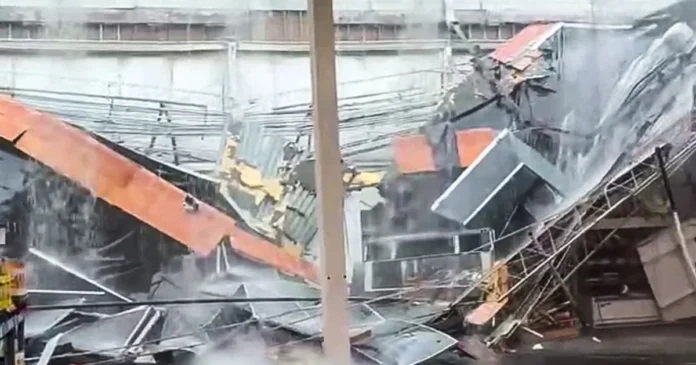

A partial roof collapse at the BJ’s Wholesale Club on Route 35 in Oakhurst — the commercial district within Ocean Township, Monmouth County — sent ceiling tiles, structural debris, and a wall of accumulated rainwater crashing into the store’s interior at approximately 11:16 a.m. on Monday, July 6, as the severe weather system that had been hammering New Jersey since the Fourth of July weekend delivered its most damaging single event of the extended storm sequence. The collapse affected roughly 20 percent of the warehouse-style building’s flat roof, concentrated over the bakery and west sections of the store. Twenty-seven people — a combination of customers and staff — were inside when the structure gave way. All of them evacuated without fatalities. Two individuals were briefly entrapped when heavy store displays shifted under the initial collapse, but freed themselves and were able to exit under their own power. No deaths or serious injuries were reported from what was, by the visual record of the security footage that circulated nationally within hours of the event, among the more dramatic structural failures of a civilian building during the weekend’s storm sequence.
The physical mechanism behind the collapse is not difficult to explain in structural terms. Warehouse and big-box retail buildings typically feature large, flat or low-slope roofing systems designed for drainage within a specific design threshold of rainfall accumulation. When a storm deposits rainfall faster than that drainage capacity can handle, water ponds on the surface. The weight of standing water on a flat commercial roof accumulates with the density of water — approximately 62 pounds per cubic foot — which means that a modest depth of standing water across several thousand square feet of roof surface represents a load burden of many tons that the original structural engineering did not anticipate as a sustained condition.
The Oakhurst storm deposited up to six inches of rainfall across Monmouth County within a 24-hour period, a total that the accumulated weight of pooled water on the BJ’s roof translated into the structural overload that produced the Monday morning collapse. The video documentation of the moment shows the roof section over the bakery department descending rapidly, releasing the standing water and debris into the shopping aisles in a single concentrated event rather than a gradual deterioration.
Ocean Township Police Chief Michael Sorrentino confirmed the specific details of the evacuation and the two brief entrapments in public statements following the event. The security footage that New York Post and ABC News obtained and published shows the moment most immediately and most viscerally: a senior shopper browsing the bakery section — standing within feet of the point where the roof would give way seconds later — turned and moved clear of the collapse zone before the ceiling section fully descended, a sequence of proximity and timing that the media coverage has characterized as a near-miss measured in inches. The footage of the moment circulated rapidly on social media platforms throughout Monday afternoon, the combination of its documentary completeness and the visible human close-call making it the kind of event video that news organizations and social media audiences simultaneously process as both a dramatic story and a genuine accounting of what structural failure in a civilian commercial space looks like in real time.
The emergency response reflected both the severity of the structural damage and the uncertainty that any partial building collapse creates about whether all occupants are accounted for. The Monmouth County Sheriff’s Office and New Jersey Urban Search and Rescue deployed interior drones and specialized K-9 search units to conduct primary and secondary sweeps of the debris field, verifying that no one remained trapped or unaccounted for in the sections of the building affected by the collapse. The deployment of search and rescue resources of this scale reflects the standard protocol for structural collapse events: visual accounting of the people known to be in a building at the time of a collapse is not sufficient confirmation that the debris field is clear, and the K-9 and drone sweep provides the systematic verification that the incident command cannot otherwise obtain in a compromised structural environment. That sweep confirmed no additional victims.
The BJ’s Wholesale Club location at 1200 Route 35 in Oakhurst remains closed indefinitely pending evaluation by structural engineers, who will assess the integrity of the remaining roof sections, the load-bearing walls, and the internal structure of the building before any determination about reopening or remediation can be made. The structural evaluation process for a partial commercial building collapse is not rapid — it requires engineering surveys, documentation of the failure point, assessment of the undamaged sections’ continued structural adequacy, and in most cases regulatory review before any reopening authorization can be issued. BJ’s has not announced a timeline for the evaluation or provided any public statement regarding the affected location’s eventual status.
Monmouth County Sheriff Shaun Golden issued a public advisory urging drivers to avoid Route 35, Park Avenue, and Deal Road in the Oakhurst area in the immediate aftermath of the collapse and the accompanying flooding. The weather system that produced the BJ’s collapse is the same extended storm sequence that Governor Sherrill addressed at her July 4 and July 5 emergency briefings, which had already produced 22 suspected heat-related deaths across New Jersey during the preceding days, four suspended NJ Transit rail lines, over 120,000 homes without power, and a flood watch covering 17 counties. Monday’s collapse added a structural failure to that growing list of the weekend’s documented physical consequences, and occurred as the storm system was delivering additional rainfall on top of ground that was already saturated from multiple prior storm rounds.
The broader context of the Oakhurst collapse — a building failure during a storm event whose specific rainfall totals exceeded the drainage assumptions embedded in the structure’s design — is consistent with the pattern of infrastructure stress events that extended severe weather sequences produce across densely built environments. New Jersey’s stock of large-format retail buildings, many of which were constructed during the big-box expansion of the 1980s and 1990s, includes a significant number of flat-roof warehouse structures whose drainage systems were designed to handle historical rainfall rates that the current regional climate is producing at increasing frequency and intensity. The BJ’s roof collapse in Oakhurst on July 6 is one data point in that broader pattern, resolved without loss of life through a combination of the speed of the evacuation, the narrow margin of the near-misses captured on camera, and what Chief Sorrentino and Sheriff Golden characterized as fortunate timing in the movement of the people inside the building in the seconds before the collapse.
















