
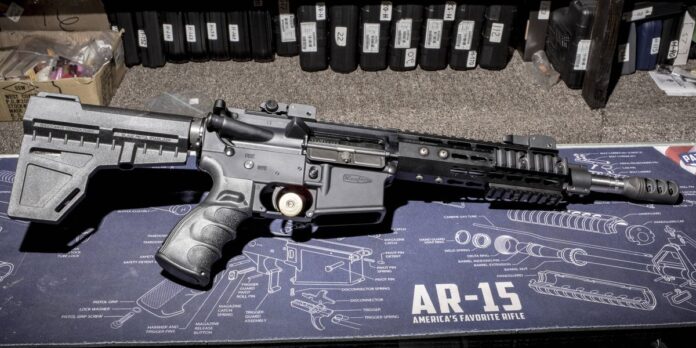

The Third U.S. Circuit Court of Appeals issued a genuinely landmark ruling on Friday, July 17, 2026, striking down New Jersey’s decades old bans on semi-automatic rifles, including AR-15 style firearms, and large capacity magazines holding more than ten rounds. The 10 to 5 en banc decision marks the first time any federal appeals court has invalidated a state level assault weapons ban, placing New Jersey’s firearms laws at the center of a genuinely significant constitutional moment for Second Amendment jurisprudence nationally.
Writing for the majority, U.S. Circuit Judge Arianna Freeman held that the text of the Second Amendment protects commonly owned semi-automatic rifles and standard capacity magazines specifically because they are in common use for lawful purposes, a legal standard drawn directly from existing Supreme Court precedent. In reaching that conclusion, the court applied the framework the U.S. Supreme Court established in New York State Rifle and Pistol Association v. Bruen, which requires modern firearm restrictions to align with America’s historical tradition of firearm regulation dating back to the founding era. Under that Bruen framework, the majority found that New Jersey failed to identify sufficient historical analogues from that regulatory tradition to justify the restrictions the state first enacted in 1990, leading the court to conclude the bans could not survive constitutional scrutiny under the current legal standard.
The scope of Friday’s decision extends considerably further than an earlier district court ruling issued in July 2024, which had struck down New Jersey’s ban only as it applied specifically to Colt manufactured AR-15 rifles. Friday’s appeals court decision goes well beyond that narrower holding, striking down the prohibition on all types of semi-automatic rifles covered under the state’s original ban and lifting the ten round magazine capacity limit entirely, giving the ruling a genuinely sweeping practical effect across New Jersey’s broader firearms regulatory framework.
The decision did not come without significant internal disagreement on the court itself. Five dissenting judges argued that the firearms at issue represent uniquely dangerous, military style weapons that states retain a legitimate interest in regulating, and they specifically noted that the majority’s reasoning breaks from how other federal appeals courts have approached similar restrictions in recent years. That dissent points directly to a genuine and immediate circuit split, since an Illinois federal appeals court issued a ruling just one week earlier upholding a broadly similar semi-automatic weapons ban in that state, meaning two different federal circuits have now reached opposite conclusions on what is functionally the same constitutional question.
That split arrives at a particularly consequential moment, since the U.S. Supreme Court is already preparing to review similar firearm bans originating in Illinois and Connecticut during its next term. With the Third Circuit’s ruling now creating a direct conflict with at least one other federal appeals court on nearly identical legal questions, the stage appears increasingly set for the Supreme Court to deliver a nationwide constitutional resolution on assault weapons and large capacity magazine restrictions, an outcome that would carry direct consequences for gun regulation far beyond New Jersey’s own borders.
For now, Friday’s ruling represents a genuinely significant shift in New Jersey’s firearms regulatory landscape, and it is likely to be appealed further given both the scale of its practical impact and the sharp five judge dissent accompanying the majority’s decision. Whether this ruling ultimately stands, gets narrowed, or is eventually overturned will depend heavily on how the broader legal landscape develops as the Supreme Court takes up related cases from other states in the coming term, making this decision one chapter in what remains a genuinely unresolved and actively evolving area of constitutional law.
















