
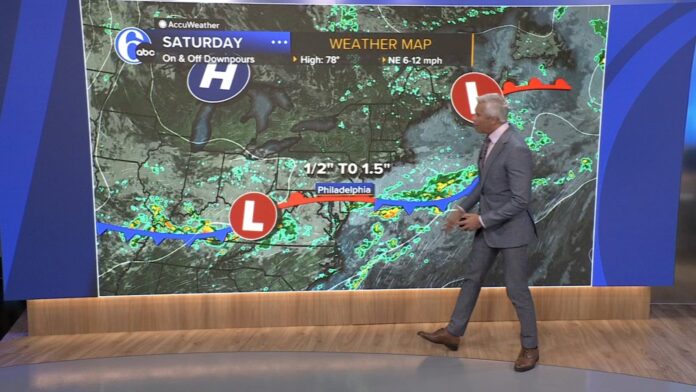

New Jersey is waking up this Saturday morning to gray skies, steady rain, and the kind of thick, swampy air that makes the calendar feel dishonest. It is late June, the humidity is sitting at 89 percent, and the temperature of 70°F feels considerably warmer than that — a “feels like” reading of 76°F that will only climb as the day progresses. A light southwest wind at just 2 mph is not doing anyone any favors. But as uncomfortable as this weekend’s weather is shaping up to be, it is the week ahead that has forecasters genuinely concerned. New Jersey is on a direct collision course with an extreme heatwave, and the numbers being discussed for next week are not routine summer heat. They are the kind of temperatures that demand preparation, precaution, and real awareness of who in your community is most vulnerable.
Before we get there, let’s get through the weekend first — because there is meaningful weather to account for before the heat machine switches on.
Daily Forecast
| Day | Sky Condition | Temperature | Chance of Rain |
|---|---|---|---|
| Sat, Jun 27 | 76°F / 67°F | 48% | |
| Sun, Jun 28 | 80°F / 63°F | 35% | |
| Mon, Jun 29 | 86°F / 64°F | 15% | |
| Tue, Jun 30 | 89°F / 67°F | 10% | |
| Wed, Jul 1 | 97°F / 74°F | 15% | |
| Thu, Jul 2 | 101°F / 79°F | 15% | |
| Fri, Jul 3 | 100°F / 73°F | 5% |
Upcoming Weather Details
- Weekend Showers: Rain is highly likely today, shifting mostly south of the I-195 corridor. Intermittent clouds and patchy morning fog will dominate Sunday.
- Impending Heatwave: Sunshine returns on Monday as temperatures climb into the mid-80s. By midweek, an intense heatwave arrives, sending temperatures sweltering past 100°F by Thursday.
Saturday, June 27: Rain, Clouds, and a Muggy, Unsettled Day
Today is not the day to make ambitious outdoor plans. Temperatures will reach the mid-70s for most of New Jersey, held down by persistent cloud cover and rounds of rainfall pushing across the state from west to east throughout the day. The atmosphere is loaded with moisture, and those periods of rain will carry occasional embedded thunderstorms — not necessarily severe, but enough to complicate travel, outdoor events, and anything requiring dry skies.
The geographic split today is worth noting. South Jersey is the most favored region for rain and storm activity, while North Jersey carries the lowest likelihood of widespread precipitation. Central Jersey falls somewhere in between, and the lean is toward a rainier outcome for the central part of the state rather than a dry one. Wherever you are in New Jersey, a 48 percent chance of rain means you bring the umbrella and accept that the day may be interrupted.
Winds will remain light out of the south, which means the humidity is not going anywhere. Overnight lows will settle back into the 60s statewide, but do not expect a comfortable evening. The combination of warmth and moisture lingering through the night gives tonight a decidedly swampy character that is unlikely to offer much in the way of relief. This is the kind of overnight that reminds you how different a hot summer night feels from anything earlier in the year.
Sunday, June 28: The Better Half of the Weekend
Sunday represents the best opportunity of the weekend for anything resembling acceptable outdoor conditions, and for New Jersey residents with plans, it is the day to favor. High temperatures will climb into the low-to-mid 80s for most of the state, with coastal areas — particularly along the East Central and Southeast Jersey Shore — potentially staying in the upper 70s as onshore flow from the east and northeast tempers the warmth near the water.
Skies will be mixed, with sun and clouds sharing the stage throughout the day. The feel will remain humid, and forecasters are not dismissing the possibility of an isolated shower or thunderstorm developing during the afternoon. But the coverage will be considerably lower than Saturday, and the storm threat is not expected to be widespread or organized. If you have outdoor commitments on Sunday, go — just keep an eye on the radar in the afternoon hours and be ready to shift plans quickly if a storm pops nearby.
Winds will be light out of the east and northeast, and overnight lows will once again fall into the 60s. Sunday night into Monday morning represents the last period of relative comfort before the atmospheric pattern makes its dramatic shift.
What Is Actually Happening With the Atmosphere — and Why Next Week Is So Concerning
To understand why next week looks the way it does, it helps to understand the atmospheric mechanism driving it. Right now, the upper-level pattern over the eastern United States is what meteorologists describe as a zonal flow — a relatively flat, west-to-east movement of the jet stream that has allowed weather systems to move through the region and kept any single air mass from dominating for an extended period. That is why this weekend has been unsettled rather than brutally hot. The atmosphere is in motion, and New Jersey is on the receiving end of that movement.
That is about to change in a dramatic way. The upper-level pattern is expected to evolve into what forecasters are calling a summer death ridge — a term that is about as descriptive as meteorological language gets. Rather than flowing from west to east, the jet stream will buckle sharply northward, well north of New Jersey, leaving the Garden State locked beneath a powerful, persistent dome of high pressure at the upper levels of the atmosphere. This kind of setup traps hot air in place, suppresses storm development during most of the day, and allows surface temperatures to climb dramatically over successive days as the ground and the lower atmosphere absorb heat without any significant relief.
Under a summer death ridge, the daytime heating cycle becomes brutal. Temperatures climb rapidly in the morning hours, peak at extreme levels in the afternoon, and then — unlike a more typical summer hot spell — fail to recover much overnight because the ridge keeps nighttime temperatures elevated as well. For people without air conditioning, elderly residents, outdoor workers, young children, and anyone with cardiovascular or respiratory conditions, this is precisely the kind of multi-day heat event that carries genuine health risk.
The Heat Forecast: Monday Through Friday
Monday, June 29, serves as the transition day — partly sunny skies, temperatures climbing into the mid-80s, humidity beginning to reassert itself after the weekend’s systems have cleared. The heat index will likely push the “feels like” reading above 90°F for much of the state even on this opening day of the heat event. A 15 percent chance of showers keeps the possibility of an afternoon storm on the table, but most of New Jersey can expect a predominantly dry and increasingly hot day.
Tuesday, June 30, tightens the screws further. Cloudy skies with temperatures reaching 89°F and heat indices that will likely push the real-feel readings into the mid-to-upper 90s or beyond for much of the state. The cloud cover on Tuesday actually represents a somewhat complicated forecast detail — clouds during a heat event can trap overnight warmth, preventing temperatures from recovering as much as they might on a clear night, which means Wednesday morning could start with a higher baseline temperature than Tuesday morning did.
Wednesday, July 1, is when the ridge asserts itself fully. Partly sunny conditions with actual temperatures potentially reaching 97°F for many New Jersey locations. Heat indices — the combined effect of temperature and humidity — will push the real-feel readings well above 100°F, particularly for communities near the I-95 and New Jersey Turnpike corridor through the center of the state, where the urban heat island effect compounds an already extreme atmospheric situation. Any afternoon thunderstorm that does develop on Wednesday will be a welcome but brief interruption to conditions that will otherwise be relentless.
Thursday, July 2, represents the likely peak of this event. A sunny day with high temperatures forecast at or above 101°F for significant portions of New Jersey. Overnight lows on Wednesday night into Thursday morning will be in the upper 70s — warm enough that sleeping without air conditioning becomes not just uncomfortable but potentially dangerous for vulnerable individuals. The heat index on Thursday afternoon could reach 108 to 112°F in some areas, conditions that the National Weather Service classifies as posing major risk to human health and requiring significant precautionary measures.
Friday, July 3, remains extremely hot — partly sunny with a high near 100°F and a 5 percent chance of rain. The ridge is expected to begin breaking down and shifting to the northeast on or around July 3, which should start the process of more settled conditions arriving ahead of the Independence Day holiday weekend. However, “more settled” does not mean cool, and lingering heat and humidity will likely persist into July 4th weekend. The broader outlook suggests New Jersey will not see meaningful temperature relief even between heat waves — this is, as one forecaster put it plainly, the warmest time of year and it is time to bake.
The I-95 Corridor Heat Island Factor
Heat waves are not experienced uniformly across a state as geographically diverse as New Jersey, and this one will be no exception. The communities that consistently face the highest heat index readings during extreme events are those clustered along the I-95 and New Jersey Turnpike corridor — Newark, Elizabeth, Jersey City, Hoboken, Trenton, and the dense suburban communities surrounding them. In these areas, the urban heat island effect — created by the concentration of asphalt, concrete, rooftops, and reduced tree canopy that absorbs and radiates heat rather than reflecting or cooling it — can add four to eight additional degrees to the ambient temperature compared to more rural or vegetated areas nearby.
For a heat event that is already forecast to produce actual temperatures of 101°F, that additional heat loading means some urban neighborhoods could experience real-feel conditions approaching or exceeding 115°F during peak afternoon hours on Thursday. These are not conditions that can be safely dismissed or managed with a fan and an open window. They require access to air conditioning, and for residents in older housing stock, lower-income households, or communities with limited access to cooling infrastructure, the public health stakes of this event are very real.
New Jersey residents who do not have home air conditioning are encouraged to identify the nearest cooling center before the heat arrives. Many municipalities open public buildings — libraries, community centers, senior centers — as designated cooling locations during extreme heat events. Checking with your local government or county health department in the next 24 to 48 hours, before the heat peaks, is the most important preparatory step anyone without reliable home cooling can take.
Preparing for Extreme Heat: What You Need to Know Now
The window between now and Monday is the preparation window, and using it well can make a significant difference in how New Jersey residents experience what is coming. Here is what matters most in the days ahead.
Hydration is not optional during a heat event of this magnitude. The combination of temperatures above 100°F and heat indices potentially exceeding 110°F will cause dangerous dehydration even in otherwise healthy adults who are not exerting themselves heavily. Drinking water consistently throughout the day — before thirst develops — is essential. Alcohol and caffeine both accelerate dehydration and should be consumed with extra caution during the hottest days.
Timing outdoor activity is equally critical. If work, exercise, or other outdoor demands require time outside, the early morning hours — before 10 AM — represent the least dangerous window of the day. By mid-afternoon on peak heat days, spending extended periods outdoors without access to shade and cooling represents a genuine health risk for many people. Workers in construction, landscaping, agriculture, and other outdoor industries face the most significant occupational heat exposure and should ensure their employers are following proper heat safety protocols.
Checking on neighbors, particularly elderly residents and those living alone, is one of the most valuable things a community can do during an extreme heat event. The mortality risk associated with prolonged extreme heat falls disproportionately on older adults, on people with cardiovascular and respiratory conditions, on infants and young children, and on those who are isolated and may not be able to ask for help. A knock on the door or a phone call during the hottest days of the week can be a genuinely life-saving act.
Pets need protection too. Animals left outdoors during this kind of heat event face the same physiological risks as humans and require access to shade, fresh water, and significantly reduced activity during peak heat hours. Leaving pets in parked vehicles even briefly during a heat wave of this intensity is extremely dangerous and should be avoided entirely.
A Look Toward July 4th Weekend
The very early read on Independence Day weekend suggests that the ridge driving the heat event is expected to shift northeast around July 3rd, beginning to introduce somewhat more settled conditions for the holiday. That said, “more settled” in this context means the extreme upper-level heat dome retreats enough to allow more typical late-June and early-July atmospheric patterns to develop — not a return to comfortable temperatures. Heat and humidity will linger. Pop-up afternoon storms may return. The holiday weekend is unlikely to be a cool or breezy escape from what the preceding week delivers.
What the forecast for July 4th weekend does suggest is that the most dangerous period of this heat event — the days when temperatures approach or exceed 100°F and the atmosphere is locked under the ridge without meaningful overnight recovery — will likely be centered on the June 30 through July 3 window. Planning accordingly, making sure cooling resources are identified and accessible before the worst days arrive, and approaching the first part of next week with genuine caution rather than complacency will serve New Jersey residents far better than hoping the forecast softens.
New Jersey’s Weekend and Week Ahead: The Full Picture
What New Jersey is navigating over the next eight days is the kind of atmospheric transition that summer occasionally produces but rarely delivers this dramatically. A soggy, unsettled weekend gives way to a transition day of building heat, which gives way to one of the most intense heat events the region has seen in years. The full day-by-day picture looks like this: Saturday brings rain and mid-70s, Sunday improves to partly cloudy low-80s, Monday opens the heat at the mid-80s, Tuesday reaches 89°F with clouds, Wednesday hits 97°F with partial sun, Thursday peaks at 101°F under full sun, and Friday holds at 100°F as the ridge begins its slow retreat.
Get through the weekend comfortably. Appreciate Sunday for what it is — a brief window of relative normalcy before the heat machine turns on. And use the time between now and Monday evening to prepare your household, your family, and your community for the days that follow. The atmosphere is going to do what it is going to do. New Jersey’s job is to be ready for it.
















