
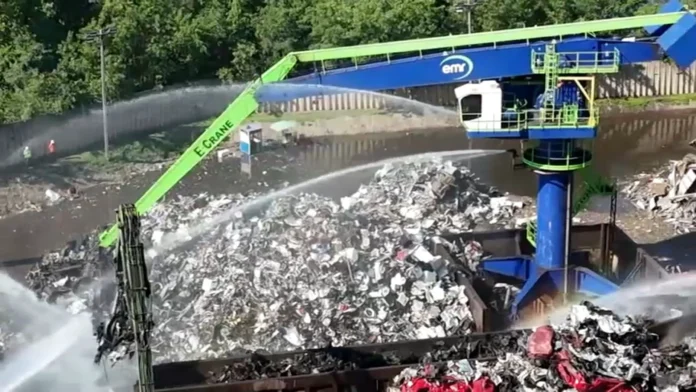

Camden’s yearslong battle with EMR Recycling has reached a striking new chapter, one in which a judge’s ruling has effectively overturned the will of an entire city council. Just one day after Camden’s council voted unanimously, seven to nothing, to reject a proposed settlement that would have allowed the scrapyard to reopen under strict conditions, a New Jersey Superior Court judge stepped in on Wednesday, July 8, and cleared the way for EMR to resume operations anyway, provided the company can prove to the court that a new fire suppression system is fully installed and functioning. The decision has left residents of the surrounding Waterfront South neighborhood stunned, and it has reignited a debate that sits at the uncomfortable intersection of public health, municipal authority, and the financial leverage a major employer can wield even after repeatedly catching fire.
To understand how the fight ended up in a courtroom rather than settled at the local level, it helps to go back to May 29, the date of the fire that finally pushed Camden past its breaking point. That blaze was not an isolated incident. It marked at least the thirteenth fire at the EMR facility since 2020, a run of incidents that included four major blazes in just the past two years alone, an extraordinary frequency even for an industry that everyone acknowledges carries inherent fire risk. Scrap and metal recycling operations are expected to have occasional flare-ups given the nature of the material passing through their shredders, but a track record like EMR’s is virtually unheard of, and it left city officials concluding that the company had exhausted whatever benefit of the doubt it once had. In direct response to the May 29 fire, Camden issued an emergency order on June 2 suspending EMR’s operating license outright, a move city leaders framed as a necessary step to protect a community that had grown increasingly convinced its air, and its health, were being sacrificed for the sake of a scrapyard’s bottom line.
EMR did not accept that shutdown quietly. The company’s attorneys moved quickly to sue the city, arguing that Camden had violated basic due process protections by suspending the license without first providing a formal administrative hearing. Under the legal principles governing how municipalities regulate private businesses, even a company with a documented history of safety violations retains a right to that kind of process, and EMR leaned heavily on that argument in court. The company also put a specific price tag on its grievance, claiming that the shutdown was costing it somewhere between four million and ten million dollars in lost revenue every single week, and warning that continued closure would force layoffs among its workforce. That financial claim did more than generate headlines. It created genuine exposure for Camden taxpayers, since a city that loses a lawsuit like this one can find itself on the hook for significant damages, turning what began as a public safety dispute into a high-stakes financial standoff as well.
It was against that backdrop that attorneys for both sides negotiated a settlement designed to end the litigation without a trial. The proposed deal centered on what amounted to a phased reopening of the facility, structured so that EMR would regain its operating license, effectively the city’s permission to restart its shredders, in exchange for accepting a demanding set of new safety obligations. Under the terms attorneys drafted, EMR would have been required to pay for an actual Camden firefighter to be stationed on-site around the clock, a direct acknowledgment of how often the fire department has had to respond to the property. The company would also have had to overhaul its handling of lithium-ion batteries, which investigators and fire officials have identified as the source of many of the blazes, since these batteries can ignite unpredictably when damaged or improperly sorted. Rounding out the agreement, EMR would have been obligated to report any flare-up to authorities immediately rather than allowing incidents to escalate before anyone outside the facility was notified. In exchange for the city agreeing to those terms and allowing the reopening, EMR would have dropped its multimillion-dollar claims against Camden entirely, resolving the financial threat hanging over the city at the same time it resolved the operational one.
On paper, the settlement offered Camden a version of accountability, real safety upgrades, a permanent firefighter presence, and financial protection from a costly lawsuit. In practice, it satisfied almost no one who had to live next to the plant. Residents from Waterfront South packed the council chambers ahead of the vote, describing years of breathing in acrid, black smoke every time another fire broke out, smoke that carries the byproducts of burning plastic and heavy metals rather than anything resembling ordinary combustion. For many of these residents, the settlement’s safety conditions, however strict on paper, were beside the point. They had watched EMR promise improvements before, and they had watched fires keep happening anyway. Council members ultimately echoed that sentiment, characterizing the settlement as a compromise the city was no longer willing to accept and effectively declaring that EMR had used up its credibility after what amounted to three strikes too many. Rather than trade a full shutdown for a set of new rules, the council voted unanimously to reject the deal outright, sending a clear signal that residents wanted the facility closed for good rather than reopened with conditions attached.
That unanimous rejection, however, did not end the matter. Because the settlement collapsed, the underlying lawsuit EMR had filed against the city was still very much alive, and it landed back in front of a Superior Court judge for resolution. The judge’s ruling effectively split the difference between the two sides in a way that satisfied neither the company nor the community, but tilted meaningfully in EMR’s favor. Rather than upholding Camden’s full suspension of the operating license, the judge ruled that EMR can legally restart its metal shredder once it demonstrates to the court that an upgraded, fully functional fire suppression system is in place. In practical terms, the judge substituted the city council’s blanket prohibition with a narrower, conditions-based standard, allowing the business to resume as long as it meets a specific technical benchmark rather than facing the indefinite closure the council had voted to preserve.
The legal reasoning behind that outcome traces directly back to the due process argument EMR raised from the outset. Because Camden’s emergency shutdown bypassed a formal administrative hearing, the city found itself vulnerable in court regardless of how justified its underlying safety concerns were. That vulnerability helps explain why the city has not simply been able to collect damages from EMR despite years of fires and fines. Municipal fire departments are funded through taxpayer dollars specifically to respond to emergencies, and cities generally cannot bill a private company for that standard emergency response unless they can affirmatively prove gross negligence or specific code violations in court, a higher bar than most residents might assume. Compounding the issue, the code violation fines Camden has issued against EMR over the years have routinely been appealed by the company, leaving those penalties tied up in prolonged legal proceedings rather than resulting in any immediate financial consequence.
City officials have indicated they intend to appeal the judge’s decision, setting up yet another round in a fight that has already stretched across years and multiple legal fronts. For the residents of Waterfront South, though, the deeper frustration extends beyond any single ruling or appeal. The damages at the center of this dispute were never really about the city’s finances or EMR’s lost revenue, even though those dollar figures dominate the headlines. The real cost has been borne by the people living closest to the facility, who have repeatedly found themselves breathing in the aftermath of fires they had no role in causing and little power to prevent. As EMR moves to satisfy the court’s fire suppression requirement and prepares to restart operations, that underlying tension, between a company defending its right to operate and a neighborhood insisting it has already paid enough in air quality and health risk, remains entirely unresolved, and it is likely to define the next stage of this fight just as much as it defined the last.
















