
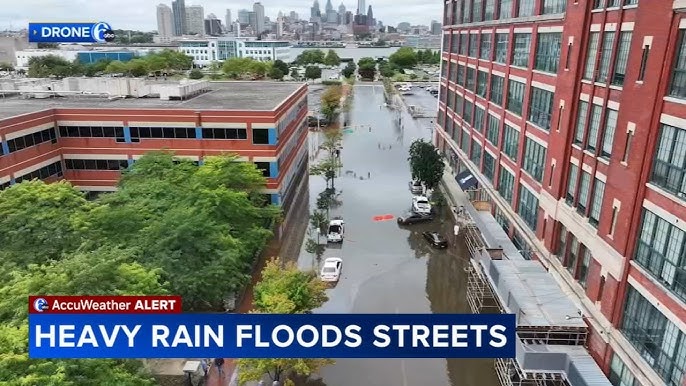

On Monday morning, July 6, as New Jersey was still completing its accounting of the Fourth of July weekend’s storm damage — the 22 suspected heat deaths, the four suspended NJ Transit rail lines, the BJ’s Wholesale Club roof collapse in Oakhurst — a concentrated thunderstorm cell stalled over Camden City and deposited nearly three inches of rainfall in approximately one hour, producing what local government officials described as the most severe flash flooding the city has sustained since Superstorm Sandy in 2012 and Hurricane Irene the year before that. The comparison to Sandy and Irene is the specific context Camden officials have used to communicate the event’s severity to the public and to state emergency management authorities, because what made Monday’s flooding notable was not simply the volume of water but where it went: into streets and into basements in parts of the city that do not typically flood under ordinary storm conditions, a geographic reach that suggests the morning’s rainfall exceeded the drainage infrastructure’s design capacity by a margin that ordinary summer storms in Camden do not routinely approach.
The combination of rainfall volume and timing was the immediate physical cause. Three inches in one hour is a rainfall rate that overwhelms the storm sewer systems of nearly any urban environment in the Northeast, since those systems were typically designed to manage rainfall events at rates of one to two inches per hour, and older legacy sewer infrastructure — the kind that serves much of Camden’s densely built residential and commercial core — was often designed to even more conservative thresholds that reflected the storm frequency patterns of previous decades rather than the increasingly intense precipitation events that the region is now producing with greater regularity. The complicating factor on Monday morning was a localized high tide condition in the Delaware River tributary drainage systems that Camden’s stormwater infrastructure connects to, which reduced the effective outfall capacity of the drainage network at precisely the moment the surface runoff from the storm was arriving in volume. The water had nowhere to go quickly enough.
Emergency crews conducted more than 40 water rescues across Camden County through the morning, responding primarily to motorists who had driven into flooded roadways and become trapped as water levels rose faster than the vehicles could be reversed out of harm’s way. The specific locations where vehicles were stranded document the storm’s geographic pattern: Admiral Wilson Boulevard and Route 30, the critical artery near the Benjamin Franklin Bridge that connects Camden to the Philadelphia-area regional road network, was completely closed for nearly an hour as floodwaters covered the roadway and trapped dozens of vehicles under conditions of reduced visibility. Market Street outside The Victor building, one of Camden’s most prominent residential developments, was documented under deep floodwater. Vehicles required towing from Cooper Street, Delaware Avenue, and the intersection of 7th and Atlantic — the downtown commercial core of a city that is still in the middle of a sustained economic revitalization effort after decades of disinvestment. No injuries or fatalities were reported. That outcome, in a flood event producing 40 water rescues from stranded vehicles, reflects both the quality of the emergency response and the specific circumstances that allowed all 40 rescue subjects to exit their vehicles and reach safety.
The commercial loss documentation that has emerged from Monday’s flooding gives the most concrete measure of what the event cost at the individual business level. The JYM Supermarket on Haddon Avenue experienced a complete basement submersion, with the owner reporting $10,000 in merchandise losses from floating inventory alongside an estimated $50,000 to $80,000 in destroyed refrigeration equipment — compressors and motors that were submerged in water, which typically renders commercial-grade refrigeration irrepairable rather than simply requiring cleaning and restart. For a neighborhood grocery store operating on the margins that most independent supermarkets in lower-income urban markets navigate, a $50,000 to $80,000 equipment loss alongside a $10,000 inventory loss represents a potentially business-ending financial event. The owner’s frustration with the city’s recurring drainage limitations, expressed publicly in the aftermath, reflects a grievance that Camden business owners and residents have been articulating for years: that the storm sewer infrastructure underlying the city’s commercial corridors has not kept pace with the intensity of rainfall events the region is now producing, and that the consequences of that infrastructure gap fall disproportionately on the people and businesses least equipped to absorb them.
Governor Mikie Sherrill issued a public statement following the Camden flooding confirming that the New Jersey Office of Emergency Management remains fully activated to assist hard-hit communities in Camden and to assess the scope of damage that may qualify for federal infrastructure repair funding. The activation of the Emergency Operations Center and the engagement of OEM resources positions Camden for the FEMA disaster declaration threshold tracking that is the necessary precondition for any federal relief. Local government officials have made explicit what the tracking process requires: residents and business owners in Camden who sustained structural property damage from Monday’s flooding are urged to call the city’s damage assessment hotlines at 856-757-7132 or 856-757-7139, which feed into the cumulative damage documentation that FEMA uses to evaluate whether a county or municipality has crossed the threshold for disaster declaration eligibility. The individual calls matter because FEMA’s disaster declaration process is driven by aggregate damage figures that accumulate through exactly these individual property assessments — a business owner who does not call to report $60,000 in refrigeration losses is a data point missing from the calculation that determines whether Camden ultimately receives federal assistance.
The context in which Monday’s flooding occurred — the fourth day of a statewide emergency weather event that had already produced 22 suspected heat deaths, widespread power outages, a partial commercial building roof collapse, and suspended transit service across four NJ Transit rail lines — created a specific challenge for Camden’s emergency response: first-responders and emergency management personnel were already committed to the prior weekend’s damage assessment and ongoing power restoration work when the Monday morning thunderstorm arrived. The ability to execute 40 water rescues without reported injuries under those conditions is a reflection of the emergency services capacity the county was able to deploy, but it also illustrates the specific vulnerability of densely built urban communities to rapid-onset flooding events: the warning window between a thunderstorm beginning and floodwaters reaching vehicle-stranding depth in low-lying roadways can be measured in minutes rather than hours, leaving no practical time for voluntary evacuation of motorists who have already committed to routes that will shortly be impassable.
The Sandy comparison that Camden officials have invoked is not rhetorical. Superstorm Sandy’s impact on Camden in October 2012 included flooding that produced federal disaster declarations and multi-year infrastructure repair processes that are still not fully complete. Irene in 2011 produced comparable flooding in many of the same locations. The recurring nature of these events in Camden’s specific geography — its position at the confluence of multiple tributary drainage systems, its dense street grid with limited permeable surface area, and its aging stormwater infrastructure — is the physical context in which the July 6 flooding should be understood: not as an unprecedented random event, but as the latest and most severe iteration of a pattern that will continue to produce comparable or worse outcomes until the drainage infrastructure is materially improved. The FEMA assessment process that the city has activated, and the OEM resources that Governor Sherrill has committed to the recovery, are the immediate response. Whether they translate into the infrastructure investment that would prevent the next comparable event is the question that the community of residents and business owners who lost property on Monday morning have every reason to want answered.
















