
New Jersey has long served as a crossroads for ideas. From the colonial debates that helped shape a nation to the university classrooms, seminaries, research institutions, and civic organizations that continue influencing public discourse today, the Garden State remains a place where conversations about ethics, leadership, faith, and society regularly intersect. Now, one of New Jersey’s most respected theological institutions is bringing those conversations to a global audience through a new podcast designed to examine some of the most pressing issues facing modern society.
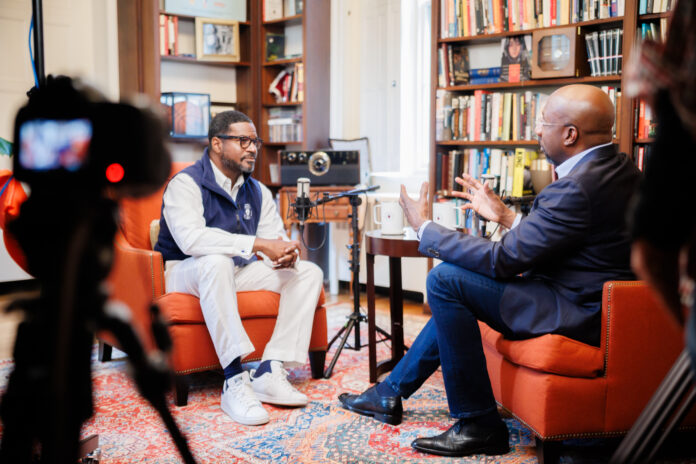
Princeton Theological Seminary has officially launched Expanding the Table, a new podcast hosted by Seminary President Rev. Dr. Jonathan Lee Walton. Debuting on June 15, 2026, the series seeks to create a thoughtful forum where scholars, religious leaders, policymakers, historians, healthcare experts, and public intellectuals can engage in meaningful conversations about the role faith continues to play in shaping contemporary life.
At a time when public discourse is often reduced to brief social media exchanges, political sound bites, and ideological divisions, Expanding the Table aims to slow the conversation down. The podcast embraces deeper inquiry, inviting listeners into discussions that explore how theological traditions, spiritual values, and ethical frameworks influence the decisions individuals and institutions make every day.
The launch represents more than a new media initiative for Princeton Theological Seminary. It reflects a broader effort to reintroduce thoughtful dialogue into conversations about leadership, justice, democracy, healthcare, culture, education, and social responsibility.
The title itself carries profound significance.
Drawing inspiration from the Parable of the Great Banquet found in the Gospel of Luke, Expanding the Table embraces the idea that important conversations become stronger when more voices are welcomed into them. Rather than limiting discussions to a narrow range of perspectives, the podcast seeks to broaden participation and encourage listeners to consider viewpoints that may challenge assumptions, deepen understanding, and inspire reflection.
For Rev. Dr. Jonathan Lee Walton, whose leadership at Princeton Theological Seminary has emphasized engagement with both faith communities and broader society, the project serves as an extension of the seminary’s historic mission.
For more than two centuries, Princeton Theological Seminary has been a significant center of theological education and intellectual inquiry. Located in one of New Jersey’s most historic academic communities, the institution has educated religious leaders, scholars, educators, and public servants who have contributed to conversations extending far beyond church walls.
With Expanding the Table, the seminary is adapting that tradition for a digital age.
The podcast arrives during a period when questions about faith and public life have become increasingly complex. Communities across the nation continue grappling with issues ranging from political polarization and social justice to mental health, religious diversity, civic engagement, and the search for shared values in an increasingly fragmented society.
These are not exclusively political questions. They are fundamentally human questions.
How should societies balance competing interests while preserving dignity and fairness? What role can faith traditions play in promoting understanding across cultural and ideological divides? How can communities address challenges related to mental health, loneliness, and social isolation? What ethical responsibilities accompany leadership in public institutions?
These are precisely the types of conversations the podcast intends to explore.
The inaugural episode immediately signals the scope and ambition of the project.
The first guest is U.S. Senator Rev. Dr. Raphael G. Warnock of Georgia, one of the nation’s most prominent faith leaders serving in elected office. During the conversation, Walton and Warnock explore the relationship between faith and democracy, the responsibilities of public leadership, civic participation, voting rights, and themes from Warnock’s book The Crooked Places Made Straight.
The discussion serves as an example of the podcast’s central approach. Rather than focusing solely on current events, conversations are framed within larger questions about moral responsibility, ethical leadership, and the values that shape public institutions.
Future episodes promise to broaden that exploration even further.
Season One will examine how spirituality intersects with teenage mental health, a subject of increasing concern for educators, parents, healthcare providers, and faith communities alike. Other episodes will investigate religious diversity and the role it plays within modern democratic societies. Additional discussions will address questions surrounding ethical governance, public service, community building, and the evolving relationship between faith and civic life.
The breadth of topics reflects the reality that faith does not exist in isolation from society.
Questions of meaning, purpose, morality, justice, compassion, responsibility, and community have influenced human civilizations for thousands of years. Whether expressed through organized religion, personal spirituality, philosophical traditions, or cultural values, these questions continue shaping public discourse today.
By bringing together experts from multiple disciplines, Expanding the Table creates opportunities to examine those intersections from numerous perspectives.
The podcast also arrives at a significant moment for New Jersey’s growing role in media production and digital content creation.
The state’s expanding film, television, streaming, and podcasting sectors have transformed New Jersey into an increasingly influential hub for content development. While much of the attention often focuses on major film productions and television projects, educational and intellectual programming represents another important dimension of the state’s creative economy.
Projects like Expanding the Table demonstrate that New Jersey’s media landscape extends beyond entertainment alone. The state continues producing content that contributes to national conversations about culture, education, history, ethics, and public life.
For Princeton Theological Seminary, the podcast offers an opportunity to engage audiences who may never physically visit the campus but who remain interested in the questions the institution has explored for generations.
Podcasting has become one of the most effective platforms for long-form conversation, allowing listeners to engage with complex topics during commutes, workouts, travel, and everyday routines. Unlike traditional broadcast formats constrained by rigid time limits, podcasts create space for nuance, reflection, and detailed exploration.
That format is particularly well suited to discussions involving theology, philosophy, leadership, and ethics.
These subjects rarely lend themselves to simplistic answers. Meaningful engagement often requires context, historical perspective, and thoughtful examination of competing viewpoints. The podcast medium provides exactly that opportunity.
What distinguishes Expanding the Table from many contemporary programs is its commitment to intellectual curiosity rather than ideological certainty. The series is designed not to provide easy conclusions but to encourage deeper thinking.
In an era where audiences are frequently presented with prepackaged narratives and polarized viewpoints, there is growing demand for forums that prioritize thoughtful inquiry over confrontation. The podcast seeks to occupy that space by bringing together guests who can illuminate complex issues through expertise, experience, and meaningful dialogue.
For listeners throughout New Jersey and beyond, the series offers an invitation to participate in conversations that transcend traditional boundaries between faith, education, politics, culture, and public service.
The launch also underscores Princeton’s continuing influence as a center of scholarship and civic engagement. The town has long been associated with ideas that shape national and international conversations. Through this new platform, that tradition continues in a format accessible to audiences around the world.
As Expanding the Table begins its first season, its mission is both ambitious and timely. The podcast seeks to foster conversations capable of bridging divides, encouraging reflection, and exploring how spiritual wisdom and ethical leadership can contribute to addressing the challenges of contemporary society.
For New Jersey, the project represents another example of how the state continues contributing to conversations that reach far beyond its borders. For listeners, it offers an opportunity to engage with ideas that challenge, inform, and inspire.
At its core, Expanding the Table is built around a simple but powerful premise: meaningful dialogue has the potential to create greater understanding, stronger communities, and a more thoughtful public square. In a time when those qualities are increasingly valuable, Princeton Theological Seminary’s newest initiative arrives with both relevance and purpose.
The conversation has begun, and the table is growing larger.