
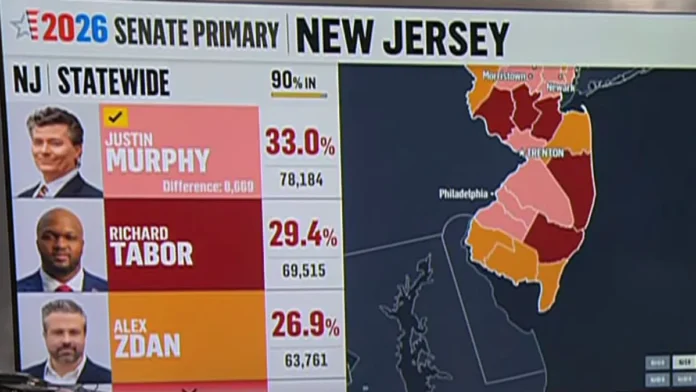

New Jersey’s 2026 primary election delivered clarity to one of the state’s most closely watched federal contests, as Justin Murphy emerged victorious in the Republican race for the United States Senate, securing the GOP nomination and earning the opportunity to challenge longtime Democratic incumbent Cory Booker in November.
Murphy’s victory concludes a competitive Republican primary campaign and officially launches what is expected to be one of the most closely scrutinized statewide political battles of the 2026 midterm election cycle. While national attention remains focused on control of Congress, New Jersey’s Senate race now enters a new phase as Republicans attempt to break one of the longest-running Democratic holds on a statewide federal office in the nation.
The results also provide a significant milestone in Murphy’s long political journey. After an unsuccessful bid for the Republican Senate nomination in 2024, the Burlington County attorney, military veteran, and former elected official returned to the campaign trail determined to build broader support across New Jersey’s Republican electorate. This time, voters delivered him the nomination.
According to election projections, Murphy defeated fellow Republican candidates Richard Tabor, Alex Zdan, and Robert Lebovics in a crowded four-way contest, capturing approximately one-third of the vote and finishing ahead of the field to secure the party’s endorsement for the general election.
His victory reflects a Republican electorate searching for a candidate capable of energizing the party’s base while presenting a contrast to one of New Jersey’s most recognizable political figures. Murphy now becomes the face of the state Republican Party’s effort to challenge Senator Cory Booker, who advanced to the general election after running unopposed in the Democratic primary.
The matchup immediately creates a stark contrast in political experience, campaign resources, and statewide recognition.
Booker enters the general election as one of the Democratic Party’s most prominent figures. First elected to the Senate in 2013 following a special election, Booker has spent more than a decade representing New Jersey in Washington after previously serving as mayor of Newark. His national profile, fundraising network, and incumbent status make him a formidable opponent.
Murphy, meanwhile, represents a different political story. His campaign has focused heavily on grassroots activism, government reform, fiscal conservatism, and what he describes as a need to challenge entrenched political institutions. While political analysts widely view him as an underdog entering the fall campaign, his supporters argue that the national political environment and voter frustration with Washington create opportunities for Republican candidates across the country.
The Republican nominee’s personal story has become a central component of his campaign narrative.
Murphy enlisted in the United States Navy at just 17 years old and served aboard the USS Comte De Grasse during a period that included deployment in the Arabian and Persian Gulf region during the Iran-Iraq conflict. Following his military service and honorable discharge, he pursued a career in law while remaining active in Republican politics throughout New Jersey.
His involvement in public affairs stretches back decades.
Murphy served on the Tabernacle Township Committee after being elected in 2000 and became involved in numerous Republican campaigns and organizations throughout Burlington County and beyond. His political résumé includes leadership roles with local Republican organizations, county committees, and statewide reform efforts. Over the years, he developed a reputation as a committed grassroots conservative focused on fiscal accountability, tax policy, and government efficiency.
Professionally, Murphy has built a legal practice concentrating on estate planning, real estate law, contract matters, energy consulting, and economic development initiatives. Supporters frequently point to that experience as evidence of his understanding of both private-sector challenges and public policy issues.
Throughout the campaign, Murphy emphasized a platform centered on dramatic government restructuring and institutional reform. Among his most discussed proposals are calls to abolish the Internal Revenue Service and the U.S. Department of Education, make the Department of Government Efficiency a permanent federal entity, strengthen border security measures, and significantly reduce federal bureaucracy.
Those positions resonated with many Republican primary voters who continue to favor candidates advocating substantial changes to the structure and scope of federal government operations.
Murphy has also spoken extensively about the need to revitalize Republican organization and activism throughout New Jersey. During the campaign, he repeatedly expressed optimism about what he sees as growing grassroots energy across the state, particularly among newly elected county party leadership and local activists seeking to expand Republican influence in traditionally Democratic territory.
That optimism will now be tested in a statewide election that presents enormous challenges for any Republican candidate.
New Jersey has not elected a Republican to the United States Senate since 1972, making the state one of the most difficult environments in the country for GOP Senate hopefuls. Democrats maintain significant voter registration advantages, and statewide federal elections have consistently favored Democratic nominees for decades.
The financial landscape presents another hurdle.
Federal campaign finance filings indicate that Booker enters the general election with a substantial fundraising advantage and a national donor network capable of generating significant resources. Murphy’s campaign, by comparison, will need to rapidly expand its fundraising operation while simultaneously building statewide name recognition.
Yet history has shown that political environments can change quickly, particularly during midterm election cycles.
Control of Congress, national economic conditions, immigration policy, public spending, government accountability, and ongoing debates over federal authority are expected to dominate political conversations across the country between now and November. Murphy’s campaign will likely seek to connect those broader national issues to concerns facing New Jersey voters, while Booker is expected to emphasize his experience, legislative record, and ability to deliver for the state.
The Senate contest also unfolds against the backdrop of a highly active political year throughout New Jersey.
Voters are simultaneously evaluating congressional races, local elections, county contests, and broader questions about the state’s future direction. Issues ranging from transportation infrastructure and housing affordability to immigration policy, economic development, healthcare access, and public education continue to shape political debate across the Garden State.
As the campaign shifts into general election mode, both candidates will be tasked with defining not only themselves but also the future they envision for New Jersey.
For Murphy, the challenge will be transforming a primary victory into a statewide coalition capable of competing in one of the nation’s most Democratic-leaning states. For Booker, the task will be defending a seat he has held for more than a decade while responding to a national political environment that remains highly polarized and increasingly unpredictable.
What is certain is that New Jersey voters now have their Senate matchup.
After months of campaigning and a competitive Republican primary, Justin Murphy has earned the nomination and secured his place on the November ballot. The next chapter begins now, as New Jersey prepares for a statewide Senate race that will draw attention from political observers across the country and help shape the balance of power in Washington.
With the primary decided, the focus shifts from winning a party nomination to winning over an entire state. For Murphy, the road ahead may be steep, but the opportunity is now his. For Booker, the campaign to retain one of New Jersey’s most prominent political offices officially enters its next phase. And for voters, the choices they make this November will help determine not only who represents New Jersey in the United States Senate, but also which vision of government, leadership, and public policy will carry the day in one of America’s most politically significant states.
















