
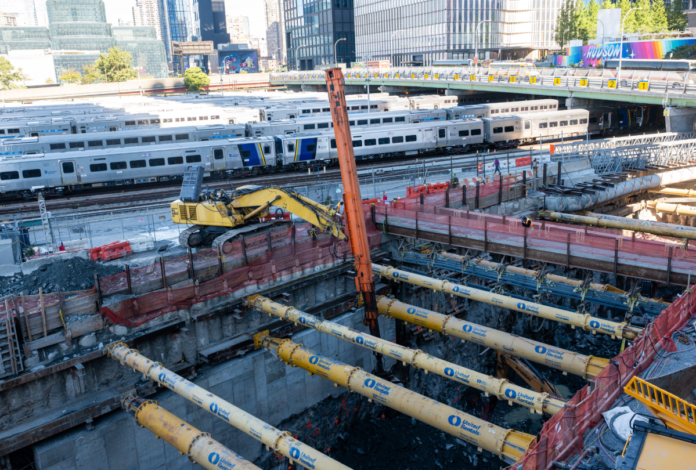

The largest transportation infrastructure project in the United States has officially crossed another major milestone, bringing New Jersey one step closer to a rail network capable of supporting the economic demands of the Northeast for generations to come.
The Gateway Development Commission has awarded the contract for Construction Package 3 of the Hudson Tunnel Project, known as the New Jersey Surface Alignment Project, to Skanska Creamer Sanzari NJSA JV. The $711.7 million contract represents far more than another construction award. It signals the continued transformation of one of the most critical transportation corridors in North America and reinforces New Jersey’s central role in the future of regional mobility, economic growth, job creation, and infrastructure modernization.
For decades, transportation planners, elected officials, business leaders, labor organizations, and commuters have understood a simple reality: the century-old rail connection beneath the Hudson River remains one of the most vulnerable pieces of infrastructure in the nation. Every weekday, hundreds of thousands of passengers depend on a system operating at or near capacity, relying heavily on tunnels originally opened in 1910.
The Hudson Tunnel Project was conceived to solve that challenge.
Now, with seven of the ten major construction packages either completed or actively underway, the vision is steadily becoming reality.
The newly awarded New Jersey Surface Alignment Project will create approximately 1.5 miles of critical infrastructure stretching from County Road in Secaucus to the future tunnel portal near Tonnelle Avenue in North Bergen. While the new tunnel itself often receives the most public attention, transportation experts have long emphasized that the supporting infrastructure connecting those tunnels to the existing Northeast Corridor is equally essential.
Without those connections, the benefits of a new tunnel could never be fully realized.
The New Jersey Surface Alignment Project serves as that vital link.
Once completed, the project will establish the infrastructure necessary for future rail systems, tracks, signals, communications equipment, and operational technology that will connect the new Hudson River tunnel directly to the existing Northeast Corridor network. The result will be a stronger, more resilient transportation system capable of handling future growth while reducing the risks associated with relying on aging infrastructure.
The scope of work is substantial.
Construction crews will build more than 7,500 feet of new infrastructure designed specifically to support future rail operations. The project includes approximately 4,170 feet of retaining walls and specialized embankments that will create new track corridors adjacent to the existing Northeast Corridor alignment.
Engineers will also construct more than 3,100 feet of elevated viaduct structure designed to carry future rail traffic across portions of the Meadowlands. These structures will allow trains to move efficiently while minimizing impacts on sensitive environmental areas that have long defined the region’s landscape.
Additional work includes the construction of new bridges spanning Secaucus Road as well as active freight corridors currently operated by Conrail and the New York, Susquehanna and Western Railway. Supporting infrastructure such as drainage systems, access roads, maintenance facilities, utility relocations, equipment platforms, stairways, and signal-related improvements are also included within the contract.
Taken together, the project represents one of the most complex transportation construction efforts currently underway in New Jersey.
What makes the challenge even greater is the environment in which construction must occur.
Unlike projects built on undeveloped land, crews will be working directly adjacent to active rail lines that remain critical to daily Northeast Corridor operations. Maintaining safe and uninterrupted rail service while simultaneously constructing entirely new infrastructure requires an extraordinary level of coordination among contractors, engineers, rail operators, NJ Transit, Amtrak, and project managers.
Every phase of construction must be carefully sequenced to protect workers while minimizing disruptions to one of the busiest passenger rail corridors in the Western Hemisphere.
The Meadowlands portion of the project presents another layer of complexity.
The New Jersey Meadowlands remains one of the region’s most important ecological resources, containing wetlands, wildlife habitats, flood mitigation systems, and environmental assets that require extensive protection. Construction activities in these areas must comply with stringent environmental regulations designed to preserve sensitive ecosystems while allowing critical infrastructure improvements to move forward.
Balancing transportation modernization with environmental stewardship has become one of the defining characteristics of major infrastructure projects throughout New Jersey, and the Hudson Tunnel Project continues that approach.
The Gateway Development Commission’s approval of seven Alternative Technical Concepts as part of the contract award further illustrates the project’s focus on innovation.
These Alternative Technical Concepts, commonly referred to as ATCs, allow private-sector engineering and construction teams to propose enhanced methods that differ from preliminary project designs while still meeting all required safety, operational, and performance standards.
Following extensive technical evaluations, project officials concluded that the selected concepts would reduce overall costs, minimize environmental impacts, improve construction efficiency, and lower long-term maintenance requirements once the infrastructure enters service.
The result is a project that benefits not only from public investment but also from private-sector expertise and innovation.
The economic implications of the Hudson Tunnel Project continue to expand as construction progresses.
Infrastructure investments of this scale create impacts that extend far beyond the construction site itself. Engineers, laborers, equipment operators, suppliers, manufacturers, logistics providers, environmental consultants, transportation specialists, and countless supporting industries all contribute to the project’s success.
The Hudson Tunnel Project has already generated tens of thousands of jobs while driving billions of dollars in economic activity throughout New Jersey, New York, and the broader national economy.
For New Jersey specifically, the benefits are expected to be transformative.
The Northeast Corridor serves as the economic backbone of the state, connecting residents to employment centers, educational institutions, healthcare facilities, entertainment venues, and business districts throughout the region. Enhancing that network improves mobility, increases reliability, supports future development, and strengthens the state’s competitiveness within the national economy.
Reliable transportation infrastructure remains one of the most important factors influencing business investment decisions, workforce mobility, and long-term economic growth.
That reality helps explain why the Hudson Tunnel Project continues to receive bipartisan attention and support from transportation advocates across the region.
Beyond economics, the project addresses a critical resiliency challenge.
The existing Hudson River rail tunnels suffered extensive damage during Superstorm Sandy, exposing vulnerabilities that continue to concern transportation planners more than a decade later. Saltwater intrusion, aging infrastructure, and increasing maintenance demands have reinforced the urgency of creating additional capacity and redundancy beneath the Hudson River.
The new tunnel and its associated infrastructure will provide exactly that.
Instead of relying on a single aging connection, the region will gain a more resilient transportation network capable of maintaining service even when maintenance, repairs, or emergencies impact portions of the system.
For commuters, the benefits may eventually translate into fewer delays, improved reliability, increased service flexibility, and a transportation network better equipped to meet future demand.
For businesses, it means stronger regional connectivity and improved workforce access.
For New Jersey, it represents one of the most significant infrastructure investments in state history.
The contract award to Skanska Creamer Sanzari NJSA JV marks another visible sign that the Hudson Tunnel Project is moving beyond planning and into sustained construction. What was once discussed primarily in studies, proposals, and funding debates is increasingly becoming a physical reality across the New Jersey landscape.
As construction begins on the New Jersey Surface Alignment Project in 2026, residents will witness another major chapter in a generational effort to modernize the transportation network that powers the Northeast.
The work underway today will influence how millions of passengers move throughout the region for decades to come. It will strengthen economic connections, improve resiliency, create jobs, support future growth, and help ensure that one of the nation’s most important transportation corridors remains capable of serving the demands of the twenty-first century.
The Hudson Tunnel Project was always about more than a tunnel.
It is about creating the infrastructure foundation for the next century of mobility, commerce, and opportunity. With the award of Construction Package 3, New Jersey has taken another substantial step toward that future.
















