

A decade in the making has come down to a matter of weeks.
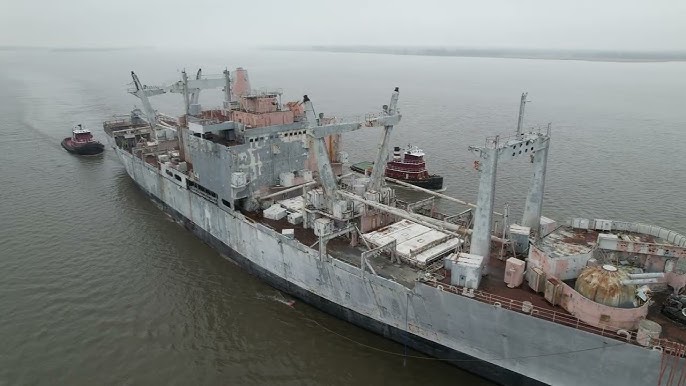
In one of the most urgent and consequential preservation efforts in New Jersey’s cultural history, the Battleship New Jersey Museum & Memorial is mobilizing a time-sensitive recovery operation to salvage irreplaceable artifacts, documents, and original equipment tied to the legendary Iowa-class battleships—before they are permanently lost in the dismantling of the former USS Charleston (LKA-113).
What is unfolding is not just a recovery mission. It is a high-stakes race to preserve a critical chapter of American naval history, one that directly connects to USS New Jersey herself—the most decorated battleship in U.S. Navy history and a cornerstone of New Jersey’s cultural identity.
At the center of this effort lies an extraordinary reality: inside the massive cargo holds of USS Charleston sits what may be the single largest remaining collection of Iowa-class battleship materials in existence.
These include original blueprints, operational manuals, mechanical components, and historical artifacts that were removed and stored when ships like USS New Jersey transitioned into museum status decades ago.
Now, with Charleston en route to a scrapyard in Brownsville, Texas, the window to recover these materials is closing rapidly.
The timeline is unforgiving. Charleston’s cargo hatches were sealed on March 5, 2026, marking the beginning of her final journey. Once the ship arrives and the holds are opened, the Battleship New Jersey team will have approximately four weeks to locate, extract, and transport the items they previously identified—if they can mobilize in time.
This mission has been years in preparation. As far back as December 2020, during a severe snowstorm, a museum curator traveled to Philadelphia under extreme conditions to begin cataloging what could be saved. With just a day and a half to navigate cargo holds packed floor-to-ceiling with crates, the team tagged as many critical items as possible, prioritizing those that would have the greatest impact on restoration, preservation, and public education.
What they found was nothing short of extraordinary.
Among the most valuable recoverable assets are air handler units designed specifically for Iowa-class battleships. These components are essential to maintaining the ship’s internal climate systems, and replacing or repairing them using modern methods can cost upwards of $40,000 per unit. Recovering original parts not only preserves historical accuracy but could save hundreds of thousands of dollars—resources that can instead be reinvested into further restoration efforts.
Equally significant is the discovery of an original World War II-era steam whistle, an artifact that carries both historical and emotional weight. Items like this are not merely mechanical—they are sensory connections to the past, capable of bringing visitors closer to the lived experience of those who served aboard these ships.
Perhaps most critical, however, are the complete log office blueprints and operational manuals from USS New Jersey and USS Missouri. No single, fully intact set of Iowa-class blueprints currently exists in any archive. The recovery of these documents represents a once-in-a-generation opportunity to fill gaps in the historical record, with plans to eventually preserve and digitize portions of the collection through national archival systems.
The urgency is compounded by the condition of these materials. After years without proper climate control, many paper documents are already showing signs of deterioration. Exposure to humidity and mold poses a serious risk, threatening to render some items unusable if they are not recovered and stabilized quickly. Every day that passes increases the likelihood of irreversible loss.
From an operational standpoint, the mission is as complex as it is critical. It requires coordination with Naval Sea Systems Command, logistical planning for long-distance transport, crane operations to remove heavy equipment, and the mobilization of specialized teams capable of handling fragile and historically significant materials. The financial requirements reflect this complexity, encompassing travel, labor, equipment, and transportation costs that must be secured in advance.
This effort also represents a defining moment for New Jersey’s broader cultural preservation landscape. As highlighted across the Explore New Jersey Art & Culture section, institutions throughout the state are increasingly engaged in initiatives that protect, interpret, and elevate historical narratives. The Battleship New Jersey’s mission stands at the forefront of that movement, demonstrating how preservation is not a passive act, but an active, time-sensitive commitment.
The significance of this recovery extends beyond the museum itself. USS New Jersey is more than a historic vessel—it is a living educational platform, a symbol of service, and a tangible link to pivotal moments in global history. Every artifact, every document, and every component recovered from Charleston has the potential to deepen that connection, enhancing exhibits, informing research, and ensuring that future generations can engage with history in a meaningful way.
What makes this moment particularly powerful is its singularity. There is no second opportunity. Once Charleston is dismantled, the contents of her cargo holds will be dispersed, destroyed, or lost to time. The materials currently within reach represent the last consolidated repository of Iowa-class resources anywhere in the world.
For the Battleship New Jersey Museum & Memorial, this is not just about preservation—it is about responsibility. It is about honoring the legacy of those who served, maintaining the integrity of one of the most important naval artifacts in existence, and ensuring that history is not only remembered, but accurately represented.
As the clock continues to tick, the mission moves from planning to execution. The coming weeks will determine whether these irreplaceable pieces of history are saved or lost forever.
In New Jersey, where history and identity are deeply intertwined, the outcome of this effort will resonate far beyond the deck of a single ship. It will define how we preserve the past—and how we carry it forward.
















