
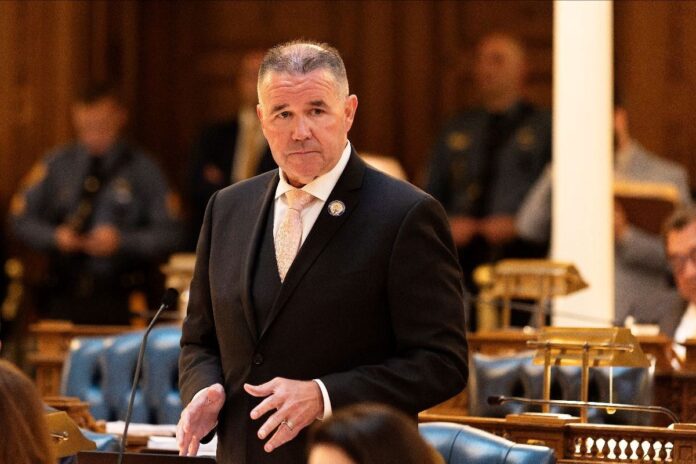

Assemblyman Alex Sauickie is using New Jersey’s newly enacted $60.7 billion budget to press a simple argument, that Trenton has money for its priorities, and restoring cost of living adjustments for retired police officers and firefighters should be one of them.
Why Should Retired Cops Wait 25 Years? A Republican Assemblyman Points to the Budget’s Other Line Items
Assemblyman Alex Sauickie, a Republican representing New Jersey’s 12th Legislative District, is pressing legislative leaders to advance long stalled legislation restoring cost of living adjustments for retired police officers, firefighters, and state troopers, using the state’s newly enacted fiscal year 2027 budget as his central piece of evidence that the money exists if lawmakers choose to prioritize it.
A 25 Year Wait, According to the State’s Own Treasurer
Automatic cost of living adjustments for retirees in New Jersey’s state administered pension systems have been suspended since 2011, when lawmakers tied their eventual restoration to specific pension funding benchmarks rather than a fixed calendar date. During this year’s budget hearings, State Treasurer Aaron Binder told lawmakers those statutory funding thresholds might not be reached for another 25 years, a timeline Sauickie has seized on directly in pressing for a more targeted, faster fix specifically for police and fire retirees.
Sauickie is the lead sponsor of legislation that would restore automatic COLAs specifically for members of the Police and Firemen’s Retirement System who have been retired at least ten years, applying to annual, ordinary disability, and accidental disability pension benefits and covering surviving beneficiaries as well. Rather than drawing directly on the pension funds themselves, which remain underfunded relative to their long term obligations, the bill calls for the state to finance the adjustments through direct appropriations, an approach Sauickie has described as avoiding a false choice between strengthening the pension systems and actually restoring benefits retirees were promised. The bill has drawn support from the New Jersey Fraternal Order of Police, the Professional Firefighters Association of New Jersey, the New Jersey State Retired Police and Firemen’s Association, and the state’s PFRS COLA Forum, along with bipartisan sponsorship from Democratic Assemblyman Joe Danielsen.
Three Line Items, Two Very Different Stories
To make his case that funding priorities, not available money, are the real obstacle, Sauickie pointed to three specific items inside the state’s newly signed $60.7 billion budget. Each carries real context worth understanding beyond the dollar figure alone.
$120 Million for Jersey City
A financial assistance package, split between $105 million in long-term, low-interest loans and $15 million in transitional grants, aimed at helping Jersey City close a roughly $255 million structural budget deficit that Mayor James Solomon has attributed to the previous administration.
State and city officials have said the package avoided a worst-case 31 percent property tax increase and deep cuts to municipal services, though it came with conditions including a state-appointed fiscal monitor now overseeing the city’s spending decisions.
$20.2 Million for Immigration Legal Services
A $12 million increase to New Jersey’s Detention Deportation Defense Initiative, bringing its total funding to $20.2 million. The program, created in 2018, provides free legal representation to low-income residents facing immigration detention or deportation.
Governor Sherrill’s administration has framed the increase as a due process protection amid expanded federal immigration enforcement, including at the Delaney Hall detention facility in Newark, while critics including Sauickie and other Republican lawmakers argue the funding should instead go toward direct property tax or utility relief for residents.
$50,000 for the Paterson Cricket League
A narrowly targeted appropriation earmarked specifically for the Paterson Cricket League, the kind of small, highly specific line item Sauickie has grouped alongside the budget’s larger allocations as an example of discretionary spending.
What Sauickie Is Actually Arguing
Sauickie’s broader point is not that any single one of these appropriations is inherently wrong, but that their combined existence undercuts the argument that a full quarter century timeline for restoring first responder COLAs is simply unavoidable given the state’s finances. He has framed his own bill as fiscally responsible specifically because it does not draw down the pension systems themselves, instead asking the state to appropriate the cost directly, the same basic mechanism used to fund the Jersey City aid package and the immigration legal services increase he is contrasting it against.
Whether lawmakers ultimately agree that a targeted COLA restoration for retired first responders deserves the same budgetary priority as municipal fiscal stabilization or expanded legal defense funding remains an open, genuinely contested question in Trenton, one that touches on competing claims about which state obligations deserve to move first. What is not in dispute is the underlying math Sauickie is pointing to, that New Jersey’s newly enacted budget does, in fact, direct meaningful sums toward each of the three items he named, even as retired police officers, firefighters, and state troopers continue waiting for adjustments that have not moved in more than a decade.
















