
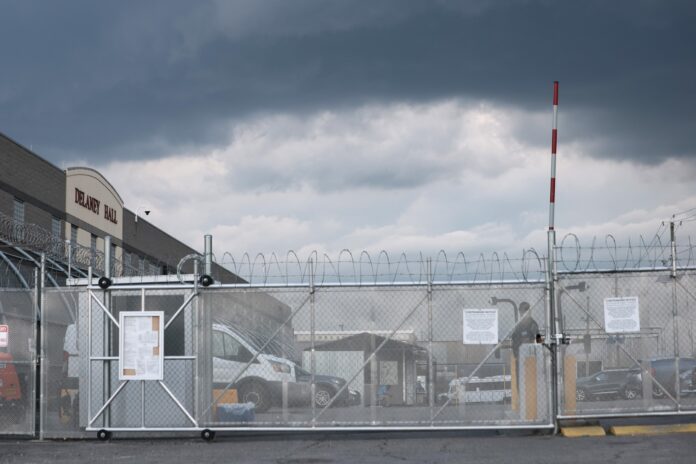

At a roundtable meeting this week, one woman spoke up about her experience dealing with the local immigration detention center. At the meeting in a borough hall, she said that her father, a legal resident of New Jersey with 41 years of residency, was picked up by ICE agents just days ago. He is being held at the Delaney Hall immigration detention center in Newark because he is not receiving the health care he needs for his high blood pressure and other diseases, she said.
As a member of New Jersey’s congressional delegation, Rep. Pallone called for a roundtable meeting this week with Perth Amboy Deputy Mayor Kate Triggiano and advocates for immigrants to discuss conditions at the detention center and to share information about how immigration policies are being enforced in New Jersey. Pallone, who toured the facility, said that the issue he found most troubling about the treatment of undocumented residents in the state was the inadequate medical care provided to those in detention. Inside the small infirmary at Delaney Hall, he noted, there is only one physician who provides care to the detainees there, which means that many are forced to wait for treatment.
The meeting took place at a time when the detention center in Newark has become an issue for residents of the state. With New Jersey ranking eighth in the nation in terms of number of immigrants arrested, ICE operations have increased throughout the state, especially in nearby Freehold and Perth Amboy, according to Pallone. He blames the current administration’s allocation of nearly $200 billion for immigration enforcement for the uptick in activity, while also suggesting that local law enforcement could be asked to take on similar responsibilities as those that the Roxbury Township is considering for a detention facility.
Pallone criticized the current administration’s policies on immigration, arguing that they have been a disaster, and that what he and others have seen firsthand at Delaney Hall are acts of cruelty and barbarism by federal authorities. Everyone at the roundtable discussion seemed to agree, as Pallone himself noted, but none of the advocates had any ideas about how to change the situation in the short term. The issue was complicated by the fact that Democrats are now a minority in the state legislature, and no matter how much they may have wanted to, they could not force any changes to the immigration enforcement system in the short term.
The most interesting statement, perhaps, was made by Pallone about the situation with ICE in general and the current political realities of the situation in particular. He argued that although there is an ideological consensus among many Republicans that undocumented immigrants who have committed crimes should be deported, there is not the same will to take stronger measures against those who are otherwise law-abiding residents who happen to be in the country illegally. The reality of the situation, as he sees it, has not changed significantly, despite the change in presidential administrations.
What Pallone proposed as solutions to the problems currently affecting many undocumented residents in New Jersey can be seen as logical extensions of what he said previously. He suggested that a pathway to citizenship be created for undocumented immigrants who have been in the country for a certain period of time and have no criminal records. ICE officials should be required to have warrants when entering private homes and businesses, he argued, and should not be allowed to wear masks, as the state of New Jersey has recently banned them from doing so. This is not exactly an effective measure since, despite the law banning them, few can realistically stop the federal authorities from continuing to do so.
The idea of a pathway to citizenship is nothing new, as similar concepts have been introduced numerous times before, dating back to the presidency of George W. Bush. It always failed due to strong opposition from both Democrats and Republicans, who both support stricter immigration controls, although they disagreed on the details. The situation in Congress has changed little in the meantime, and the prospects for such a bill being passed this time are no better than they were a decade or two ago.
In his closing remarks, Pallone tied the issue of immigration policy to the social consequences it was having on residents of New Jersey, arguing that the mass deportation of undocumented immigrants who have been living and working in the state was tearing local communities apart. He reminded his colleagues in the state legislature that he felt that the federal government needed to be held accountable for the way it treated residents, including those who had been living in the country illegally. He spoke again of his concerns about the conditions inside Delaney Hall after touring it, arguing that the federal government should not spend money on enforcing immigration laws when it did not even meet the minimum standards of civility and humanity in its dealings with undocumented immigrants.
Hazel Applewhite of the Ironbound Community Corporation in Newark spoke most eloquently about the social impact of the immigration crackdown during the roundtable. The children of Ironbound’s residents were afraid to go home every day, she said, and parents were increasingly likely to think about separation rather than family life. The situation in the neighborhood was an example of how the mass deportation of undocumented immigrants would affect many other communities in the state, she said. Others spoke in similar terms about the social impact of the crackdown on immigration enforcement. The mass deportation of undocumented immigrants who have beenliving and working in the state would have devastating social consequences for many residents, especially those who were close to them or employed them.
The meeting served mostly as an opportunity for the local congressman to speak out about the conditions at Delaney Hall, as few changes were expected to happen any time soon. This was evident from the discussion, where most participants seemed to accept the current state of affairs as inevitable. However, it did serve as an important reminder that the immigration policies promoted by the current administration, as well as the crackdown on undocumented residents, were having a direct impact on many New Jersey residents. Immigration policy remains one of the most politically charged issues in American society, and the views expressed at this roundtable are likely to resurface in the national debate in the near future, influencing the ongoing confrontation between Democrats and Republicans on this issue.
















