
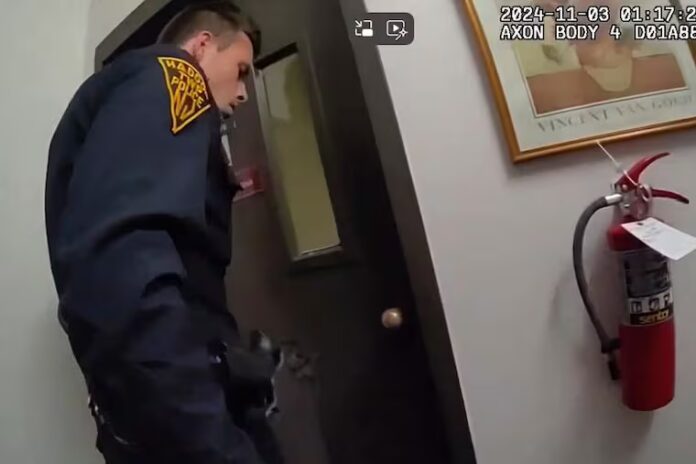

A New Jersey state grand jury has ruled to not charge Haddon Township police officer Luke Falkenberg for the fatal shooting in 2024 that claimed the life of 46-year-old Keith Edelin of Pennsauken. A man who was confronted by police inside the Westmont senior apartment complex. The decision to not press criminal charges came on the July 28, 2026, when the investigative body voted on a ‘no-bill’ for Falkenberg. A finding that the evidence did not demonstrate criminality on behalf of the officer, who shot Edelin following an altercation on the stairs of the building. The grand jury concluded that the officer’s use of force was justified in the circumstances as described by investigators.
The ruling brought a close to more than a year-long criminal probe into the fatal shooting of Edelin that began back in 2024, although the case still has to go before another state agency, that looks into similar cases in the state, as a part of New Jersey’s multi-step process for the investigation of police shootings.
The Shooting Timeline
On the night of the shooting, which took place in the early hours of November 3, 2024, Haddon Township police were called to the scene of an attempted burglary in the Rohrer Towers II senior apartment complex on West Crystal Lake Avenue in Westmont. According to the police report, one of the residents called 911 after finding an unknown male entering the hallway outside her doorway on the second floor.
Upon arrival at the apartment complex, police noticed blood trails on the lobby floor, elevator, and carpeted corridors. Following the trail of blood led officers to the stairwell, where Edelin was located on the second-floor landing with a knife. Per the police account and the body-camera footage, officers spent the next 2 minutes confronting Edelin, who was ordered to drop the weapon several more times. Edelin replied that he was not going to harm himself, and was not willing to go with police, claiming that he did not want to go back to prison. Falkenberg then opened fire with his service handgun, which struck Edelin in the heart. The officers provided first aid to Edelin, who was pronounced dead at Cooper University Hospital by paramedics almost an hour after the shot was fired. Falkenberg and his colleagues were unhurt.
The Reason For Grand Jury Proceedings
Under the New Jersey Independent Prosecutor Directive, any death at the hands of law enforcement is subject to a vote before a grand jury as a part of the process of criminal justice oversight. A mechanism put in place to satisfy the need for an independent investigation into police shootings. This is also the reason why the case against Falkenberg, which took place in 2024, is still being prosecuted in 2026. The state Office of the Public Integrity and Accountability (OPIA) is responsible for conducting such investigations, which are then presented to the grand jury for a vote. In the case of Falkenberg, the evidence gathered by the OPIA includes the 911 call records, radio transmissions, body-camera footage, ballistics reports, and an autopsy performed on Edelin.
The grand jury reviewed the details of the case and heard arguments from both sides on the relevance of the charges before voting on July 27, 2026. The jurors reviewed the evidence and the legal requirements for criminal charges of homicide and self-defense by law enforcement. Ultimately, no charges against Falkenberg were approved by the grand jury, which ruled to not present the case for trial.
Following Procedures
The decision by the grand jury to not bring criminal charges against Falkenberg marks the end of the criminal side of the case. Although the process of criminal justice oversight in New Jersey involves more steps before the police officer could be acquitted. The case is set to go before another agency, the Office of the Public Integrity and Accountability, as another part of the state’s protocol for police shootings. One that entails a separate administrative review to determine if Falkenberg committed any misconduct under the jurisdiction of the OPIA, which may differ from the charges voted upon by the grand jury. The investigation, which could take months to conclude, will involve a separate review of the circumstances surrounding the shooting. It has the authority to investigate and penalize police misconduct, even if the initial finding by the grand jury cleared the officer of all charges. As a matter of fact, in most instances, the administrative hearing can have more far-reaching consequences for the officer involved than a potential criminal trial. However, the outcome of the proceedings will remain separate from the criminal trial, which concluded earlier this month, and, as such, will not be made public.
Haddon Township police shooting case against Falkenberg has moved to the next stage in New Jersey’s multi-tiered system of criminal justice oversight. After more than a year-long criminal investigation that began in 2024, the case has been reviewed by the State Grand Jury, which voted to dismiss all charges against Falkenberg with no bills. Now the case will be considered by another state agency, charged with reviewing police misconduct claims to determine if any administrative penalties are applicable in the case.
















