
Most people have never heard of Synametrics Technologies, and that is exactly how a lot of infrastructure software works. It sits behind the scenes, doing the unglamorous job of keeping email flowing, data backed up, and databases queryable, while the businesses that depend on it never have to think about it twice. That quiet reliability is precisely the reputation Synametrics has built since 1997 from its base in Millstone, New Jersey, and it’s the reason the company’s latest release, Xeams Version 10.3, Build 6436, is worth paying attention to even if you’ve never used the product yourself.
Synametrics is a privately held software company that has spent nearly three decades building tools for IT administrators, developers, and enterprises who want more control over their own infrastructure than a typical cloud subscription allows. The company’s footprint is larger than its name recognition would suggest. Its software is used by more than 50,000 enterprises and roughly one million individual users around the world, spanning industries that range from healthcare and finance to education and government. What ties that customer base together isn’t the industry they work in. It’s a shared preference for owning their data and their infrastructure rather than renting it from a third party.
A Product Line Built Around Control, Not Convenience
Synametrics organizes its business around four core products, each addressing a different piece of the same underlying philosophy. WinSQL is a universal database management tool and SQL query builder that lets developers connect to essentially any relational database, write and execute queries, and manage schemas without being locked into a single vendor’s ecosystem. Syncrify handles private cloud backup and data synchronization, letting organizations back up files from client machines to a centralized, self-hosted repository using incremental backup protocols rather than shipping that data off to a third-party cloud provider. SynaMan is a web-based remote file manager that allows secure sharing, uploading, and downloading of large files from anywhere, again without routing that traffic through an outside cloud service. And then there is Xeams, the company’s flagship product and the one at the center of this latest announcement: a secure, all-in-one email server and messaging platform built to handle spam filtering, firewall protection, and message archiving under a single roof.
The common denominator across all four products is a bet that a meaningful share of the market, particularly IT administrators and technical teams working in regulated or security-conscious environments, wants infrastructure that lives on its own servers rather than someone else’s. That’s not a fashionable position in an industry that has spent the last decade pushing everything toward the cloud, but it’s a position Synametrics has built a durable business around, and Xeams is the clearest expression of it.
What Xeams Actually Does, and Why Administrators Choose It
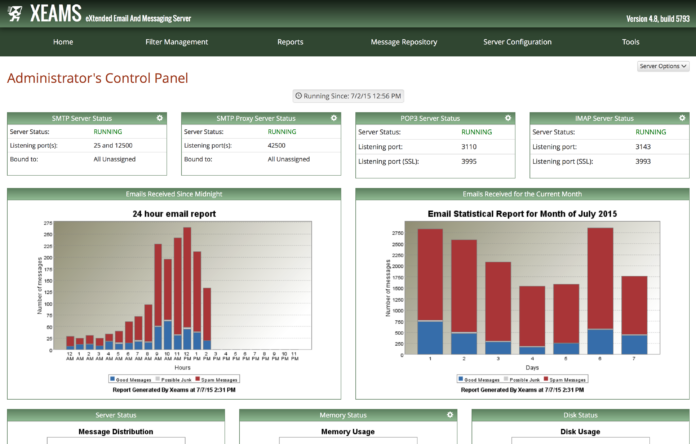
Xeams, whose name stands for eXtended Email And Messaging Server, functions as a comprehensive on-premise and cloud-capable email security platform. It’s designed to sit between an organization and the outside world, filtering spam, blocking phishing attempts, catching ransomware payloads before they land in an inbox, and preventing sensitive data from leaking out through email in the first place. Over its many version cycles, Xeams has built out support for the authentication and validation standards that modern email security depends on: DMARC, SPF, DKIM, and encryption protocols that protect messages end to end. It also offers archiving, clustering for high availability, and detailed reporting tools that give administrators visibility into what’s moving through their mail servers at any given moment.
What distinguishes Xeams from a typical hosted email security add-on is precisely that on-premise flexibility. An organization running Xeams isn’t handing its email traffic and metadata to an outside cloud vendor. It’s running the platform on infrastructure it controls, which matters enormously to businesses in regulated industries, government-adjacent contractors, and any organization for which data sovereignty isn’t optional.
The 10.3 Release: A Modernized Interface Paired With Deeper Administrative Control
Xeams 10.3, identified internally as Build 6436, arrives as the latest step in a release cadence that has moved quickly over the past year. Synametrics pushed out Version 10.0 in January, addressing the industry-wide shift away from basic SMTP authentication as Microsoft 365 and Google Workspace phased it out, a change that had left legacy devices like printers, scanners, and older monitoring tools unable to send mail through modern cloud providers. That was followed by Version 10.2 in the spring, which focused heavily on SSL certificate automation, tightening the integration with Let’s Encrypt so that new certificates could be applied without restarting the server and renewed automatically on a shorter, more security-conscious cycle.
Version 10.3 continues that same throughline of pairing a modernized user experience with expanded administrative depth. The release brings a refreshed web-based interface, continuing Xeams’s long-standing approach of managing the entire server through a browser rather than a separate desktop application, and it extends single sign-on support so administrators and end users can authenticate directly through Microsoft and Google Workspace identity providers. That’s a meaningful convenience for IT teams managing accounts across a hybrid environment of on-premise infrastructure and cloud-based identity systems, since it means one fewer set of credentials to manage and one less point of friction for end users logging into their mail accounts.
Underneath the interface changes, Xeams 10.3 keeps building on the security architecture the platform has spent years refining: AI-assisted threat detection tuned to catch phishing attempts and impersonation attacks, quarantine and reporting tools that give administrators a clear picture of what’s being blocked and why, and the kind of granular configuration options that let a company’s IT staff tailor the platform to their specific compliance requirements rather than accepting a one-size-fits-all default. For organizations already running Xeams, the update continues a pattern Synametrics has followed release after release: incremental, security-first improvements delivered through a built-in update manager rather than a disruptive migration.
Why a Company Like This Matters More Than Its Name Recognition Suggests
There’s a broader story here that goes beyond a single version number. Synametrics operates in a corner of the software industry that rarely makes headlines, precisely because doing the job well means nobody notices you’re doing it at all. Email security, database tooling, and backup infrastructure are the kind of unglamorous categories that only become visible when something goes wrong: a phishing email that gets through, a backup that fails at the worst possible moment, a database migration that goes sideways. Synametrics has spent close to thirty years building tools meant to make those failure moments rarer, and the fact that its products serve more than 50,000 enterprises without the brand recognition of a Google or a Microsoft says something about how it has chosen to compete. Rather than chasing market visibility, the company has built a reputation among the technical staff who actually have to keep infrastructure running, the people who care less about a flashy product launch and more about whether a tool does exactly what it promises, release after release, for years at a time.
That approach has aged well. As more organizations grow uneasy about how much of their infrastructure, and how much of their data, lives inside someone else’s cloud, the self-hosted, on-premise model Synametrics has built its entire product line around looks less like a legacy holdout and more like a deliberate hedge against exactly the kind of third-party dependency that has become a genuine liability for businesses that prize data privacy and operational control. Xeams 10.3 is a small, incremental release in the grand scheme of software history. But it’s also a snapshot of a New Jersey company that has spent nearly three decades quietly proving that infrastructure you own and control still has a real place in a market that keeps insisting everything belongs in someone else’s cloud.