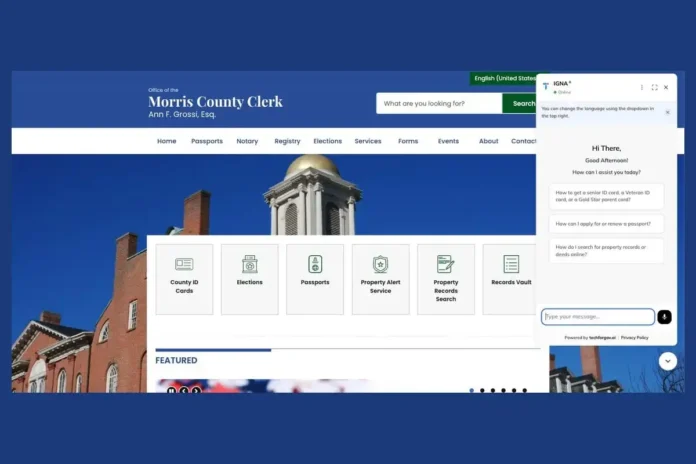

Ask anyone who has ever tried to renew a passport at a county office, track down an old property deed, or figure out which form covers a notary application, and you’ll hear the same complaint: government information is out there, but finding it shouldn’t feel like a research project. Morris County Clerk Ann F. Grossi is betting that a new AI-powered virtual assistant, now live on the Clerk’s Office website, can close that gap for good.
The tool went live this week, and county officials are calling it a first for New Jersey. No other county clerk’s office in the state has rolled out a resident-facing, AI-driven virtual assistant of this kind, according to the announcement from Grossi’s office. That distinction is not just a marketing line. It reflects a broader shift happening quietly across local government, where offices that have historically run on phone trees, paper forms, and posted office hours are beginning to experiment with tools that never clock out.
What the Assistant Actually Does
Strip away the buzzwords and the function is straightforward. The Virtual Assistant answers questions about the core services the Morris County Clerk’s Office handles every day: passport applications, property records, elections and voter information, business registrations, notary public services, and veterans’ records. It’s built to be available around the clock, seven days a week, which means a resident wondering at 9 p.m. whether they need an appointment for a passport renewal doesn’t have to wait until morning to find out.
That always-on availability is really the heart of the pitch. Government offices operate on business hours. Questions about government services don’t. Anyone who has ever needed an answer at an inconvenient time understands the disconnect, and this tool is a direct attempt to close it.
Importantly, the assistant is not positioned as a replacement for the people who work at the Clerk’s Office. It’s designed to sit alongside them, handling the repetitive, common questions so that staff can spend more time on the cases that actually need a human being: complicated property record searches, in-person passport processing, or the kind of detailed guidance that a chatbot simply isn’t built to give. Clerk Grossi framed it that way in her own remarks, noting that residents “deserve quick, reliable access to information” whether they’re dealing with a passport, a property search, or a question about an upcoming election, and that the new system is meant to deliver exactly that without displacing the personal service the office is known for.
The Partners Behind the Build
Morris County didn’t build this system alone. The Clerk’s Office worked with two outside firms to plan, develop, and deploy the assistant: TechForGov, a government technology company that focuses on secure AI tools for public agencies, and Arlington Analytics, a consulting firm that helps public sector organizations put data and AI to work in their operations.
Himanshu Goil, the founder and CEO of TechForGov, described the collaboration as an example of how AI can be harnessed specifically to improve the resident experience, calling the partnership with Morris County an honor and framing the goal as pairing advanced AI with information residents can actually trust, so that people get accurate answers fast while staff are freed up to handle more complex, personalized work.
Michael Stanzilis, CEO of Arlington Analytics, struck a similar note, crediting Grossi’s willingness to modernize and arguing that the project shows how artificial intelligence can strengthen public service rather than replace it, by making government more accessible, more responsive, and more efficient. He went further, suggesting Morris County’s approach could serve as a model other local governments look to as they weigh their own path toward what he called responsible innovation in the public sector.
Why This Is a Bigger Deal Than It Sounds
It’s easy to read a press release like this and file it under routine government upgrade. But there’s a reason county clerks across the country are starting to pay attention to tools like this one, and it has less to do with novelty and more to do with math.
County clerk offices are, in practice, information hubs. They sit at the intersection of elections, property law, vital records, and business regulation, which means the range of questions that come through their doors is enormous, and a huge share of those questions are repetitive. Where is my polling place. What do I need to bring for a passport appointment. How do I search a deed. What’s the fee for a notary commission. These are not complicated questions in isolation, but multiplied across tens of thousands of residents, they add up to a significant amount of staff time spent answering the same handful of things over and over.
An AI assistant that can field those questions instantly, at any hour, changes the math on both sides. Residents get answers without waiting on hold or driving to a courthouse. Staff get more room to handle the harder cases: the property title dispute that needs a real records search, the passport applicant with a name discrepancy, the elections question that requires actual judgment. Grossi’s office is explicit that this is the intent. The system is designed to complement, not replace, the customer service the office already provides.
There’s also a modernization signal here that goes beyond Morris County itself. New Jersey has 21 counties, each with its own clerk’s office, each handling a similar mix of passport services, property records, and elections administration. If Morris County’s rollout works as intended, reducing call volume, cutting down on repeat visits for basic questions, and improving resident satisfaction, it becomes a template other counties can point to when they’re deciding whether to invest in similar technology. That’s precisely the outcome Stanzilis pointed to when he called Morris County an example other local governments could follow.
The Trust Question Nobody Can Skip
Any time artificial intelligence gets introduced into a government service, the same question follows close behind: can residents actually trust what it tells them? Government information carries real consequences. A wrong answer about a passport deadline can cost someone a trip. A wrong answer about a property record can cause real confusion in a legal or financial transaction. A wrong answer about an election deadline can, in the worst case, cost someone their vote.
That’s precisely why the language coming out of Morris County leans so heavily on words like reliable, accurate, and trusted. The Clerk’s Office frames the tool’s mission around providing information that is easy to understand while keeping the same standards of accuracy and transparency the office has always held itself to. TechForGov’s own description of its mission centers on pairing advanced AI with trusted government information specifically so that residents get accurate answers, not just fast ones.
Whether the assistant lives up to that framing over time is something residents will judge for themselves, one interaction at a time. But the emphasis on accuracy and transparency, rather than simply speed or convenience, is a notable choice, and it suggests the office understands what’s actually at stake in putting an AI system in front of the public for something as consequential as government records and services.
What This Means If You Live in Morris County
For residents, the practical upshot is simple. The Clerk’s Office website now has a tool that can walk you through the basics of passport applications, help you understand property record searches, answer election-related questions, explain the business registration process, clarify notary public requirements, and point you toward veterans’ records services, all without requiring a phone call or an office visit during business hours.
It won’t replace an in-person passport appointment, and it isn’t going to conduct a legal property search on your behalf. What it can do is shortcut the part of the process that used to eat up the most time: figuring out what you actually need to do next. For a lot of residents, that’s the part that matters most.
The Bigger Picture for New Jersey Government
Morris County’s launch lands at a moment when public agencies across the country, not just in New Jersey, are wrestling with how to modernize resident-facing services without losing the human touch that government is supposed to provide. The Clerk’s Office is staking out a position that AI and personal service aren’t in competition with each other, that the technology’s real value is in absorbing the repetitive workload so people can focus on the parts of the job that actually require a person.
Whether that balance holds up as more residents start using the tool, and whether other New Jersey counties follow Morris County’s lead, is the next chapter of this story. For now, Morris County has planted a flag as the first county clerk’s office in the state to try it, and the rest of New Jersey’s local governments are almost certainly watching to see how it plays out.