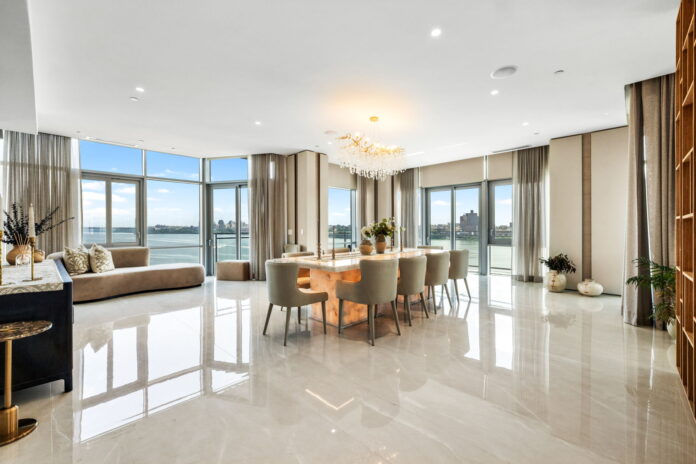

From a combined three-penthouse estate on the Hudson to a nine figure refinancing deal in Journal Square, New Jersey’s real estate market continues running hot at every price point, even as the statewide housing market shows early, modest signs of cooling.
A $45,000 a Month Penthouse and a $109 Million Tower Refinance Anchor This Week in NJ Real Estate
New Jersey’s real estate market delivered a genuinely wide range of headlines this week, spanning an ultra luxury waterfront rental unlike anything typically seen on the leasing market, a nine figure refinancing deal in one of the state’s hottest transit corridors, and fresh statewide data showing home prices still climbing even as the market shows the earliest signs of leveling off. Taken together, the week offers a useful snapshot of just how differently New Jersey’s real estate story is playing out depending on which corner of the market you’re looking at.
Three Penthouses, One 8,500 Square Foot Estate
The week’s most eye catching listing sits along the Hudson River in Edgewater, where a full floor residence created by combining three originally separate planned penthouses has hit the leasing market at 45,000 dollars a month. The fully furnished, roughly 8,500 square foot home at 1000 Portside Drive occupies an entire floor of its building and is wrapped in balconies on all four sides, delivering panoramic views spanning the Manhattan skyline, the Hudson River, and the George Washington Bridge simultaneously. The listing is being handled by Enrique Napoles and Mark Trompeter of SERHANT, who have described the residence less as an oversized apartment than as a private estate in the sky.
Napoles has framed the listing as evidence that New Jersey’s Gold Coast can genuinely compete with Manhattan’s own luxury market on scale and privacy, two qualities that have become increasingly difficult to find even at the highest price points directly across the river. Private showings are available strictly by appointment through the listing brokerage.
A $109.5 Million Bet on Journal Square
On the financing side of the market, the joint venture behind 425 Summit, the recently stabilized luxury apartment tower in Jersey City’s Journal Square neighborhood, has secured 109.5 million dollars in permanent financing. CBRE arranged the deal with Northwestern Mutual on behalf of the venture between Spitzer Enterprises and Arden Group, with the new loan retiring the construction financing that funded the building’s original development following its successful lease up and stabilization.
Completed in 2024 and sitting just one block from the Journal Square PATH station, 425 Summit is now 98 percent leased, spanning 390 units across studio, one, two, and three bedroom layouts, with structured parking, resident storage, and ground floor retail fronting Sip Avenue. CBRE Senior Vice President Matthew Pizzolato said the property represented a compelling opportunity in one of the region’s most dynamic residential markets, crediting the building’s transit connectivity, construction quality, and operating performance with drawing significant interest from lenders. The deal adds to a wave of major capital flowing into Journal Square specifically, where more than 10,000 apartments are currently under construction, joining recently financed projects including a 220 million dollar construction loan for the 56 story Imperial Tower and a 375 million dollar construction loan backing the 840 unit JFK Boulevard development.
The Statewide Market Keeps Climbing, Just a Little Slower
Zooming out to the broader statewide picture, New Jersey’s median home sales price climbed to somewhere between 585,000 and 598,000 dollars depending on the data source, reflecting a year over year increase of roughly 5.4 to 5.9 percent. Inventory has genuinely started loosening up alongside those rising prices, with active residential listings reaching 32,264 homes statewide, a 9.3 percent increase from a year earlier, while townhouse and condo listings specifically climbed 3.8 percent over the same span. That combination represents a real, if still modest, return of sellers to a market that has spent years defined by historically tight supply.
Even with more homes on the market, competition has not meaningfully cooled. Depending on the data source, homes are spending anywhere from roughly 24 to 41 days on the market before selling, and close to half of all listings, about 48.3 percent, are still fetching above their original asking price. Builders, for their part, have leaned into incentives like mortgage rate buydowns and closing cost credits to keep buyers engaged despite still elevated interest rates, a sign that even as inventory grows, affordability rather than availability remains the central obstacle standing between buyers and closed deals.
Industrial, Office, and a 45 Year First
Beyond residential activity, several notable commercial and industrial deals rounded out the week.
Cranbury Logistics
CBRE Investment Management acquired a major East Coast logistics portfolio including a 772,000-square-foot Cranbury warehouse.
Parsippany Office Leasing
Signature Acquisitions secured 78,000 square feet in new leases and expansions at 300 Kimball Drive.
Clifton Multifamily
A local apartment building sold for $3.8 million, its first sale in more than 45 years, according to Kislak.
NJHMFA Tax Credit Auction
The state housing agency raised $35 million through an affordable housing tax credit auction to fund new production statewide.
Harrison Riverbend, Phase Four
Advance Realty Investors secured a $173.4 million construction loan for Block B2, a 524-unit addition to its transit-oriented Riverbend District near the Harrison PATH station.
Berkeley Heights Redevelopment
A former corporate office campus is being converted into a large-scale, mixed-use live-work-play district as part of an ambitious 185-acre redevelopment plan.
Harrison’s momentum specifically continues building on land Advance Realty has spent years assembling near Sports Illustrated Stadium and the Harrison PATH station. Cushman and Wakefield arranged the new financing, which pairs a joint venture equity investment from Tel Aviv based Menora Mivtachim with construction financing from Northwestern Mutual, the same lender behind this week’s 425 Summit refinancing in Journal Square. The fourth phase alone will add 524 market rate units, more than 12,000 square feet of ground floor retail, and a 355 space parking garage to a district that has already delivered more than 900 apartments across three prior phases, with a full build out ultimately planned to reach roughly 3,800 residences once complete.
State Oversight and a Capital City Under Investigation
On the policy side, Trenton secured a 7.5 million dollar state grant aimed at stabilizing and demolishing vacant, hazardous city owned properties, part of a broader municipal push to address blighted parcels that have sat unresolved for years. That funding news arrived the same week New Jersey State Police detectives searched two offices inside Trenton City Hall, an investigation the state Attorney General’s Office confirmed involved the Division of Criminal Justice and the Office of Public Integrity and Accountability. According to Mayor Reed Gusciora and the Attorney General’s Office, the search centered on allegations that a former employee in the city’s Division of Inspections and Department of Housing and Economic Development failed to properly deposit money collected for permits into municipal accounts, a matter the city itself had identified, investigated internally, and referred to state prosecutors roughly two years earlier. No charges had been filed as of this writing, and the former employee has not been publicly identified.
Separately, state officials have moved to crack down on a newer and less visible practice in New Jersey’s rental market, issuing compliance actions aimed at landlords who use algorithmic rent setting software to help determine lease pricing. Critics of these tools have argued that when large numbers of landlords in the same market feed data into the same pricing algorithm, the software can function similarly to coordinated price setting, artificially pushing rents higher than a genuinely competitive market would otherwise produce, even without any direct communication between individual landlords. The state’s enforcement action reflects a broader wave of scrutiny such software has drawn from regulators and lawmakers across multiple states over the past two years.
Combined with the state housing agency’s affordable housing tax credit auction, which raised 35 million dollars specifically earmarked for boosting production statewide, the week’s policy activity points to continued public sector effort to address both the supply and the integrity of New Jersey’s housing market, even as private capital continues chasing the state’s most in demand residential and logistics assets at a considerably faster pace.