

The summer of 2026 has produced an unusually concentrated national conversation about what happened in Philadelphia in July 1776 — the ceremonies, the reenactments, the synchronized public readings, the tall ships in the harbor marking the 250th anniversary of a document that has been celebrated, contested, reinterpreted, and invoked across every political and cultural argument the country has had with itself for two and a half centuries. Against that backdrop of formal commemoration, a debut novel published by Historium Press is doing something that the fireworks and the flag-waving and the official readings of the Declaration cannot easily do: it is asking its readers to consider who else was in those rooms, and what it meant to have heard every word of a document proclaiming universal human liberty from the position of the person most directly and brutally excluded from its promise.
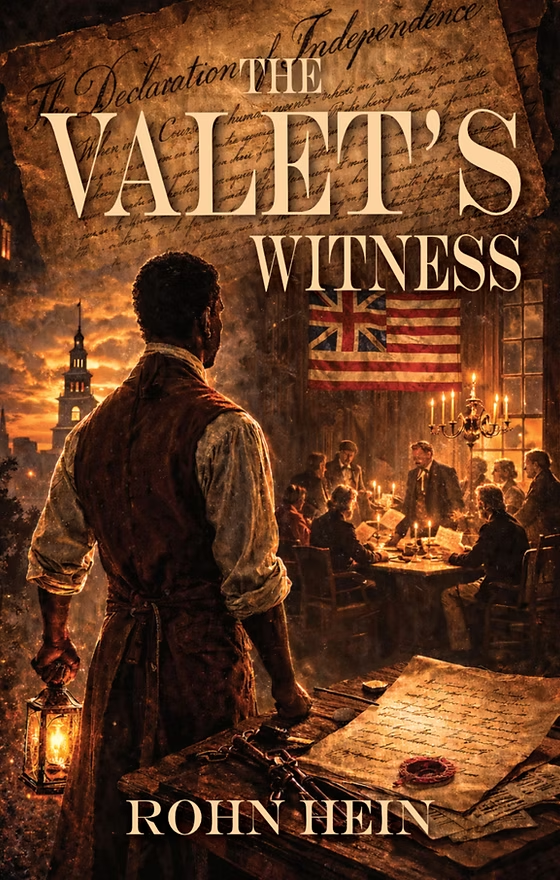
The Valet’s Witness, written by Rohn Hein, centers on two figures whose names appear in no official account of the Second Continental Congress’s deliberations. The first is Edward Rutledge, the youngest delegate to attend the Congress — he was 26 years old in the summer of 1776, representing South Carolina, a brilliant and strategically minded man who understood with clarity what the other delegates sometimes obscured in their enthusiasm for the revolutionary moment’s rhetoric. Rutledge understood that the institution of slavery was the economic foundation of his home state and the economic foundation of the Southern colonies generally, and that any document that condemned slavery, however indirectly, was a document that threatened the social and economic order he represented. He worked, with considerable political skill, to ensure that Thomas Jefferson’s original draft — which included a passage condemning the slave trade and, by extension, the institution it fed — was removed from the final text. He succeeded. The Declaration of Independence, as signed and as celebrated for 250 years, contains no condemnation of slavery, no acknowledgment of the humanity of the hundreds of thousands of enslaved people whose labor was making the economic prosperity of the nation’s founders possible. That outcome was not accidental. It was the product of deliberate negotiation, and Rutledge was one of its primary architects.
The second figure is Pompey, Rutledge’s enslaved valet — a fictional character who, in Hein’s construction, moves through the same charged physical spaces that the delegates occupy, but from the position that determines everything about the experience: invisible to the men conducting the business of national liberation, close enough to hear every debate, every compromise, every moment in which the gap between the document’s stated ideals and the lived reality of the people it excluded was openly, knowingly, and strategically navigated. Pompey does not speak in the chambers where the Declaration is being drafted. He is not consulted, acknowledged, or addressed. He passes through the narrow stairwells and service corridors that connected the Congress’s visible spaces to the kitchens, supply rooms, and back passages where the enslaved domestic staff moved through the building’s daily operations, carrying the information they had overheard in the rooms their labor made possible. In Hein’s telling, those corridors are not simply logistical infrastructure. They are a parallel intelligence network, a shadow Congress of servants and valets whose fragmentary, overheard knowledge of what was being decided above them constituted an unofficial and unrecorded account of the nation’s founding.
The historical record that Hein is drawing on and fictionalizing is not a matter of speculation. Jefferson’s original draft of the Declaration did contain a passage attacking the British Crown specifically for introducing and sustaining the slave trade — a passage that the Continental Congress removed during the editing process to secure Southern delegates’ support for the full document. Jefferson, who wrote the most eloquent and famous statement of universal human equality in the history of American political writing, owned more than 600 enslaved people over his lifetime and freed only a handful of them, including two of his own children, and only after his death, when the financial pressures of his estate made the dispositions unavoidable. The men who gathered in Philadelphia in July 1776 were not naive about these contradictions. They were intelligent, politically sophisticated, and acutely aware of the gap between what the Declaration proclaimed and what the social order they were protecting required. Edward Rutledge, in particular, left enough of a documentary record that historians have been able to reconstruct his specific role in ensuring that the slavery passages were removed — making him a historically documented figure whose fictional representation in Hein’s novel has genuine archival grounding, even as the novel’s specific scenes and conversations are imagined rather than transcribed.
What makes The Valet’s Witness particularly well-timed for its moment — and particularly relevant to the New Jersey and Philadelphia regional audience that has been living inside the 250th anniversary commemorations all summer — is its insistence on holding both realities simultaneously without collapsing one into the other. The novel does not argue that the Declaration was worthless because its authors were hypocrites. It does not argue that the hypocrisy is irrelevant because the ideals themselves have proven durable. It argues, through the specific dramatic situation it creates between Rutledge and Pompey, that both of these things are simultaneously true and that the distance between them is the central unresolved tension of American history — the tension that produced the Civil War, the Reconstruction era and its violent undoing, the civil rights movement of the twentieth century, and the ongoing arguments about what American democracy means and for whom it was designed.
Hein has spoken publicly about the specific intellectual challenge that the novel presented — how to render the founding moment from the perspective of someone whose subjective experience of that moment was radically different from the experience of the men whose names appear at the bottom of the document, while maintaining the historical discipline that serious historical fiction requires. The slave valets who served the Continental Congress delegates were real people whose names, in most cases, were not preserved in any official record. Pompey is a fictional composite rather than a documented individual, but the social position he occupies — enslaved domestic worker with intimate access to the private conversations and deliberations of politically powerful white men — is historically documented across the entire period of American slavery. The information networks that enslaved people maintained, sharing knowledge gleaned from their positions of forced proximity to power, are a documented historical phenomenon that scholars of slavery have written about extensively, and Hein’s novel formalizes that phenomenon as a central narrative device.
The structural choice of telling the story from within the corridors and service passages rather than from inside the chambers themselves is both historically honest and narratively powerful. Pompey does not know everything that happens in the rooms he cannot enter. His account is fragmentary, partial, and dependent on what he can overhear from the passages, what other valets relay through the informal information network the novel constructs, and what he can infer from the behavior of the men he serves and observes at close quarters. That partiality is the point: the novel is explicitly organized around the contrast between the official history written by those with the power to shape its narrative and the fragile, incomplete, unrecorded memories of the people who were present but excluded from authorship. The title itself — The Valet’s Witness — signals what the novel is claiming: that there is a different kind of witnessing available to those who are present without power, and that the account produced from that position is not simply a supplement to the official record but an indictment of what the official record chose to include and exclude.
The timing of the novel’s arrival in the summer of America’s 250th birthday is exactly the kind of juxtaposition that serious historical fiction works best in the presence of. When New Jersey residents travel to Philadelphia this summer for the Wawa Welcome America festival, the synchronized Declaration readings, or the Sail 4th 250 maritime celebration, they are participating in commemorations built around a specific, celebratory account of what happened in that city in 1776. The Valet’s Witness is asking what happens when that account is read alongside the account that Pompey’s descendants — the descendants of the people who were physically present in that building but excluded from its most consequential decisions — might tell about the same summer, the same rooms, the same document. The novel’s answer is not comfortable. It is not meant to be. It is, however, historically grounded, fictionally disciplined, and available at exactly the moment when the 250th anniversary commemorations have put the summer of 1776 back at the center of American public attention in a way that makes Hein’s specific intervention timely rather than merely interesting.
The Valet’s Witness is available in hardcover and as an ebook through Historium Press and major online retailers. For readers who spent this summer in Philadelphia or along the New Jersey shore during the America 250 events, engaging with Hein’s novel as a complement to the commemorative experience provides the kind of friction — the kind of deliberately uncomfortable historical perspective — that the official commemorative calendar is not designed to provide. The Declaration of Independence was read aloud in Morris County on July 8, in synchronized readings that connected New Jersey to every other state in the country at the exact moment the document was first proclaimed publicly 250 years ago. The Valet’s Witness asks who else was listening that day, from which doorway, with what understanding of what the words actually promised and what they deliberately omitted.
















