
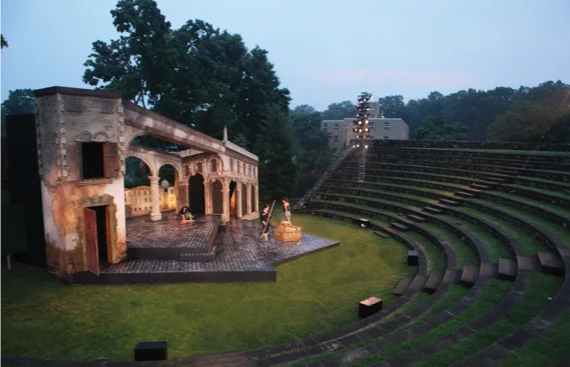

Two Convent Road in Morris Township is not the address that most New Jersey summer theater attendees would think to look up. It does not appear on the marquee of any commercial entertainment district. The nearest landmark for someone arriving by public transit is the Convent Station stop on the NJ Transit Morris and Essex Lines, and the walk from the platform to the venue crosses the campus of Saint Elizabeth University in a way that produces, at a certain point, a moment of genuine surprise: a Greek amphitheater, built entirely of local fieldstone and concrete, with tiered semi-circular seating carved into a natural hillside and a grass performance space at its center, surrounded on all sides by trees old enough to have grown into a canopy that closes overhead on summer evenings. The building is called The Greek Theatre. It was constructed in 1932 by the Sisters of Charity, who operated the institution then known as the College of Saint Elizabeth, so that the students of the all-women’s college could perform classical plays, pageants, and graduation ceremonies in an outdoor setting modeled explicitly on the Theatre of Dionysus in Athens. It is one of the only amphitheaters of its type in the United States, and every summer since 2002, the Shakespeare Theatre of New Jersey has been presenting professional productions in it.
The Dionysus connection embedded in the amphitheater’s design is not ornamental. The Theatre of Dionysus on the south slope of the Acropolis in Athens is the literal birthplace of Western drama — the oldest surviving theater in the world, the site where Sophocles, Euripides, and Aristophanes first brought their tragedies and comedies before Athenian audiences in the fifth century BCE, and the architectural template from which every subsequent theater design, across twenty-five centuries and every inhabited continent, ultimately derives. Building the College of Saint Elizabeth’s outdoor performance space in the image of that original is a specific and serious choice rather than a decorative one. It places the women who would perform there in direct material lineage with the oldest tradition of theatrical performance in human history, and it creates a physical environment whose acoustic and visual design reflects principles that have been empirically validated across two and a half millennia of use. The semi-circular seating arrangement that bounces sound from the performance space up through the tiered stone rows does not require significant electronic amplification to be effective — the shape itself does the acoustic work, which is why the designers of the ancient world built theaters this way, and why audiences at The Greek Theatre in Morris Township find themselves hearing Shakespeare’s language with a clarity and directness that many modern indoor theaters, with all their sound system technology, do not reliably produce.
The Sisters of Charity built the amphitheater in 1932, and the structure they created was not diminished by the nine decades that followed, though it was significantly neglected. By the late twentieth century, the original masonry had become overgrown and underutilized, the campus’s performance culture having shifted indoors and the theater’s maintenance having fallen behind what its continued use would have required. The Shakespeare Theatre of New Jersey’s partnership with Saint Elizabeth University, formalized in 2002, was the event that changed the theater’s trajectory: the company undertook a comprehensive restoration of the original fieldstone masonry, installed modern theatrical sound and lighting systems that integrate with the amphitheater’s structure without overwhelming its historic character, and inaugurated the Outdoor Stage program that has since become one of the most distinctive annual offerings in the New Jersey arts calendar. The Wall Street Journal recognized the Shakespeare Theatre of New Jersey as the Best Company of the Year in 2014, and the outdoor amphitheater at Saint Elizabeth University is among the physical and programmatic assets that earned the company that reputation.
What the theater looks like in practice, on a summer evening when the gates open ninety minutes before the production begins, is worth describing in some detail for anyone who has not been. The audience does not arrive to assigned seats and stadium rows. They arrive to the tiered stone hillside with blankets, folding chairs, and the elaborate provisions that the theater’s picnic culture has inspired over twenty-plus years of outdoor season programming: wine and cheese, fruit and bread, full-spread suppers laid out on the grass slopes while the sky above the amphitheater changes from late afternoon blue through the gradual gradient of a summer sunset. The trees that surround the performance space are fully grown enough to create enclosure without obstruction, and the particular quality of evening light filtered through that canopy — the specific gold that precedes the hour before dark in the Jersey summer — is something that no interior theater, however designed, can replicate. The grass performance space itself is where the actors will appear, emerging from the trees that function as natural wings and backstage corridors, crossing the outdoor stage whose edges are defined by where the forest begins rather than by any architectural boundary. The theater can accommodate approximately 450 people per performance, which keeps the gathering intimate enough that the distance between audience and performer never reaches the remove that large-scale outdoor festivals produce.
The specific experience of watching Shakespeare performed in this space carries qualities that the playwright’s work rewards specifically. Shakespeare’s company, the Lord Chamberlain’s Men, performed in the open-air Globe Theatre, an outdoor venue whose acoustic and atmospheric conditions were not fundamentally different from what The Greek Theatre produces in Morris Township — the ambient sounds of the environment, the visible relationship between weather and performance, the collective experience of a shared outdoor space in which the artificial boundary between the theatrical world and the natural world is permeable in both directions. When a line from a Shakespearean comedy lands against the sound of crickets in the surrounding woods, or when a dramatic pause coincides with the moment the sun drops below the tree line and the stage lights take over from the fading natural light, the conjunction is not accidental. It is the theater working the way outdoor theater has always worked, integrating its setting rather than defending against it.
The Shakespeare Theatre of New Jersey’s ticketing policy for the outdoor stage reflects the organization’s explicit commitment to making its programs accessible to the full range of the community it serves. Children age 17 and under receive free tickets, a policy that transforms the calculus of a family outing considerably — a parent who can bring two children to a professional Shakespeare production without paying for their tickets is participating in a different kind of cultural access than one who must budget for the full family at professional theater prices. The 30 Under 30 discount program addresses the access barrier for young adult audiences specifically, acknowledging that building the next generation of serious theatergoers requires making serious theater financially available to that generation at the point in their lives when the habit forms. The result of these policies is a summer audience at The Greek Theatre that genuinely spans age ranges and family configurations in ways that single-price professional theater venues rarely produce, which is part of what gives the amphitheater’s atmosphere its specific character on a performance evening.
The 2026 Outdoor Stage production is Rogue Shakespeare’s The Merry Wives of Windsor, which runs August 14 through August 23 at The Greek Theatre on the Saint Elizabeth University campus. Rogue Shakespeare is the company’s outdoor production format: minimally staged, maximally physical, designed to meet the open-air amphitheater on its own terms rather than importing the technical apparatus of an indoor production into an environment that the play’s energy should fill on its own. The Merry Wives of Windsor, Shakespeare’s fast-moving domestic comedy about the women who repeatedly outsmart the self-aggrandizing Falstaff, is well suited to the outdoor format and to the specific acoustic and atmospheric qualities of The Greek Theatre — broad comedy, physical situations, the kind of collaborative audience energy that summer evening outdoor performance generates. Tickets and information are available through the Shakespeare Theatre of New Jersey’s website. The Convent Station train station is the most convenient public transit access point for the venue, with the campus accessible by a short walk from the platform. For Morris County residents and for visitors willing to make the trip to 2 Convent Road, the Greek Theatre is the thing.
















