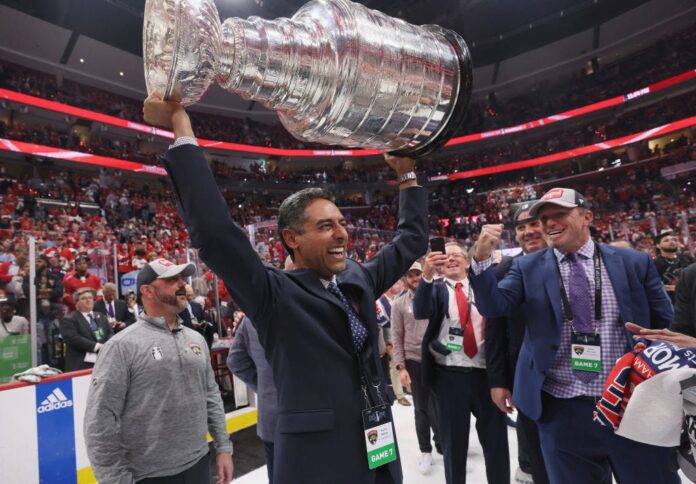

The next chapter for the New Jersey Devils has officially begun, and it is already unfolding with urgency, scrutiny, and a level of organizational recalibration that signals just how pivotal this offseason will be—not only for the roster, but for the identity of the franchise itself. As of April 24, 2026, the most significant development surrounding the team is the arrival of new General Manager Sunny Mehta, whose hiring represents both a strategic pivot and a clear message from ownership that the status quo is no longer acceptable.
This is not a routine transition. It is a calculated reset following a season that fell short of expectations, where a 42-37-3 record ultimately left the Devils outside the postseason picture. For a team that had positioned itself as an emerging contender in recent years, the failure to qualify for the Stanley Cup Playoffs underscores the gap between potential and execution—a gap Mehta has been brought in to close with precision.
Ownership, led by Josh Harris and David Blitzer, did not move passively in securing Mehta. Their pursuit was deliberate and aggressive, driven in part by the understanding that his profile as a rising executive made him a target for multiple franchises across the league, including major-market competitors. That urgency reflects the stakes: the Devils are no longer rebuilding—they are recalibrating in pursuit of contention.
At the center of this transition is a front office philosophy expected to lean heavily on modern roster construction principles, data-informed decision-making, and a willingness to challenge assumptions that may have guided prior personnel strategies. Mehta’s early presence has already created a sense of direction internally, even as the external questions surrounding the team continue to mount.
One of the most immediate and consequential uncertainties involves head coach Sheldon Keefe. While no formal decision has been announced regarding his status for the 2026–27 season, the discussion itself is indicative of the broader evaluation underway. Coaching continuity can offer stability, but in a results-driven league, it must be weighed against performance metrics and alignment with the new general manager’s long-term vision. Whether Keefe remains behind the bench or becomes part of the transition will signal how aggressively Mehta intends to reshape the organization.
Beyond the bench, the roster itself presents a complex matrix of decisions that will define the trajectory of the franchise over the next several seasons. At the forefront is captain Nico Hischier, who is entering the final year of his contract and becomes eligible for an extension on July 1. Hischier represents more than just production; he is the structural backbone of the team’s leadership core. Any negotiation surrounding his future will carry implications not only for cap management but for the cultural continuity of the locker room.
The Devils must also address a group of pending unrestricted free agents, including Evgenii Dadonov, Zack MacEwen, and Dennis Cholowski. These decisions, while less headline-driven than franchise cornerstone contracts, are equally critical in shaping depth, flexibility, and roster balance. In a league governed by tight salary cap constraints, secondary moves often dictate whether a team can sustain competitiveness over an 82-game season.
Perhaps the most polarizing conversation surrounding the Devils right now centers on Timo Meier. Once viewed as a cornerstone acquisition when he arrived at the 2023 trade deadline, Meier’s trajectory has become a focal point of debate due to a steady decline in offensive production relative to his contract value. Signed to an eight-year deal carrying significant cap implications, Meier was expected to anchor the team’s scoring depth. Instead, his output has trended downward over multiple seasons, culminating in a 2025–26 campaign that raised legitimate concerns about long-term return on investment.
This is where Mehta’s decision-making framework will be tested early. Moving a player of Meier’s profile is not simply a hockey decision—it is a financial and strategic one that involves contract retention considerations, trade market dynamics, and timing within the broader cap landscape. With the NHL salary cap projected to rise in coming seasons, the calculus becomes even more nuanced. The Devils must determine whether patience yields a rebound or whether proactive asset management is the more disciplined approach.
Defensively, similar questions persist. Veteran presence, including players like Brenden Dillon, has been evaluated not just through performance metrics but through cost-efficiency and roster fit. Clearing cap space to reallocate resources toward higher-impact contributors could become a priority, particularly if the organization identifies opportunities to upgrade both blue-line mobility and transitional play.
Amid the uncertainty, there are undeniable bright spots that reinforce why the Devils remain a team with significant upside. Jack Hughes continues to elevate his profile as one of the league’s premier talents, and his recent international success—delivering a gold medal for Team USA with a decisive “Golden Goal” performance at the 2026 Winter Olympics—only amplifies his stature. Hughes is not just a franchise player; he is a defining figure whose trajectory aligns with the competitive window the Devils are trying to reestablish.
Supporting him, Jesper Bratt has maintained his role as a consistent offensive contributor, while Luke Hughes represents the next wave of defensive evolution, bringing skill, pace, and modern puck-moving capabilities that are essential in today’s NHL structure. In net, Jacob Markström experienced a challenging statistical season, but goaltending volatility across the league suggests that bounce-back potential remains within reach, particularly with improved defensive support.
What defines this moment for the Devils is not a lack of talent—it is the necessity of alignment. Talent alone does not translate into sustained success without structural cohesion, role clarity, and consistent execution. The gap between where the Devils are and where they expect to be is no longer theoretical; it is measurable, and it is driving every decision being made at the organizational level.
For fans across New Jersey, this offseason carries a different kind of anticipation. It is not rooted in speculation alone, but in the understanding that meaningful change is already underway. The introduction of a new general manager, the evaluation of coaching leadership, and the potential reshaping of the roster all point toward a franchise that recognizes the urgency of its situation and is willing to act decisively.
Those looking to track every development, roster move, and organizational shift as it happens can follow ongoing coverage through the New Jersey Devils section on Explore New Jersey, where the full scope of this evolving story continues to unfold.
The Devils are not starting over. They are refining, recalibrating, and, most importantly, redefining what the next phase of their competitive window will look like. In a league where momentum is fragile and opportunity is fleeting, the decisions made over the coming months will determine whether this team reclaims its trajectory—or continues to search for it.