
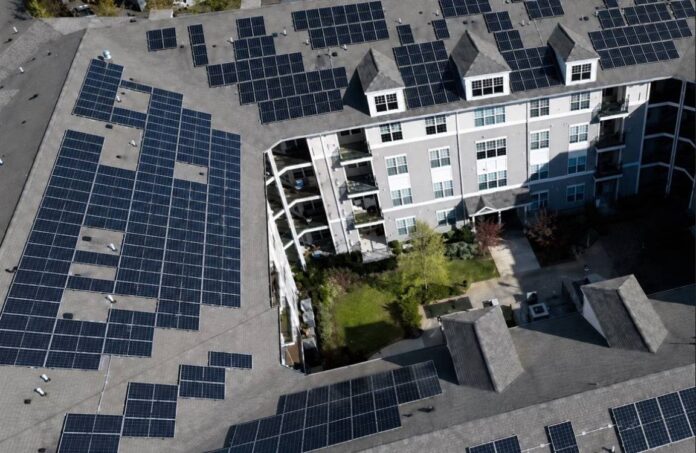

New Jersey’s renewable energy transformation continues to accelerate, and one of the latest examples of that momentum can now be found in Morris County, where a major solar installation has been completed atop an AvalonBay residential community in Boonton. The finished project, developed through a partnership between PowerLutions Solar, REV Energy Ventures, and AvalonBay Communities, represents far more than another rooftop solar array. It showcases the growing role that innovative engineering, sustainable development, and clean-energy investment are playing in reshaping how multifamily housing communities operate throughout the Garden State.
As New Jersey continues pursuing ambitious clean-energy objectives while balancing growing residential demand, projects like the newly completed Boonton installation provide a compelling glimpse into how existing communities can reduce operating costs, lower environmental impacts, and contribute to a more resilient energy future without requiring massive new land development. The achievement also highlights the increasingly important role that solar technology is playing in apartment communities, condominium developments, and other multifamily residential properties where traditional renewable energy solutions have often faced unique logistical challenges.
The Boonton project consists of a 747-kilowatt direct current rooftop solar system designed across multiple residential buildings within the AvalonBay community. While that figure alone represents a significant renewable energy investment, the true story lies in what the system will deliver over time. The installation is expected to generate approximately 821 megawatt-hours of clean electricity annually, producing enough energy to offset the equivalent annual power consumption of roughly 79 average homes.
In practical terms, that means thousands of dollars in electricity savings over the life of the project while simultaneously reducing reliance on traditional fossil-fuel-generated power sources. The environmental impact is equally noteworthy. The system is projected to eliminate approximately 300 metric tons of carbon dioxide emissions every year, helping reduce the community’s overall carbon footprint while supporting broader state and regional sustainability initiatives.
For New Jersey, a state where available land remains limited and development pressures continue increasing, rooftop solar projects have become an increasingly valuable strategy for expanding renewable energy production. Rather than consuming agricultural land or open space, rooftop installations leverage existing structures to generate electricity where it is needed most. Multifamily communities present an especially attractive opportunity because they combine large roof footprints with significant electricity demand, creating ideal conditions for distributed energy generation.
Yet multifamily solar projects often present engineering challenges that do not exist in traditional single-family residential installations. Apartment communities typically feature multiple structures, separate electrical systems, varied roof configurations, and utility interconnection limitations that can make large-scale renewable energy deployment far more complicated than it initially appears.
That complexity is precisely what makes the Boonton project stand out.
Rather than treating the property as a conventional solar installation, engineers designed a sophisticated system spanning 13 separate utility interconnections distributed across multiple residential rooftops. This approach allowed the development team to dramatically expand the amount of solar generation capacity available to the property without triggering costly utility infrastructure upgrades that frequently become obstacles for larger projects.
In many developments, expanding solar capacity beyond certain thresholds can require significant modifications to utility equipment and local grid infrastructure. Those upgrades often introduce additional costs, regulatory reviews, and lengthy timelines that can slow or even halt renewable energy projects altogether. By utilizing a carefully structured multi-interconnection design, the Boonton installation successfully maximized rooftop generation potential while maintaining compatibility with existing utility infrastructure.
The technical architecture of the project further reflects the evolution of modern solar technology. The installation incorporates high-performance Talesun solar modules paired with Enphase microinverter technology, providing individual panel-level monitoring and enhanced system management capabilities. Unlike traditional centralized inverter systems, microinverter configurations allow each panel to operate independently, improving performance, reliability, and long-term maintenance visibility.
This level of monitoring provides operational advantages that extend beyond energy production. Property managers can identify individual panel performance, quickly diagnose issues, and optimize overall system efficiency in ways that were far more difficult with earlier generations of solar technology. The result is a smarter, more responsive renewable energy asset capable of delivering consistent performance throughout its operational lifespan.
The project’s integration into New Jersey’s net-metering framework further enhances its value. Connected through Jersey Central Power & Light, the system enables electricity generated by the solar array to offset common-area energy usage throughout the residential complex. Common-area expenses such as hallway lighting, exterior illumination, community facilities, maintenance operations, and shared infrastructure can represent substantial operating costs for apartment communities. Reducing those expenses through on-site renewable energy generation creates long-term financial benefits that support both property operations and sustainability goals.
For AvalonBay Communities, one of the nation’s leading apartment developers and operators, the project reflects a broader industry shift toward environmental responsibility and energy efficiency. Across the country, residential developers increasingly recognize that sustainability has evolved from a marketing feature into a core operational strategy. Residents are paying closer attention to environmental performance, energy consumption, and the sustainability commitments of the communities they choose to call home.
That trend is particularly pronounced in New Jersey, where environmental stewardship, smart growth initiatives, and renewable energy investment have become central themes in economic development discussions. Municipal leaders, developers, utility providers, and sustainability advocates increasingly view clean-energy infrastructure as both an environmental necessity and an economic opportunity.
The completion of the Boonton project arrives during a period of unprecedented growth within New Jersey’s solar industry. The state has spent decades building one of the nation’s strongest renewable energy markets through supportive policies, incentive programs, and forward-looking regulatory frameworks. As a result, solar power has become an increasingly familiar part of the New Jersey landscape, appearing on homes, schools, warehouses, office buildings, industrial facilities, and now an expanding number of multifamily residential developments.
What makes the latest installation especially significant is its potential as a model for future projects. Multifamily housing remains one of the most challenging sectors for widespread solar adoption despite representing a substantial portion of the state’s housing inventory. Demonstrating that a large, technically complex apartment community can successfully deploy a sophisticated multi-building solar system creates a roadmap that other developers and property owners may soon follow.
The implications extend beyond a single property in Morris County. As New Jersey continues addressing housing needs, energy demands, and environmental goals simultaneously, projects that successfully integrate renewable energy into existing residential communities will become increasingly important. They offer a path toward cleaner electricity generation without sacrificing land resources while helping reduce operating expenses and improve long-term sustainability outcomes.
For residents driving through Boonton, the solar panels may simply appear as another modern infrastructure improvement. Behind the scenes, however, the completed installation represents a remarkable convergence of engineering innovation, environmental stewardship, private-sector investment, and long-term planning. It demonstrates how thoughtful renewable energy development can transform ordinary rooftops into productive clean-energy assets while helping advance New Jersey’s broader vision for a more sustainable future.
As communities across the state continue searching for practical ways to reduce emissions, strengthen energy resilience, and modernize residential infrastructure, the newly completed PowerLutions Solar project in Boonton stands as a powerful example of what can be achieved when technology, sustainability, and smart development work together toward a common goal. In many ways, it is not simply a solar project. It is a glimpse into the future of multifamily living in New Jersey.
















