
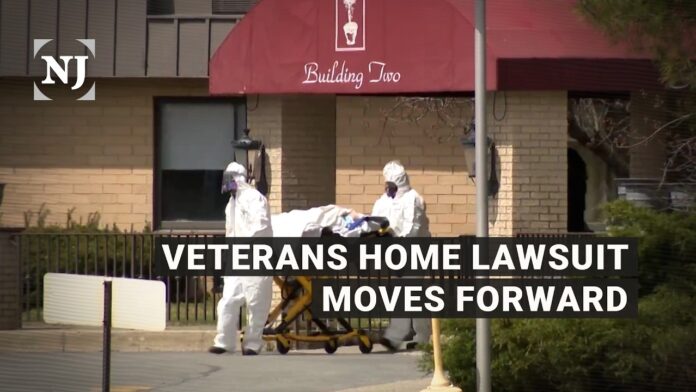

A Superior Court judge has cleared the way for more than 40 frontline nurses and aides from the Menlo Park veterans home to bring their pandemic era lawsuit to trial, after finding enough evidence that management’s early COVID decisions may have crossed the line from negligence into intentional harm.
NJ Veterans Home Workers Say They Were Told Masks Would Scare Residents. A Jury Will Now Decide If That Was Negligence or Something Worse.
A Middlesex County Superior Court judge has ruled that a lawsuit brought by more than 40 frontline healthcare workers from the state run veterans home in Menlo Park can proceed to trial, rejecting the state’s effort to shield itself behind standard workers’ compensation immunity. The lawsuit alleges that home administrators, during the earliest and deadliest weeks of the COVID-19 pandemic, made decisions that left nurses, nurse’s aides, and at least one physician directly exposed to a virus that ultimately killed hundreds of residents and multiple staff members at the state’s veterans facilities.
What the Lawsuit Actually Alleges
At the center of the case is what plaintiffs’ attorneys have described as a genuinely chilling early pandemic directive. According to court filings, Menlo Park administrators explicitly barred staff from wearing masks or gloves during the outbreak’s opening weeks, reportedly out of concern that visible protective equipment might frighten residents. Separate reporting on related litigation has described internal emails in which staff described working in direct proximity to symptomatic residents without any protective equipment at all, and at least one employee with a documented medical condition was reportedly sent home rather than permitted to wear a mask on the job.
Plaintiffs argue that decision went well beyond an ordinary workplace safety lapse, characterizing it instead as the deliberate removal of an essential protective measure at precisely the moment frontline staff needed it most. That distinction matters enormously under New Jersey law, since employees are typically barred from suing their employer directly over a workplace injury, confined instead to the workers’ compensation system regardless of how severe the harm turns out to be.
Why Piercing That Legal Shield Is a Genuinely Big Deal
New Jersey’s workers’ compensation system exists specifically to provide injured employees a guaranteed, no fault path to compensation while generally protecting employers from direct lawsuits over workplace injuries, however serious. Courts only allow an employee to bypass that system and sue an employer directly in narrow circumstances, typically requiring evidence that an employer knew a specific action was virtually certain to cause harm and pursued it anyway. Judge Slavin’s ruling that these plaintiffs cleared that bar, allowing their case to reach a jury rather than being dismissed outright, represents a genuinely significant legal threshold in a case involving state government defendants.
Part of a Much Larger, Already Costly Reckoning
This lawsuit does not exist in isolation. New Jersey’s veterans homes in Menlo Park and Paramus were among the hardest hit long term care facilities anywhere in the country during the pandemic’s earliest wave, with more than 200 resident deaths recorded across the state’s veterans facilities. The state has already paid more than 68 million dollars in settlements to the families of residents who died, a figure that reflects the scale of the tragedy but notably did not extend any compensation or protection to the frontline staff who were themselves treated, according to the current lawsuit, as an acceptable casualty of the crisis.
A scathing 2023 U.S. Department of Justice investigation separately found that the state had systematically violated residents’ civil rights through severe infection control failures and absentee management practices at these facilities, external federal findings that lend independent weight to allegations that have also surfaced repeatedly in years of related civil litigation. Earlier related lawsuits have described specific, documented cases, including a nursing assistant who took herself off duty against her supervisors’ wishes after developing COVID symptoms in order to avoid infecting coworkers and residents, only to be hospitalized and later die from the virus weeks afterward.
What Has Changed Since
In the years since that initial crisis, New Jersey has restructured how it oversees these facilities entirely, removing the veterans homes from the Department of Military and Veterans Affairs and placing them instead under a newly created, cabinet level Department of Veterans Affairs. Both the Menlo Park and Paramus facilities have since earned five star quality ratings from federal regulators, a marked turnaround from the conditions described during the pandemic’s earliest, deadliest weeks. That improvement does not resolve the pending litigation, however, and this case now moves toward trial as one of the more significant remaining pieces of accountability still working through New Jersey’s court system tied directly to the state’s handling of its veterans homes during the pandemic’s darkest early days.
This article describes allegations contained in ongoing civil litigation that has not yet gone to trial. The claims described here have not been proven in court, and defendants are entitled to present their own defense as the case proceeds.
















