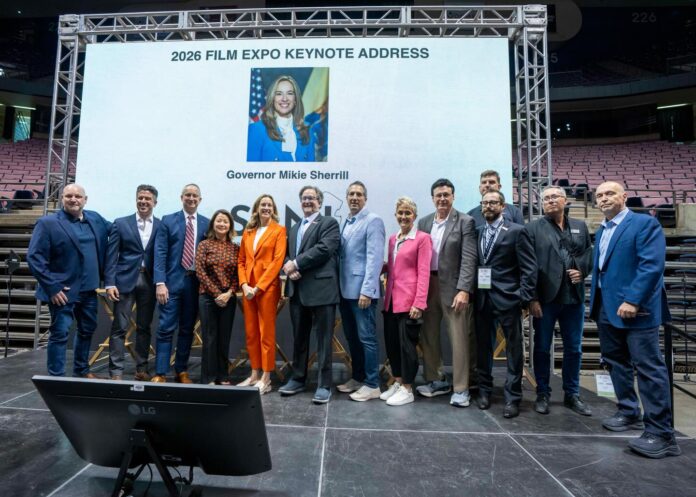

New Jersey is making an aggressive and highly calculated play to reclaim its place at the center of the American film industry, and the message from the stage at the Meadowlands could not have been clearer: this is no longer a quiet resurgence—it is a full-scale industry movement with economic weight, infrastructure investment, and global ambition. At the state’s second annual Film Expo, held inside the historic Meadowlands Arena, Governor Mikie Sherrill delivered a defining statement on the state’s cinematic future, positioning New Jersey as not just competitive—but determined to lead.
The setting itself carried symbolic significance. Once known as Byrne Arena and home to the New Jersey Nets and New Jersey Devils, the venue has evolved into a multi-use production environment, hosting large-scale events and increasingly serving as an active filming location. Its transformation mirrors the state’s broader pivot—repurposing legacy infrastructure into modern production assets that appeal to studios and content creators operating at every level of the industry.
The Film Expo drew approximately 4,000 attendees and featured around 80 vendors, creating a dense ecosystem of production companies, municipalities, service providers, and decision-makers. The objective was direct and pragmatic: connect the supply chain of filmmaking—from location scouting and permitting to post-production and workforce development—with the decision-makers shaping where and how content is produced in the United States. New Jersey is no longer asking for attention; it is building a system designed to capture it.
There is historical precedent behind the ambition. Long before Hollywood became synonymous with filmmaking, New Jersey was the industry’s original proving ground. The innovations of Thomas Edison and the early production work in Fort Lee positioned the state as a foundational force in cinema’s earliest days. The visual drama of the Palisades and the proximity to New York City created a natural production environment that attracted early filmmakers. While the eventual migration to California reshaped the industry permanently, New Jersey’s current strategy is rooted in reclaiming—not reinventing—its cinematic identity.
What distinguishes the present moment is the scale of financial and institutional commitment. New Jersey’s film and digital media tax credit program, offering incentives of up to 40 percent, has become one of the most competitive in the nation. This is not a symbolic policy—it is a strategic lever that has already delivered measurable results. Major industry players have responded with long-term investments that signal confidence in the state’s trajectory.
Netflix has announced plans for a significant production campus at the former Fort Monmouth site, a move that would anchor a new hub of content creation in Monmouth County. Lionsgate is advancing development of a major studio complex in Newark, reinforcing North Jersey’s role as a production corridor. Meanwhile, Paramount has secured space in Bayonne, further diversifying the geographic footprint of studio activity across the state. These are not isolated developments—they represent a coordinated buildout of infrastructure designed to support sustained, high-volume production.
The Expo also highlighted how municipalities across New Jersey are positioning themselves within this expanding ecosystem. Representatives from towns like Fair Lawn showcased redevelopment opportunities, including the adaptive reuse of legacy industrial sites such as the former Nabisco property. In Parsippany, local leadership emphasized the township’s logistical advantages and readiness to accommodate productions. This localized engagement is critical; the success of a modern film economy depends not just on tax incentives and studio space, but on a network of film-friendly communities capable of supporting shoots efficiently and at scale.
Governor Sherrill underscored the state’s competitive edge in one of the most practical terms possible: versatility. Few regions in the country offer the density of varied landscapes found within New Jersey’s borders. From coastal environments and dense urban corridors to suburban neighborhoods and wooded backdrops, the state functions as a compact production toolkit. Even Trenton has doubled as a convincing stand-in for Washington, D.C., illustrating the creative flexibility available to directors and location managers.
Equally important is the workforce component. The governor emphasized that New Jersey is not only attracting projects—it is building the talent base required to sustain them. From skilled trades and technical crew members to creative professionals across writing, design, and post-production, the state is aligning its labor market with the needs of a rapidly expanding industry. This alignment is essential if New Jersey is to transition from a desirable filming location to a fully integrated production powerhouse.
The economic implications are already substantial. When Happy Gilmore 2 filmed in New Jersey in 2024, the production generated approximately $152 million in economic activity for local businesses. That figure captures the multiplier effect of modern filmmaking—hotels, catering, transportation, construction, and local services all benefit from sustained production activity. Recent projects have continued that trend, with portions of films like Marty Supreme and Deliver Me From Nowhere utilizing the Meadowlands Arena as a filming location, further reinforcing the venue’s evolving role in the state’s production landscape.
Data now suggests that New Jersey is on track to become the third most active filming destination in the United States, trailing only California and New York. For many regions, that ranking would represent a ceiling. For New Jersey, it is being treated as a baseline. The state’s leadership has made it clear that the objective is not incremental progress—it is market leadership.
This momentum is unfolding against a broader national backdrop in which states are competing aggressively for film and television production, leveraging incentives and infrastructure to attract projects once automatically routed to Los Angeles or New York. New Jersey’s approach stands out for its balance of financial incentives, geographic advantages, and coordinated public-private investment. It is not simply chasing productions; it is constructing an environment where productions choose to stay.
The tone from the Expo reflected that confidence. Industry leaders, local officials, and policymakers were aligned around a shared objective: to position New Jersey as a destination where creative ambition meets operational efficiency. The message delivered from the stage resonated beyond the walls of the arena—New Jersey is no longer reintroducing itself to the film industry; it is asserting its place within it.
For ongoing coverage of New Jersey’s business climate, development strategy, and political leadership shaping industries like film and media, explore the latest updates in the politics section and continue tracking how the Garden State is transforming opportunity into sustained economic and cultural impact.