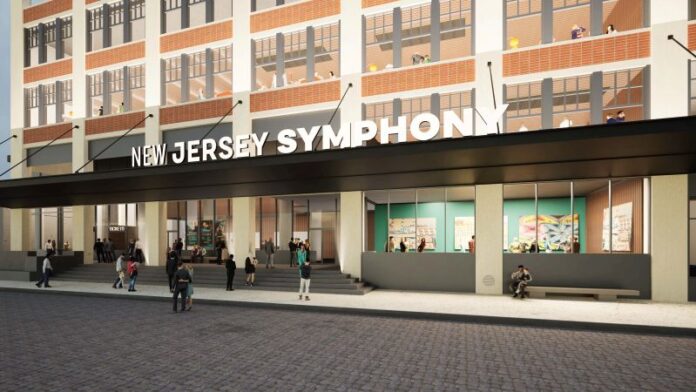

A transformative new chapter in New Jersey’s cultural future is officially taking shape in Downtown Jersey City as the New Jersey Economic Development Authority has approved a major $29 million tax credit to help construct a permanent performance venue for the New Jersey Symphony inside the rapidly evolving Powerhouse Arts District. More than simply another development announcement, the project represents one of the most ambitious investments in New Jersey’s performing arts infrastructure in recent memory and signals the continuing emergence of Jersey City as one of the Northeast’s fastest-growing cultural capitals.

The new theater, planned for the ground floor of the recently completed 151 Bay Street development, will create a long-awaited permanent Jersey City home for the New Jersey Symphony while dramatically expanding arts accessibility, educational programming, live performance opportunities, and civic engagement across Hudson County. The project combines large-scale cultural investment, modern urban development, and community-centered arts programming into a single vision that could permanently reshape the region’s entertainment and creative economy.
Located just steps from the Grove Street PATH Station in one of the state’s most aggressively developing neighborhoods, the future venue is designed to become far more than a traditional concert hall. Plans for the project include a 550-seat state-of-the-art theater alongside rehearsal spaces, production facilities, educational classrooms, workshop areas, and year-round programming spaces intended to support performances, public forums, cultural celebrations, after-school initiatives, and artistic collaborations across multiple disciplines.
The scale of the project reflects how dramatically New Jersey’s arts ecosystem has evolved in recent years.
For decades, major cultural institutions in the state remained concentrated primarily in Newark, Princeton, and select suburban arts corridors. But Jersey City’s explosive growth over the last fifteen years — particularly in the Powerhouse Arts District — has fundamentally altered that landscape. What was once viewed primarily as a commuter extension of Manhattan has steadily transformed into one of the most ambitious urban redevelopment stories anywhere in the Northeast, blending residential expansion, nightlife, culinary innovation, technology, public transit access, and increasingly sophisticated arts programming into a highly interconnected downtown environment.
The arrival of a permanent New Jersey Symphony venue now elevates that transformation to another level entirely.
The significance of the project extends beyond music itself because cultural institutions of this magnitude function as long-term civic anchors. They attract tourism, stimulate restaurant and hospitality spending, create educational partnerships, increase foot traffic for local businesses, and establish year-round economic activity that extends well beyond individual performances.
In practical terms, the venue is expected to host more than 100 public events annually, creating a constant stream of visitors moving through Downtown Jersey City’s restaurants, bars, hotels, galleries, and retail corridors. That frequency matters enormously because modern urban entertainment districts increasingly thrive on consistency rather than isolated mega-events.
The theater’s placement inside 151 Bay Street also reflects the growing integration between luxury residential development and cultural infrastructure in New Jersey’s largest cities.
The 34-story tower, developed through a partnership involving Toll Brothers and Sculptor Capital Management, stands alongside The Morgan residential complex within the broader Powerhouse Arts District redevelopment zone. The surrounding neighborhood has rapidly become one of the state’s densest concentrations of new mixed-use development, with projects such as Warren at Bay, 144 First Street, and 351 Marin helping reshape the district into a modern live-work-entertainment corridor.
Yet what distinguishes the New Jersey Symphony project from standard mixed-use development is its civic purpose.
Rather than functioning purely as a commercial amenity for nearby residents, the theater is being positioned as a publicly engaged cultural institution designed to serve both local neighborhoods and broader regional audiences. Plans for educational programming, workshops, youth engagement initiatives, and affordable arts access indicate a deliberate effort to ensure the project maintains community relevance rather than becoming an isolated luxury destination.
That emphasis on accessibility aligns closely with the broader mission the New Jersey Symphony has cultivated over the past several decades.
Founded in 1922, the orchestra has spent over a century evolving into one of the state’s defining cultural institutions. Although many residents now primarily associate the Symphony with its longstanding relationship with the New Jersey Performing Arts Center in Newark, the organization’s roots stretch even deeper into the state’s urban cultural history.
The Symphony’s predecessors were originally founded in Newark in the nineteenth century before later expanding operations into communities including Montclair and Orange. By the mid-twentieth century, the orchestra had returned to Newark as a fully established statewide institution, performing at the former Grand Mosque Theater — later renamed Newark Symphony Hall — before eventually relocating operations to NJPAC in 1997.
The Jersey City expansion therefore represents both a continuation and evolution of that legacy.
Rather than replacing Newark, the new theater broadens the Symphony’s physical footprint and extends its statewide accessibility into one of New Jersey’s fastest-growing urban regions. In many ways, the move reflects a larger statewide recognition that cultural infrastructure must expand alongside population growth and urban redevelopment if cities hope to sustain long-term economic vitality.
The investment also demonstrates how arts funding itself is increasingly being understood as economic development rather than discretionary spending.
The Cultural Arts Facilities Expansion program administered through the NJEDA reflects a broader strategy emerging throughout New Jersey: leveraging arts infrastructure to stimulate neighborhood revitalization, tourism growth, and economic diversification. Entertainment districts today function as economic engines capable of attracting both residents and businesses seeking vibrant, culturally active environments.
And Jersey City’s Powerhouse Arts District has become one of the clearest examples of that model in action.
Once heavily industrial, the district has steadily transformed into a creative and residential hub defined by adaptive reuse, modern towers, public arts initiatives, galleries, performance venues, and nightlife growth. The addition of a major Symphony theater dramatically accelerates the district’s evolution into a true cultural corridor capable of competing with major urban arts destinations throughout the region.
Equally important is what this project represents symbolically for New Jersey itself.
For decades, conversations surrounding world-class arts and entertainment infrastructure in the Northeast were dominated almost entirely by New York City and Philadelphia. But projects like this increasingly demonstrate New Jersey’s growing confidence in developing large-scale cultural destinations within its own cities rather than functioning solely as a commuter extension of neighboring metropolitan economies.
That shift matters because cultural identity increasingly influences how cities attract residents, businesses, tourism, and long-term investment.
And in Jersey City, the combination of public transit accessibility, residential growth, waterfront proximity, nightlife, restaurants, and now major performing arts infrastructure is rapidly creating one of the most compelling urban entertainment ecosystems anywhere in the state.
The theater itself will likely become one of the defining cultural landmarks of the next generation of Jersey City development.
Visitors attending Symphony performances, jazz showcases, multimedia productions, educational events, public forums, and cultural celebrations will experience not only the venue itself but the surrounding district’s broader transformation. Restaurants, cocktail lounges, hotels, galleries, waterfront spaces, and nightlife venues all stand positioned to benefit from the year-round audience traffic the project is expected to generate.
For New Jersey’s arts community, the project also sends a powerful message about the future.
At a moment when many arts organizations nationally continue navigating financial uncertainty, shifting audience habits, and post-pandemic rebuilding, the state’s willingness to support a large-scale permanent performance venue signals continued confidence in the long-term importance of live cultural experiences.
And in an era increasingly dominated by digital entertainment, projects like this reaffirm something essential: people still crave shared public experiences centered around music, performance, storytelling, creativity, and community.
That reality may ultimately be the most important aspect of the entire development.
Because while cranes, towers, tax credits, and construction plans define the project today, the true legacy of the new New Jersey Symphony venue will emerge later — when audiences begin filling seats, students begin attending workshops, musicians begin rehearsing inside its walls, and Jersey City gains not just another building, but a permanent new cultural heartbeat woven directly into the future of New Jersey itself.