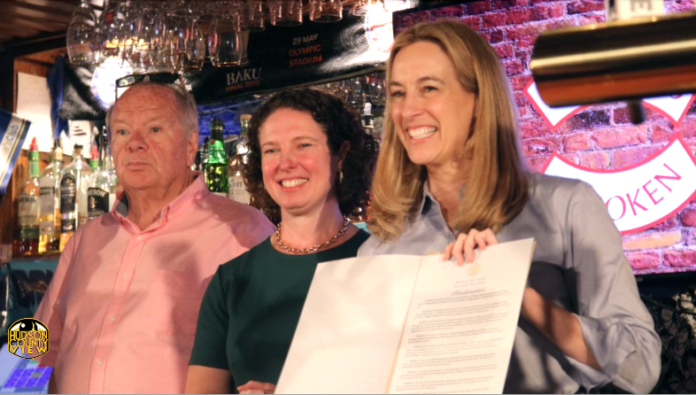

As New Jersey prepares to stand at the center of one of the largest sporting events in modern history, state officials are beginning to reshape how communities, restaurants, bars, and hospitality businesses will operate during the 2026 FIFA World Cup. In a move designed to maximize economic activity while transforming downtowns into international gathering spaces, Governor Mikie Sherrill has formally encouraged municipalities throughout New Jersey to consider extending bar and alcohol service hours during the tournament, signaling the state’s intention to fully embrace the global spotlight arriving next summer.
The announcement, made during a visit to Hoboken sports bar favorite Mulligan’s Pub, represents far more than a simple adjustment to nightlife regulations. It is part of a broader statewide strategy aimed at positioning New Jersey not merely as a neighboring host to World Cup activity, but as a primary destination for fans, tourism, entertainment, hospitality, and international cultural engagement throughout the 39-day tournament.
For New Jersey’s restaurant and bar industry, the implications could be enormous.
The World Cup routinely generates some of the highest hospitality spending figures of any global sporting event, with fans gathering for hours before and after matches in bars, restaurants, beer halls, outdoor plazas, hotel lounges, and entertainment districts. Unlike single-day events such as the Super Bowl, the World Cup creates nearly six continuous weeks of activity, producing sustained waves of tourism and nightlife traffic across host regions.
State officials clearly recognize the opportunity.
Under existing New Jersey law, municipalities already maintain significant authority over local alcohol service regulations, including the ability to determine permitted hours of sale for alcoholic beverages. Governor Sherrill’s proclamation does not mandate extended hours statewide. Instead, it formally notifies municipalities that they have the flexibility to temporarily adjust local ordinances during the World Cup while continuing to operate under oversight from the New Jersey Division of Alcoholic Beverage Control.
The strategy gives local governments the ability to tailor operating hours based on expected crowd levels, tourism demand, transportation infrastructure, public safety resources, and local business needs.
For cities like Hoboken, Jersey City, Newark, Atlantic City, and portions of the Meadowlands region expected to see substantial international visitor traffic, those extended operating windows could become a major economic driver for independently owned hospitality businesses preparing for one of the busiest periods in state history.
The significance of Hoboken serving as the backdrop for the announcement was not accidental.
Over the last decade, Hoboken has evolved into one of the region’s premier soccer-viewing destinations, with bars, pubs, and restaurants regularly packed during major international tournaments, Premier League matches, Champions League fixtures, and World Cup qualifying events. During global soccer competitions, establishments throughout the city often begin filling before sunrise, with supporters representing dozens of countries creating an atmosphere that mirrors European football districts more than traditional American sports culture.
That energy is expected to intensify dramatically during the 2026 tournament.
With MetLife Stadium set to host multiple World Cup matches — including the tournament final — New Jersey will effectively operate as one of the event’s central international hubs. Millions of visitors are expected to move throughout the greater New York-New Jersey region, bringing unprecedented attention to local hospitality businesses, transportation systems, entertainment venues, and nightlife corridors.
Governor Sherrill framed the announcement not simply as an economic measure, but as an opportunity for communities throughout New Jersey to showcase their identity, culture, and hospitality to a worldwide audience.
In many ways, the state is attempting to capitalize on a unique convergence of sports tourism, international visibility, and local economic revitalization.
For years, New Jersey’s hospitality industry has worked to recover from the long-term disruptions caused by the pandemic, inflation pressures, staffing shortages, and shifting entertainment habits. The World Cup now presents a rare opportunity for sustained business activity capable of generating significant revenue not only for stadium-adjacent establishments, but also for suburban downtowns, independent restaurants, local breweries, sports bars, and entertainment districts throughout the state.
The timing also reflects broader changes taking place within New Jersey’s nightlife and hospitality economy.
Over the last several years, municipalities across the state have increasingly leaned into outdoor dining expansions, mixed-use downtown development, brewery growth, and experiential entertainment models designed to create destination-based local economies. The World Cup provides an opportunity to accelerate those trends while introducing New Jersey communities to international audiences who may otherwise never experience them.
For bars and restaurants, extended operating hours could fundamentally reshape business projections during the tournament period.
Late-night match schedules, international time zone considerations, and staggered game windows are expected to create unusually long operating days for many establishments. Depending on the teams playing and fan demographics involved, some venues could see major activity beginning in the morning and extending deep into the night, particularly during knockout-stage matches and elimination rounds.
Hospitality operators throughout the state are already beginning preparations.
Many bars are expected to invest in expanded viewing setups, outdoor watch areas, upgraded audio systems, special menus, themed events, and multilingual staffing initiatives designed to accommodate diverse international crowds. Breweries and craft beverage producers are also positioning themselves for increased traffic as soccer tourism converges with New Jersey’s rapidly expanding independent beverage industry.
The state’s messaging surrounding public safety remains central to the initiative.
While encouraging municipalities to capitalize on the economic opportunities surrounding the World Cup, officials have simultaneously emphasized continued enforcement of responsible alcohol service practices, public safety coordination, and oversight through local law enforcement and the Division of Alcoholic Beverage Control.
That balance will likely define much of New Jersey’s broader World Cup strategy moving forward.
The state is attempting to position itself as energetic and globally welcoming without sacrificing operational stability during what will almost certainly become one of the most logistically demanding tourism events in regional history.
For many communities, the World Cup also represents something larger than business revenue alone.
It offers an opportunity for New Jersey to reshape how it is perceived internationally.
For decades, much of the region’s global attention has centered almost exclusively on New York City despite New Jersey serving as the physical home to major stadiums, transportation hubs, entertainment venues, and diverse cultural communities that define much of the metropolitan area’s identity. The World Cup creates a rare chance for New Jersey municipalities to step directly into the international spotlight and showcase their own downtowns, restaurants, waterfronts, nightlife scenes, and local culture on a worldwide stage.
In cities like Hoboken especially, that opportunity carries particular weight.
Already known for its dense concentration of bars, walkability, international dining options, and passionate soccer culture, Hoboken may emerge as one of the unofficial fan capitals of the entire tournament outside the stadium itself. Similar opportunities are beginning to emerge across Jersey City, Newark, Asbury Park, Montclair, Morristown, Red Bank, and other downtown-centered communities preparing for elevated tourism activity.
The broader hospitality industry understands the stakes.
Events of this magnitude rarely arrive with this level of duration, global visibility, and economic concentration all at once. Unlike traditional American sporting events confined to a single weekend, the World Cup becomes a month-long social ecosystem, creating recurring opportunities for local businesses to engage visitors continuously throughout the tournament.
That reality is why Governor Sherrill’s announcement is already being viewed as one of the earliest major operational signals that New Jersey intends to fully activate its hospitality economy for the World Cup era.
The tournament itself may still be months away, but across New Jersey’s bars, breweries, restaurants, and entertainment districts, preparations have clearly already begun.