
The Philadelphia Flyers did not simply win Game 2 of their Eastern Conference First Round matchup—they imposed a structure, a tone, and a level of discipline that is now reshaping expectations across the Metropolitan Division. With a decisive 3-0 shutout over the Pittsburgh Penguins on April 20, 2026, the Flyers have surged to a commanding 2-0 series lead, capturing both opening games on the road and placing themselves in a position that few projected when the postseason began.
For a region deeply connected to the pulse of East Coast hockey, including fans across South Jersey who live within the Flyers’ extended footprint, this performance resonates beyond Philadelphia. It represents a shift in trajectory, one that transforms the Flyers from a perceived underdog into a legitimate playoff disruptor at a moment when the Eastern Conference is widely considered the deepest and most competitive in the league.
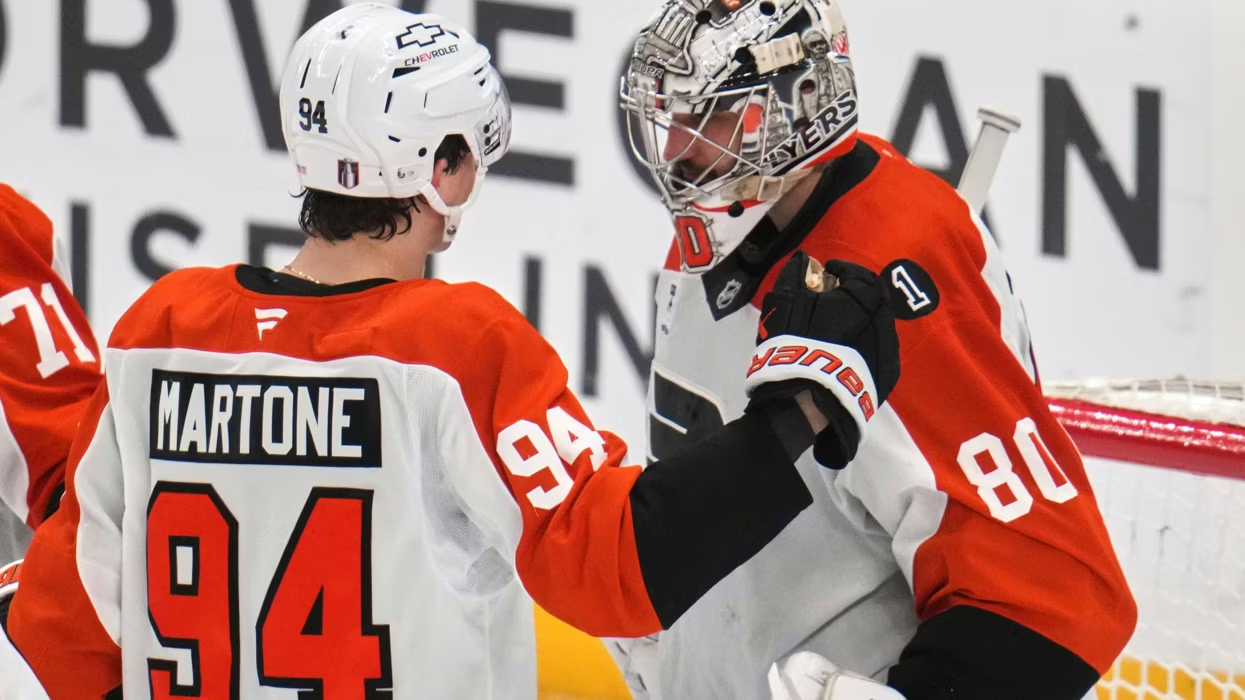
The defining force of Game 2 was goaltender Dan Vladar, whose 27-save performance delivered not only a shutout, but his first career postseason clean sheet. Vladar’s control of the crease was not reactive—it was authoritative.
He tracked pucks cleanly through traffic, neutralized second-chance opportunities, and provided the kind of stability that allows a team to play aggressively in front of him.
In a playoff environment where momentum can shift in seconds, that level of composure becomes foundational.
The game itself unfolded with deliberate precision. After a scoreless first period that saw both teams testing structure and pace, the Flyers broke through in the second with a sequence that encapsulated their current identity—efficient, opportunistic, and unrelenting. Nineteen-year-old rookie Porter Martone opened the scoring at 8:21, continuing what is quickly becoming one of the most compelling breakout performances of the postseason. By finding the net in each of his first two playoff games, Martone has entered rare company, becoming one of the youngest players in NHL history to deliver that level of immediate impact.
That goal did more than put Philadelphia ahead. It forced Pittsburgh into a more aggressive posture, which the Flyers exploited with clinical execution. Later in the period, Garnet Hathaway extended the lead with a shorthanded goal, a moment that not only widened the margin but underscored the Flyers’ dominance on special teams. Their penalty kill was flawless on the night, successfully neutralizing all five Penguins power plays while generating offense of its own—a combination that shifts both confidence and tactical leverage in a playoff series.
By the third period, the Flyers were no longer chasing control—they were dictating it. Defensive structure tightened, neutral zone play became more restrictive, and Pittsburgh’s opportunities diminished under sustained pressure. Luke Glendening’s late empty-net goal sealed the outcome, but the result had effectively been determined by the Flyers’ ability to manage the game from the midpoint onward.
The physical edge of the matchup also reached a boiling point in the closing moments, with tensions spilling into a late-game scrum that resulted in misconduct penalties for key Penguins players. That sequence, while secondary to the final scoreline, highlighted another dimension of the Flyers’ approach: they are not only executing strategically, but they are also engaging physically in a way that is wearing down their opponent over time.
What makes this 2-0 series lead particularly significant is the context. Winning the first two games of a playoff series on the road is a rare and valuable achievement, and for the Flyers, it marks the first time they have done so in this matchup since 2012. It is a benchmark that signals not just early success, but a potential shift in series control as the venue now moves to Philadelphia for Games 3 and 4.
As the series transitions to home ice, the energy surrounding the team is expected to intensify. The Flyers will return to a building that has historically amplified playoff momentum, creating an environment where structure and emotion converge. For fans across New Jersey and the broader region, this is where the series becomes tangible—where proximity meets performance, and where the opportunity to witness a pivotal playoff run moves from distant scoreboard watching to direct engagement.
Coverage within the region’s Flyers coverage continues to reflect this growing momentum, capturing not only the results but the evolving identity of a team that is beginning to redefine its ceiling. The Flyers are no longer simply competing; they are asserting a style that is proving difficult to counter—disciplined defensively, opportunistic offensively, and increasingly confident with each passing period.
Looking ahead, the implications extend beyond the current series. Should Philadelphia advance, a likely second-round matchup against the Carolina Hurricanes looms—a team widely regarded as one of the strongest in the Eastern Conference. The Hurricanes’ defensive depth and elite penalty kill present a different level of challenge, but the Flyers’ current form suggests they are building the kind of foundation necessary to compete at that level.
Across the league, the 2026 playoff field is defined by heavyweights. The Colorado Avalanche have set the standard in the Western Conference, while teams like the Buffalo Sabres and Tampa Bay Lightning have reinforced the East’s depth. Yet within that landscape, the Flyers are carving out a distinct narrative. They entered the postseason without the weight of expectation, but through two games, they have replaced that narrative with one of disruption and possibility.
For New Jersey’s hockey audience, this moment carries added significance. The proximity to Philadelphia, the shared regional intensity, and the accessibility of these games create a unique dynamic where the Flyers’ success becomes part of the broader local sports conversation. It is a reminder that playoff hockey in this region is never confined by state lines—it is a collective experience shaped by rivalry, proximity, and performance.
As Game 3 approaches, the focus shifts from establishing control to sustaining it. The Flyers have demonstrated that they can dictate pace, execute under pressure, and capitalize on opportunity. The next phase will test their ability to maintain that standard as expectations rise and adjustments are made.
What is already clear is that this series is no longer unfolding on neutral terms. The Flyers have seized the initiative, and in doing so, they have redefined the trajectory of their postseason. For a team that began as a question mark, the answer is now taking shape—one shutout, one breakout performance, and one commanding lead at a time.