
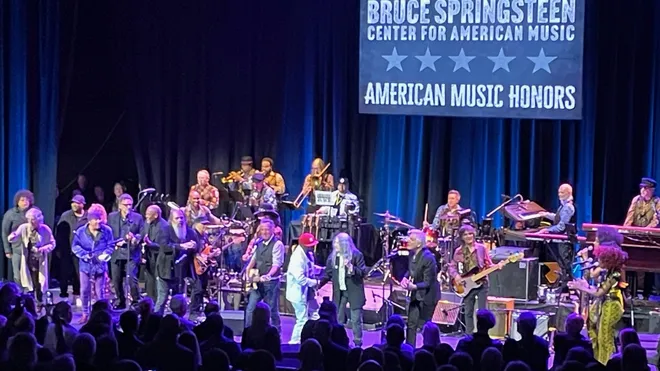

New Jersey’s position as a defining force in American music culture was reinforced in commanding fashion this past weekend as the fourth annual American Music Honors unfolded at Monmouth University’s Pollak Theatre in West Long Branch. What has rapidly become one of the most respected and intellectually grounded music recognition events in the country delivered a 2026 edition that not only celebrated legacy, but redefined the scope of influence that American music continues to hold across generations, genres, and cultural movements.
Hosted by the Bruce Springsteen Center for American Music, the American Music Honors has established itself as a distinctly New Jersey institution with national reach. Unlike traditional awards shows driven by commercial metrics, this ceremony is curated with intention, honoring artists whose contributions extend beyond charts and into the fabric of American identity itself. The result is an event that feels both intimate and monumental, grounded in scholarship yet alive with performance and presence.
The 2026 class of honorees represents one of the most expansive and genre-spanning lineups in the event’s short but impactful history. Dr. Dre’s induction marked a historic milestone as the first hip-hop artist to receive the honor, signaling a deliberate and necessary recognition of hip-hop’s foundational role in shaping modern American culture. Alongside him, Dionne Warwick’s inclusion underscored decades of vocal excellence and cultural diplomacy, while Patti Smith’s recognition reaffirmed her status as one of the most influential poetic voices in rock history. The E Street Band, synonymous with the sound of New Jersey itself, was honored for its enduring contribution to the American rock canon, while The Doors were recognized for their boundary-pushing artistry that continues to resonate across generations. A posthumous tribute to The Band added a layer of reverence, acknowledging a group whose influence remains embedded in the DNA of American roots music.
The evening was anchored by the presence of Bruce Springsteen, whose role extended beyond host and founder into that of active participant and collaborator. In one of the night’s defining moments, Springsteen joined John Densmore of The Doors for a performance of “Light My Fire,” a cross-generational collaboration that embodied the spirit of the event—artists from different eras converging in a shared celebration of music’s enduring power. The performance was not simply a highlight; it was a statement of continuity, illustrating how the threads of American music remain interconnected regardless of genre or time period.
Adding to the depth of the program, a distinguished group of presenters including Stevie Van Zandt, Jon Landau, and Jimmy Iovine brought industry perspective and historical context to the ceremony. Each introduction served as a narrative bridge, connecting the honorees’ achievements to broader cultural movements and reinforcing the intellectual framework that distinguishes the American Music Honors from conventional award platforms.
One of the most talked-about moments of the evening came with an unexpected collaboration that quickly reverberated across digital platforms. Flavor Flav joined Patti Smith on stage, creating a performance that merged punk poetry with hip-hop charisma in a way that felt both spontaneous and symbolically significant. It was a moment that encapsulated the event’s willingness to embrace the unexpected while highlighting the shared DNA that runs through seemingly disparate musical traditions.
Since its founding in 2023, the American Music Honors has built a legacy with remarkable speed. Each year’s honorees have reflected a carefully constructed narrative of American music history, from the inaugural class featuring Steve Earle, Stevie Van Zandt, Sam Moore, and Darlene Love, to subsequent ceremonies honoring icons such as John Mellencamp, Jackson Browne, Mavis Staples, Dion DiMucci, Smokey Robinson, John Fogerty, Emmylou Harris, Tom Morello, and Joe Ely. This progression has established the event as both a retrospective and a living archive, documenting the evolution of American music through the artists who have shaped it.
The Bruce Springsteen Center for American Music itself serves as the intellectual and cultural backbone of this initiative. As the official repository for Springsteen’s archives, the center extends its mission beyond preservation into active engagement, using the American Music Honors as a platform to explore the intersections of music, politics, identity, and social change. This dual function—archival and experiential—positions the center as one of the most important cultural institutions in the region.
For New Jersey, the implications are significant. The state’s music identity, long associated with iconic figures and historic venues, is now being institutionalized in a way that ensures its influence will be studied, celebrated, and expanded for generations to come. Through initiatives like the American Music Honors, New Jersey is not only reflecting on its past contributions but actively shaping the narrative of American music’s future.
This momentum aligns with the broader ecosystem highlighted across Explore New Jersey’s music coverage, where venues, festivals, and cultural programs continue to reinforce the state’s role as a live music and creative powerhouse. From intimate theaters to major arenas, and from grassroots events to globally recognized ceremonies, the infrastructure supporting New Jersey’s music scene is both deep and dynamic.
The American Music Honors stands at the center of this ecosystem as a flagship event that bridges academia, performance, and cultural discourse. It is a platform where legends are not only recognized but contextualized, where performances are not only delivered but interpreted, and where the audience is invited to engage with music as both art and history.
As the 2026 ceremony concludes, its impact extends far beyond a single evening. It reinforces New Jersey’s authority within the national music conversation, elevates the artists who have defined that conversation, and sets a new standard for how musical achievement can be honored with depth, authenticity, and purpose. In doing so, it ensures that the Garden State remains not just a birthplace of great music, but a steward of its legacy and a catalyst for its future.
















