

- This event has passed.
Brahms Requiem: A German Requiem
Morris Choral Society Brings Brahms’ Monumental “A German Requiem” to St. Mary’s Abbey in a Landmark New Jersey Choral Performance
May 16 @ 7:30 PM – 11:30 PM
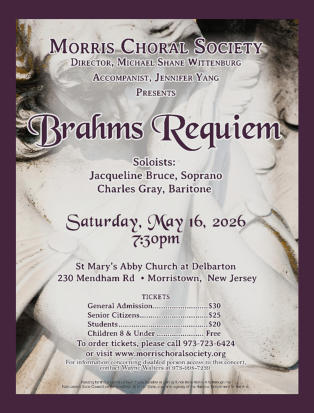
New Jersey’s reputation as a major music state has often been shaped publicly by rock legends, arena tours, jazz history, and the countless artists who have emerged from the region over generations. Yet running parallel to that celebrated popular music tradition is another equally important artistic legacy — one rooted in orchestral performance, sacred music, opera, chamber ensembles, and large-scale choral works that continue defining the cultural sophistication of communities across the state. In Morris County especially, classical and choral music remain deeply woven into the region’s artistic identity, sustained by organizations committed not only to preserving masterworks, but to presenting them with emotional immediacy and contemporary relevance. This season, the Morris Choral Society continues that tradition with one of the most ambitious and spiritually powerful performances in the classical repertoire: Johannes Brahms’ “A German Requiem.”
Presented at St. Mary’s Abbey on the campus of Delbarton School, the concert promises to be one of the defining classical music events of the season in North Jersey. Featuring full orchestra accompaniment, internationally experienced soloists, respected vocal ensembles, and the artistic leadership of conductor Michael Shane Wittenburg, the evening represents far more than a routine choral presentation. It is a major cultural event rooted in the enduring emotional power of live music performed at the highest level within one of New Jersey’s most acoustically and architecturally stunning sacred spaces.
For audiences familiar with Brahms’ monumental work, “A German Requiem” stands among the most emotionally transformative compositions ever written for chorus and orchestra. Unlike traditional Latin requiems centered heavily around judgment, fear, or liturgical ritual, Brahms approached the concept through a deeply humanistic lens. The work focuses instead on comfort, compassion, mourning, healing, memory, and emotional transcendence. It is music designed not merely to impress audiences technically, but to move them profoundly on a human level.
That emotional accessibility is precisely why the Requiem continues resonating across generations and why performances of the work remain such important events within the classical music world. Even listeners without extensive knowledge of choral repertoire often find themselves overwhelmed by the work’s emotional scale, orchestral richness, and spiritual atmosphere. Brahms created a composition capable of feeling simultaneously intimate and immense, personal and universal.
The decision to present the performance in German further reinforces the Morris Choral Society’s commitment to artistic authenticity and musical integrity. Hearing the work in its original language preserves the rhythmic and emotional nuance Brahms intended, allowing the text and music to function together exactly as composed. Combined with a full orchestra, the result promises an immersive performance experience capable of fully capturing the emotional architecture of one of classical music’s most revered masterworks.
The setting itself adds extraordinary significance to the evening. St. Mary’s Abbey at Delbarton School provides a naturally dramatic and spiritually resonant environment uniquely suited to large-scale sacred choral music. The abbey’s soaring architecture and resonant acoustics allow orchestral textures and choral harmonies to expand organically throughout the space, transforming the performance into something far more immersive than a conventional concert hall presentation.
Sacred spaces often elevate choral music in ways difficult to describe fully until experienced firsthand. The combination of architecture, reverberation, atmosphere, and visual setting creates an emotional environment where audiences feel surrounded by the music itself. For a composition like the Brahms Requiem, which depends heavily on emotional atmosphere and spiritual weight, the abbey setting becomes inseparable from the artistic impact of the performance.
The evening will also showcase the remarkable depth of vocal talent associated with the Morris Choral Society and its affiliated performers. Prior to the Requiem itself, audiences will hear performances by Express Male, an all-male vocal ensemble, and High Society, an all-female vocal group. Their selections during the concert’s opening half help broaden the evening into a larger celebration of choral artistry while highlighting the diversity of ensemble traditions thriving within New Jersey’s vocal music community.
These featured performances reinforce the idea that choral music remains far more dynamic and varied than many casual audiences often assume. Ensemble singing continues evolving across sacred, classical, contemporary, and crossover traditions while remaining rooted in the uniquely human power of collective vocal expression. The inclusion of both male and female vocal ensembles creates additional texture and contrast within the evening’s programming while showcasing the breadth of talent connected to the Morris Choral Society itself.
At the center of the production stands conductor Michael Shane Wittenburg, whose reputation within the classical and operatic worlds continues growing through a career defined by artistic versatility, technical precision, and emotionally driven musical leadership. Wittenburg’s approach to conducting has consistently emphasized emotional communication alongside musical rigor, making him especially well suited for a work as emotionally expansive as the Brahms Requiem.
Praised by legendary pianist Ruth Laredo as a “real virtuoso,” Wittenburg has conducted internationally acclaimed productions while maintaining deep involvement within New Jersey and New York’s broader cultural landscape. His career has included collaborations with Metropolitan Opera artists, performances with internationally respected instrumentalists, and appearances with major ensembles across the classical world.
His artistic résumé reflects extraordinary range. Beyond major choral and orchestral performances, Wittenburg has worked extensively within opera companies throughout Nashville, Orlando, and Sarasota while also maintaining a deep commitment to music education and mentorship. His work with young musicians through The Elizabeth Faidley Studio and his collaborative relationships with internationally recognized artists speak to a broader philosophy centered around sustaining classical music as a living, evolving art form connected directly to community and artistic development.
Under Wittenburg’s direction, the Morris Choral Society has continued strengthening its reputation as one of North Jersey’s important cultural institutions, presenting ambitious repertoire while maintaining strong community engagement. That balance between artistic excellence and local accessibility remains one of the defining strengths of regional arts organizations throughout New Jersey.
The evening’s accompanist, Jennifer Yang, brings additional international-caliber musicianship to the performance. Known for her work as a soloist, chamber musician, and accompanist, Yang has performed extensively around the world while serving for nearly a decade as organist and accompanist for Morristown United Methodist Church. Her collaborative sensitivity and technical command provide an essential musical foundation for a work as intricate and emotionally layered as the Brahms Requiem.
The featured soloists further elevate the production’s artistic stature. Soprano Cassandra Douglas returns to the Morris Choral Society stage following previous appearances that left strong impressions on local audiences. Her career has included a solo debut at Carnegie Hall’s Weill Recital Hall, recognition through Riverside Opera Company, and performances with distinguished organizations such as the American Spiritual Ensemble and the National Chorale. Her vocal clarity and expressive style make her particularly well suited for the lyrical and emotionally vulnerable passages woven throughout Brahms’ score.
Joining her is baritone Charles Gray, whose growing reputation within operatic circles continues expanding through performances with Amore Opera and other regional companies. Gray’s dramatic vocal presence and interpretive strength are expected to bring additional emotional depth to the Requiem’s baritone passages, which often function as some of the work’s most intimate and spiritually reflective moments.
Together, the soloists will help anchor a performance built around the dynamic interplay between individual voice and collective choral power. Brahms structured the Requiem in ways that allow personal reflection and communal emotional experience to coexist seamlessly within the music itself. The soloists emerge from the larger choral texture almost like individual human voices rising from collective grief, comfort, and hope.
The Morris Choral Society’s continued commitment to presenting major classical works also reflects the broader strength of New Jersey’s nonprofit arts infrastructure. Community-based choral organizations remain essential to preserving and advancing classical music traditions outside major metropolitan institutions. They provide opportunities not only for audiences to experience world-class repertoire locally, but also for residents themselves to participate directly in meaningful artistic creation.
That participatory aspect remains central to the Morris Choral Society’s mission. The organization has long served dual purposes: bringing varied choral programming to Morris County audiences while also providing opportunities for community members to perform within a serious artistic environment. New members continue joining the ensemble through auditions twice annually, reinforcing the organization’s role as both a presenting institution and a living artistic community.
At a time when digital entertainment increasingly dominates cultural consumption, large-scale live choral performance offers something uniquely irreplaceable. The physical presence of human voices singing together in shared space creates an emotional immediacy impossible to replicate through recordings or streaming platforms. Audiences experience not only music, but collective breath, resonance, silence, and emotional tension unfolding organically in real time.
That immediacy becomes especially powerful in a composition like “A German Requiem,” where themes of mortality, consolation, grief, and transcendence remain universally relevant regardless of era. The work speaks directly to human emotional experience in ways that continue feeling startlingly modern despite being composed more than a century ago.
As New Jersey continues building its identity as one of the Northeast’s most vibrant and diverse arts destinations, performances like this reaffirm the essential role classical music and choral performance continue playing within the state’s broader cultural ecosystem. The Morris Choral Society’s presentation of Brahms’ Requiem is not simply another concert on the calendar. It is a reminder of the enduring power of live music to unite communities, elevate public cultural life, and create moments of genuine emotional resonance through artistic excellence.
For audiences attending the performance at St. Mary’s Abbey, the evening promises an experience grounded in beauty, reflection, and musical grandeur — an opportunity to encounter one of classical music’s most profound masterpieces within a setting uniquely capable of amplifying its emotional and spiritual impact.











