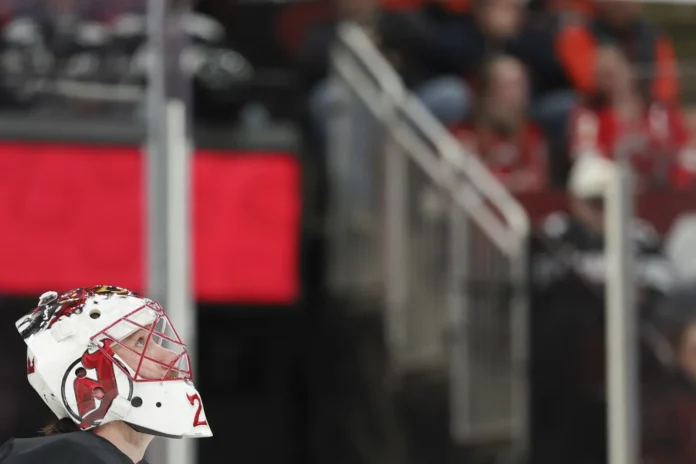

The New Jersey Devils’ 2025–26 season reached its official breaking point at Prudential Center, where a 5–2 loss to the Pittsburgh Penguins not only sealed the outcome of a single game but closed the door on postseason aspirations. For a team that entered the year with expectations of progression and stability, the result underscores a campaign defined less by one moment and more by a steady accumulation of missed opportunities, defensive breakdowns, and organizational instability.
As the final stretch of the season unfolds, the focus shifts rapidly from playoff positioning to evaluation, accountability, and the direction of the franchise. For full team coverage and ongoing developments, follow the latest updates on the New Jersey Devils.
The loss itself reflected many of the recurring issues that have defined the Devils’ season. Despite an early surge in shot volume and offensive pressure, the team once again failed to convert momentum into control. An opening stretch that saw New Jersey generate a significant shot advantage quickly unraveled following a defensive lapse that allowed Pittsburgh to capitalize on its first opportunity. That sequence set the tone for a night—and a season—where structural inconsistencies outweighed flashes of promise.
Pittsburgh’s veteran core executed with precision. Evgeni Malkin delivered both a goal and an assist, while Sidney Crosby orchestrated the attack with two assists, securing the Penguins’ postseason berth in the process. For New Jersey, the contrast was stark. Where Pittsburgh demonstrated cohesion and situational awareness, the Devils struggled with coverage, communication, and execution in key moments.
The second period offered a brief glimpse of resilience. A well-timed transition play resulted in a breakaway finish that evened the score, and a later offensive sequence brought the Devils within striking distance again. Yet each push was met with an immediate response from Pittsburgh, exposing the Devils’ inability to sustain momentum or stabilize defensively. Quick-strike goals against, particularly following turnovers and missed assignments, reinforced a pattern that has persisted throughout the year.
By the third period, the outcome felt inevitable. Another defensive breakdown led to an extended Penguins lead, and a late empty-net goal confirmed the result. Beyond the scoreboard, the underlying metrics told a similar story—limited offensive generation over the final two periods and a consistent inability to create high-danger opportunities when it mattered most.
This loss drops the Devils to 40–36–3, placing them seventh in the Metropolitan Division and mathematically eliminating them from playoff contention. More revealing than the record itself is the team’s performance within the division. A 7–17–2 mark against Metropolitan opponents highlights a critical deficiency, particularly when contrasted with significantly stronger results against teams outside the division. In a structure where divisional success is essential, this imbalance proved decisive.
As the season winds down, attention is increasingly focused on organizational changes already underway. The departure of General Manager and President Tom Fitzgerald on April 6 signals a major shift at the executive level. Speculation surrounding potential replacements, including high-profile candidates, suggests that ownership is preparing for a recalibration of both strategy and leadership philosophy.
On the roster side, the decision to shut down defenseman Luke Hughes for the remainder of the season due to an upper-body procedure reflects a long-term outlook, prioritizing health and development over short-term availability. His absence also underscores the challenges faced by a defensive unit that has struggled with consistency and growth throughout the year.
Amid these transitions, there are still individual recognitions that speak to the character within the locker room. Brenden Dillon’s nomination for the Bill Masterton Memorial Trophy by the New Jersey chapter of the Professional Hockey Writers Association highlights perseverance and dedication, particularly following offseason neck surgery. It is a reminder that even in a difficult season, individual contributions and resilience remain part of the team’s identity.
The remaining schedule—matchups against the Detroit Red Wings, Ottawa Senators, and Boston Bruins—now serves a different purpose. With playoff implications removed, these games become opportunities for evaluation, development, and assessment. Decisions regarding lineup composition, ice time distribution, and player roles will carry increased significance as the organization looks ahead to the offseason.
Beyond the immediate results, the broader narrative of the Devils’ season is one of unrealized potential. There were stretches where the team demonstrated the ability to compete at a high level, generating offense and controlling play against strong opponents. However, those moments were consistently offset by lapses in defensive structure, inconsistent special teams, and an inability to adapt within games.
Coaching and system execution will inevitably be part of the offseason conversation. Questions surrounding defensive-zone coverage, player development, and overall tactical identity have grown more pronounced as the season has progressed. The performance of the defensive group, in particular, has drawn scrutiny, with multiple players experiencing regression or stagnation.
For a franchise that has invested heavily in building a competitive core, the stakes of this offseason are significant. The decisions made in the coming months—at both the front office and roster levels—will shape not only the immediate future but the long-term trajectory of the team.
The elimination from playoff contention is not simply an endpoint; it is a pivot point. It marks the transition from expectation to reflection, from projection to accountability. For the New Jersey Devils, the path forward will require clarity, decisiveness, and a willingness to address the structural issues that have defined this season.
As the final games are played and the offseason approaches, the focus will remain on what comes next—how the organization responds, how it recalibrates, and how it positions itself to return to contention. In a league defined by parity and momentum, the margin between success and disappointment is often narrow. For the Devils, closing that gap will be the central challenge of the months ahead.