
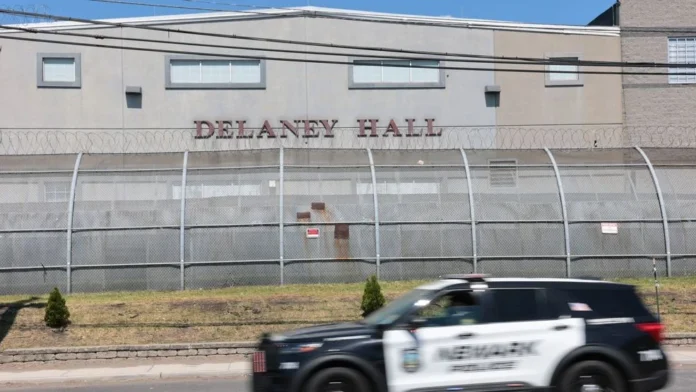

The growing conflict surrounding Delaney Hall in Newark has entered a new and increasingly contentious phase, with the U.S. Department of Justice leveling serious accusations against local officials in a court filing that has intensified an already high-profile debate over immigration enforcement, public safety, state authority, and federal oversight.
At the center of the dispute is Delaney Hall, the immigration detention facility that has become one of the most closely watched flashpoints in New Jersey’s ongoing conversation about immigration policy and government accountability. What began as disagreements over inspections, detainee conditions, and oversight authority has now expanded into a broader legal battle involving federal agencies, state leaders, local law enforcement, elected officials, advocacy groups, and residents seeking answers about how the facility is being managed.
According to a recent Department of Justice court filing, federal officials argue that a directive issued by the Newark Police Department has effectively prevented city officers from responding to incidents involving Delaney Hall in ways that federal authorities believe are necessary to maintain public order and ensure the enforcement of laws. The filing characterizes the situation as creating what federal attorneys describe as a “zone of lawlessness” surrounding the facility, language that immediately drew attention because of its severity and the implications it carries for both Newark and the federal government.
The accusation represents one of the strongest statements yet in the escalating conflict over Delaney Hall. Federal officials contend that restrictions placed on local police interactions have complicated security operations and created uncertainty regarding jurisdiction and law enforcement responsibilities. The filing argues that public safety cannot be compromised by disagreements between different levels of government and that clear lines of authority are necessary when managing facilities housing detainees under federal supervision.
Newark officials and supporters of local oversight efforts see the issue through a different lens. For many, the debate is less about creating barriers to law enforcement and more about defining the proper relationship between local police departments and federal immigration authorities. The question has become part of a broader national conversation regarding the role municipalities should play in immigration enforcement activities and how local governments balance public safety responsibilities with community trust.
The latest legal filing arrives during a period of heightened scrutiny surrounding Delaney Hall. In recent weeks, the facility has attracted significant public attention following protests, inspection disputes, hunger strike allegations, questions regarding detainee treatment, and ongoing calls for increased transparency from advocacy organizations and elected officials.
The controversy has become one of the most visible political issues in New Jersey this year, drawing responses from local leaders, state officials, members of Congress, immigration advocates, and federal agencies. Demonstrations outside the facility have brought together a diverse coalition of activists, community groups, faith leaders, and immigration rights organizations demanding greater access to information regarding conditions inside the detention center.
Those concerns have been amplified by reports from advocacy groups that have called for expanded oversight and independent reviews of detention operations. Critics argue that transparency is essential whenever individuals are being held in federal custody and maintain that public confidence depends on allowing meaningful inspections and accountability measures.
Federal officials, however, have maintained that existing procedures are sufficient and that detention facilities must operate within established security protocols designed to protect detainees, staff members, and the public. The Department of Homeland Security and other federal agencies have repeatedly defended their operational authority while disputing claims that conditions at Delaney Hall are being misrepresented.
The legal battle also highlights the increasingly complex relationship between federal immigration policy and state governance. New Jersey has often found itself at the center of national immigration debates, particularly when questions arise regarding detention practices, sanctuary policies, oversight powers, and the responsibilities of local governments.
For Governor Mikie Sherrill’s administration, Delaney Hall has become a test case in determining how state officials can monitor facilities operating within New Jersey while navigating federal authority. Recent disputes over inspections and facility access have only intensified calls from lawmakers seeking greater clarity regarding oversight powers.
That broader debate has already sparked legislative proposals aimed at increasing transparency and strengthening state inspection rights. Supporters argue that states should have the ability to verify health, safety, and living conditions within facilities located inside their borders. Opponents counter that federal detention centers must remain under federal control to ensure consistent national standards and operational security.
Meanwhile, residents of Newark find themselves watching a dispute that increasingly extends beyond the city itself. While Delaney Hall sits within Newark’s boundaries, the arguments now unfolding involve constitutional questions about federalism, immigration enforcement authority, law enforcement cooperation, and the balance of power between local, state, and federal governments.
The Department of Justice’s latest filing adds another layer of legal complexity to a situation already marked by competing narratives. Federal officials portray the issue as one of public safety and operational effectiveness. Local advocates and critics of detention policies frame the debate around oversight, accountability, and civil rights. Both sides insist their positions are necessary to protect the public interest.
What is clear is that Delaney Hall has evolved from a single detention facility into one of New Jersey’s most significant public policy battlegrounds. The arguments being presented in court today could influence not only the future of this facility but also how immigration detention centers are monitored and regulated throughout the state and potentially across the nation.
As legal proceedings continue, the outcome will likely shape discussions about transparency, public safety, immigration enforcement, and government authority for years to come. Whether the courts ultimately agree with the Department of Justice’s characterization of the situation or determine that local officials acted appropriately, the Delaney Hall controversy has already become a defining chapter in New Jersey’s ongoing role at the intersection of immigration policy, civil rights, and governmental accountability.
For now, the dispute remains unresolved, but its significance continues to grow. What happens next at Delaney Hall will be watched closely not only in Newark and throughout New Jersey, but by policymakers, legal experts, advocacy organizations, and federal officials across the country as they grapple with some of the most challenging questions facing immigration policy today.
















