
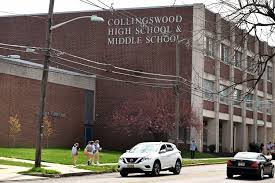

The Collingswood Board of Education has unanimously placed a $4.56 million operating referendum on the November ballot, a compromise figure well below the district’s actual budget gap, following a school closure and years of budget cuts that Superintendent Fred McDowell says stem from a genuine revenue problem rather than mismanagement.
Collingswood Schools Head Back to Voters for a Third Time in Two Years, This Time Just to Keep the Lights On
The Collingswood Board of Education voted unanimously on August 19th to place a 4.56 million dollar operating referendum before voters this November, asking the community to approve a permanent local tax increase specifically to keep daily school operations running. Superintendent Fred McDowell has framed the request as necessary simply to maintain continuity of services, with the district projecting a nearly 4 million dollar gap in its 2027-28 budget if the additional revenue does not come through.
This Is Not Collingswood’s First Trip to the Ballot Box
To understand why this specific request landed at 4.56 million dollars rather than the district’s full need, it helps to look at how Collingswood arrived at this point. This November’s vote follows two increasingly difficult years for the district’s finances, and represents the third major ballot or budget reckoning Collingswood residents have faced over that stretch.
March 2026 District identifies $3.3 million preliminary budget gap
May 2026 Board votes to close Garfield Elementary, cut 30 staff, raise taxes 6.43%
Aug. 2026 Board authorizes $4.56M operating referendum for November
The district’s largest prior ask, a 44.5 million dollar capital bond that would have closed two neighborhood elementary schools, built new athletic facilities, and reconfigured how Collingswood’s roughly 2,300 students moved through its grade levels, failed by a decisive two to one margin in September 2024. McDowell described that outcome at the time as reflecting a genuine divestment in public education, though Mayor James Maley pushed back publicly, arguing borough officials had been excluded from the planning process and pledging a different approach going forward.
That failed bond did not make the district’s underlying financial pressure disappear. By this past spring, Collingswood faced a 3.3 million dollar budget gap driven by a 305,000 dollar reduction in state aid combined with 4.8 million dollars in rising costs, a combination the board addressed by voting to close James Garfield Elementary School, cut 30 staff positions, and raise school taxes 6.43 percent inside a 50.3 million dollar budget. The closure carried a genuinely personal dimension for McDowell himself, whose own two children attended or would have attended Garfield, a fact he addressed directly and emotionally at the meeting where the closure was approved.
Why $4.56 Million and Not the Full Gap
District officials have been direct that Collingswood’s actual structural deficit runs closer to 6 million dollars, but the board settled on the smaller 4.56 million dollar figure specifically to soften the tax impact on homeowners already absorbing repeated increases in recent budget cycles. That compromise reflects a genuine tension board members have debated openly, balancing the district’s real financial need against a community that has already shouldered a 6.43 percent tax increase just months earlier, on top of years of cuts that have not fully closed the underlying gap regardless.
Unlike the 2024 capital bond, which would have funded new construction and facility upgrades, this referendum is structured entirely around day to day operating costs, the kind of recurring expenses that do not disappear once a single budget cycle closes. District officials have grouped the request into four specific funding priorities.
Staff Retention
Attracting and keeping teachers, instructional assistants, and classroom support staff to prevent class sizes from continuing to climb.
Academic & Elective Programs
Preserving specialized course tracks, elective classes, high school athletics, and extracurricular clubs from further elimination.
Student Support Services
Protecting mental health resources, academic interventionists, special education services, and guidance counseling.
Operational Overhead
Covering rising costs for payroll processing, employee health benefits, IT infrastructure, utilities, and daily facility maintenance.
What Happens on November 3rd
The board’s unanimous authorization directs the Camden County Clerk to place a formal ballot question before Collingswood voters during the November 3rd general election, asking a direct yes or no question on whether the borough should permanently raise its local school tax levy by 4.56 million dollars. A simple majority determines the outcome. If voters approve the measure, the increase becomes legally binding and the additional revenue flows directly into the district’s budget beginning the following tax cycle. If it fails, administrators say they will be forced into a second round of emergency cuts, potentially including further staff reductions, program eliminations, or additional school consolidations beyond Garfield’s closure.
Board members have also acknowledged a structural limit that will persist regardless of how November’s vote turns out. Even with a successful referendum, Collingswood remains bound by New Jersey’s standard 2 percent cap on annual tax levy growth, a constraint that will continue limiting the district’s ability to keep pace with rising health care and operational costs in future years without returning to voters again down the road.
A Notably Crowded Ballot This Year
Collingswood voters will find considerably more than a single school funding question waiting for them this November. The same ballot also carries a separate, resident driven referendum asking whether the borough should finally lift its more than century old ban on alcohol sales, an entirely unrelated but similarly high stakes local question that has drawn its own extensive public debate in recent months. Between the two measures, Collingswood residents face a genuinely consequential November ballot, one asking them to permanently fund their children’s schools, and another asking them to permanently reshape what kind of businesses can operate in their downtown.
















