
New Jersey’s unemployment rate actually improved last month even as payrolls shrank, a genuinely unusual combination the state’s labor department attributes partly to a seasonal adjustment quirk and a weak survey response rate.
New Jersey Lost 25,600 Jobs in July. The State’s Own Labor Department Says Don’t Read Too Much Into the Number.
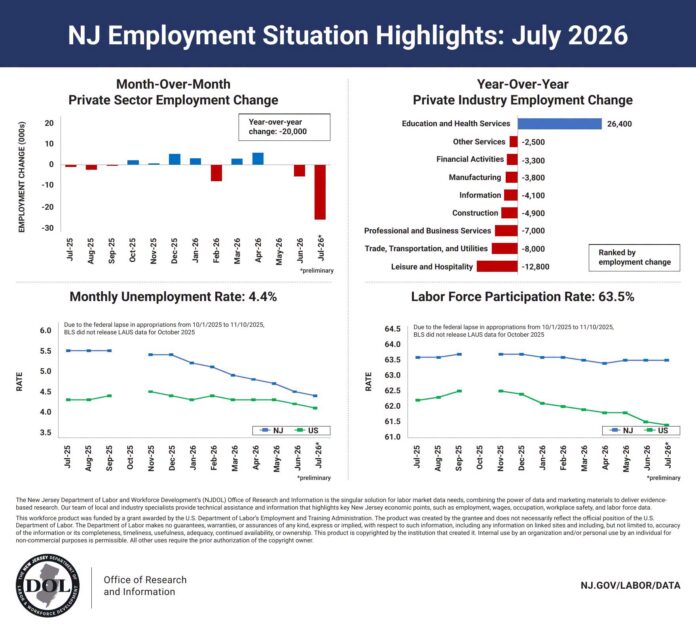
New Jersey lost 25,600 nonfarm jobs in July, according to preliminary data released August 20th by the state Department of Labor and Workforce Development, even as the state’s unemployment rate ticked down slightly to 4.4 percent. That combination, a meaningful payroll decline alongside an improving unemployment rate, reflects a genuine quirk in how these two figures get measured, since payroll and unemployment numbers come from entirely separate government surveys and can legitimately move in opposite directions within the same month.
Why the State Is Pushing Back on Its Own Number
Notably, the state’s own labor department is not treating the 25,600 figure as a straightforward reading of New Jersey’s economic health. In releasing the data, officials cautioned directly that the size of July’s employment decrease is likely overstated, pointing to two specific technical factors behind that caution. First, seasonal adjustment factors built into the federal methodology do not adequately account for typical seasonal declines in professional and business services, a sector that saw the sharpest drop of the month. Second, the department noted a lower than expected survey response rate for July specifically, the kind of data quality issue that can meaningfully skew a preliminary monthly estimate before later revisions smooth it out.
Where the Job Losses Actually Landed
| Sector | Monthly Change |
|---|---|
| Professional and Business Services | -13,400 |
| Leisure and Hospitality | -7,300 |
| Private Education and Health Services | -2,700 |
| Construction | -1,300 |
| Other Services | -1,100 |
| Financial Activities | -900 |
| Trade, Transportation and Utilities | +600 |
| Manufacturing | +100 |
| Information | +100 |
| Public Sector | +300 |
Professional and business services alone accounted for more than half of July’s total private sector job losses, precisely the category the state flagged as most affected by the seasonal adjustment issue. Only three private industries actually posted gains for the month, trade, transportation and utilities, manufacturing, and information, each adding a modest 100 to 600 jobs, nowhere near enough to offset the broader monthly decline.
June Also Got Revised, and Not in a Good Direction
Adding to the month’s uneasy picture, the department revised its June employment estimate downward, from an initially reported loss of just 300 jobs to an actual loss of 4,200. That kind of substantial downward revision is not unprecedented, but it does mean the state’s real recent trajectory has been consistently weaker than what preliminary numbers first suggested month to month. June’s unemployment rate held steady at 4.5 percent even after that revision, and the department is expected to release preliminary August data alongside a further revised July estimate around September 17th.
The Longer Term Picture Isn’t Encouraging Either
Zooming out to a full year, New Jersey has lost 19,600 nonfarm jobs since last July, with the private sector alone down 20,000 positions, only partially offset by a modest 400 job gain in the public sector. Leisure and hospitality has taken the steepest year over year hit at 12,800 jobs lost, followed by trade, transportation, and utilities at 8,000, and professional and business services at 7,000. Construction, information, manufacturing, financial activities, and other services all posted year over year losses as well. The one clear bright spot in the annual data belongs to private education and health services, which actually grew by 26,400 jobs over the same twelve month stretch, a genuinely significant gain that has helped cushion, without fully offsetting, the broader statewide decline.
That year over year weakness lines up with a separate, concrete data point tracked outside the monthly jobs report entirely. State issued Worker Adjustment and Retraining Notification filings show nearly 12,000 layoffs announced across New Jersey through late July of this year, a notably steeper pace than the roughly 8,400 layoffs announced over the same stretch in 2025. Several large, recognizable employers factored directly into that total, including Samsung, Novartis, Mars Wrigley, and Verizon, which together accounted for more than 1,600 announced job cuts expected to take effect by mid October.
Taken together, the July jobs report leaves New Jersey’s labor market in a genuinely mixed position, a monthly payroll number the state itself considers likely overstated, a modestly improving unemployment rate, a downward revised June, and a full year trend that remains negative even after accounting for real strength in the healthcare and education sector. Whether the seasonal adjustment issues the state has flagged meaningfully soften July’s headline number once revised data arrives in September remains an open question the department’s own next release should help answer.